
Art Deco Geometric Patterns: Motifs and Dating Clues
Identify Art Deco chevrons, sunbursts, steps, circles and speed lines—and learn why geometric pattern alone cannot date an object.
Émile-Allain Séguy’s Prismes overturns the idea that an Art Deco geometric pattern must be a sober arrangement of black, gold and silver. One plate layers hot-pink and white triangles over burgundy and blue stripes. Published in Paris around 1930, it was probably intended as a textile design. Another combines fragments of green circles, fireflies and blue stripes. The Metropolitan Museum of Art identifies both as period Art Deco designs (The Met, plate 20; The Met, plate 10).
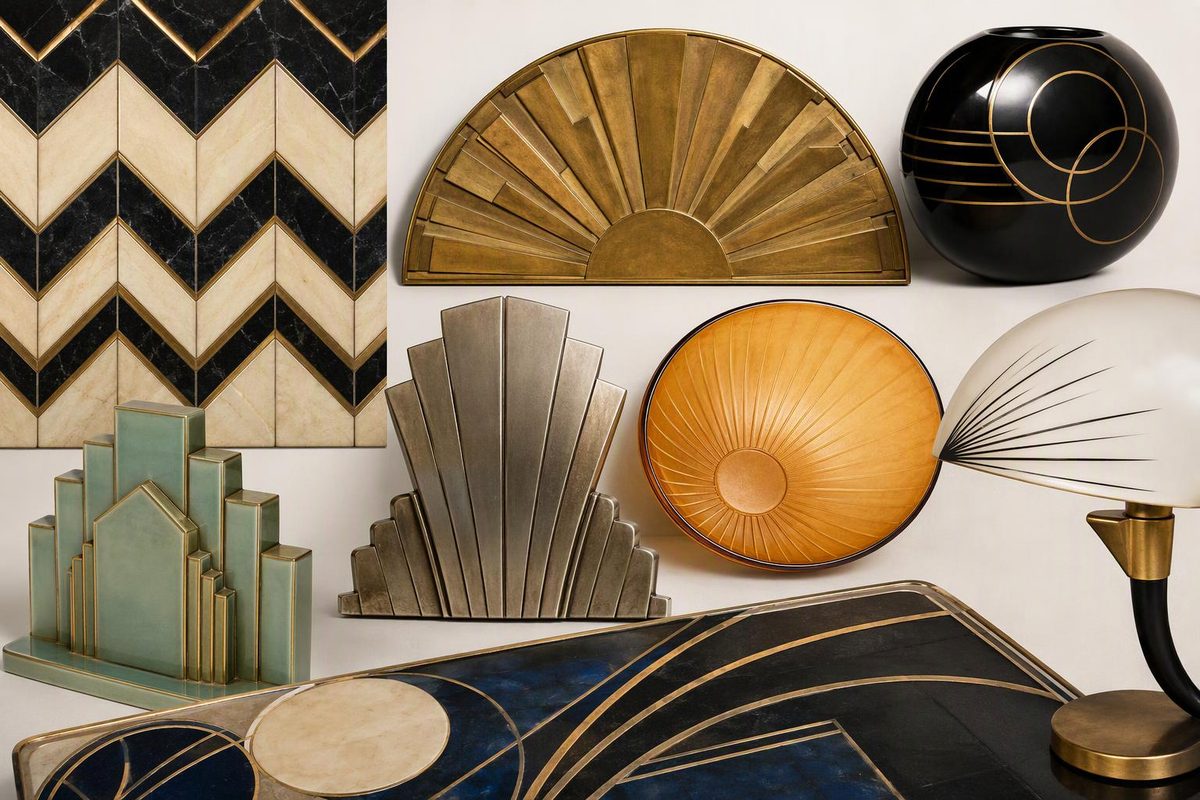
That variety is the first useful lesson: Art Deco is not one geometric pattern. It is a decorative language in which circles, triangles, rays, steps and straight lines are simplified, repeated and made visually emphatic. Geometry can support a stylistic attribution, but it cannot establish an object’s age by itself.
The principal Art Deco pattern families
A motif is an individual unit—a fan, diamond or stylized flower. A pattern is the way one or more units are repeated or arranged. A single sunburst on a mirror is therefore a Deco-associated motif, not necessarily a repeating pattern.
| Pattern family | What to look for | What to check next |
|---|---|---|
| Chevron and zigzag | Repeated V-shapes, lightning-like lines or alternating diagonals | Whether the angular design belongs to the object’s original surface, structure or later decoration |
| Sunburst and fan | Straight or tapered rays spreading from a point or semicircle | Whether the motif is integral to the form and comparable with a documented maker or model |
| Stepped or ziggurat form | Receding rectangles, tiered peaks and staircase outlines | How the steps relate to a façade, furniture front, frame or border rather than appearing as isolated ornament |
| Diamonds, triangles and polygons | Interlocking or overlapping angular units, often organized in bands | The repeat, production method and material—printed textile, woven rug, veneer, tile or molded relief |
| Circles and arcs | Concentric rings, quarter-circles, overlapping discs and geometric scallops | Whether curves are combined with angular forms, symmetry or documented period construction |
| Parallel bands and “speed lines” | Long horizontal stripes, nested lines and repeated curves | Whether the wider object has the rounded profile and horizontal emphasis associated with a streamlined direction |
| Geometricized natural or urban forms | Flowers, animals, figures, skyscrapers or machines reduced to flat shapes | Whether the subject and stylization match a documented designer, pattern book or production date |
None of these forms belongs exclusively to Art Deco. Checkerboards, Greek keys, chevrons and radiating circles all predate the interwar period. Recognition depends on a cluster of evidence, not a motif checklist.
What makes the geometry look Art Deco?
Look for several traits working together:
- Simplification: plants, figures and objects are flattened, faceted or reduced to clean outlines.
- Rhythm: shapes recur in bands, staggered rows or expanding sequences.
- Contrast: angles meet arcs, colors alternate, or reflective materials are set against quieter surfaces.
- Integration: ornament follows the proportions of a cabinet door, textile repeat, architectural bay or object rim.
- Modern subject matter: skyscrapers, machinery, electric light and movement may become both subjects and sources of form.
The style was deliberately eclectic. The V&A traces part of its linear geometry to Josef Hoffmann and Charles Rennie Mackintosh, while also noting the impact of Cubism, Futurism, De Stijl, Suprematism and Constructivism. British and American critics used such names as “Moderne,” “Jazz Moderne” and “Zigzag Moderne” for the new work (V&A). The Met similarly connects Deco with Cubist repetition and geometry and with Futurism’s interest in machines and technology (The Met).
A convincing Deco pattern can consequently appear both ornamental and mechanized: suitable for a lacquer screen yet ordered like a city grid or machine component.
Geometry did not exclude nature
A common shortcut defines Art Deco as geometric and Art Nouveau as floral. Period objects are less tidy. Deco designers retained flowers, insects, animals and human figures, often making them flatter or more stylized.
Séguy’s Prismes, for example, mixes abstract geometry with birds, flowers and insects. The Met describes the portfolio as containing geometric, abstract and semi-abstract designs rather than purely nonrepresentational work (The Met). Ruth Reeves’s 1930 screen-printed cotton voile Manhattan compresses skyscrapers, the Brooklyn Bridge, automobiles, factories, trains, aircraft and nightlife into a patterned cityscape. The V&A record supplies a named designer, the firm for which she designed it and a date—Reeves, W. & J. Sloane and 1930—making the textile far more informative than an undated fabric with vaguely similar towers (V&A).
Deco geometry also drew on forms that museums attribute to African, Egyptian and Mesoamerican art. Such sources should be named precisely when the evidence permits, rather than collapsed into the old catch-all language of the “exotic.” The V&A’s 1925 Maison Myrbor coat, for example, has bands of quartered circles that the museum describes as inspired by African art. Its wool, gold-thread embroidery, silk construction and sewn Myrbor label supply context beyond the motif (V&A).
The V&A also links the proliferation of Egyptian imagery—including lotus flowers, scarabs, hieroglyphics, pylons and pyramids—to the 1922 excavation of Tutankhamun’s tomb (V&A). A stepped border or lotus alone, however, cannot prove an Egyptian Revival attribution or an interwar date.
Pattern is a poor clock
There is no dependable “1920s pattern versus 1930s pattern” test. The Met calls the 1925 Paris exposition a “triumph of ornament” and notes that European designers and manufacturers continued promoting Art Deco well into the 1930s. It also describes substantial changes during the 1930s as rich materials and decorative flourishes lost relevance and other approaches gained ground (The Met). These developments overlapped across countries, makers and types of object.
Jean Dunand’s circa-1930 Sunrise/Sunset screen shows how restrained a period Deco design could be. Its 22-foot lacquered-wood surface uses gold and abstract solar imagery rather than a busy repeat. The Met explains that Dunand learned traditional Asian lacquering from Seizo Sugawara and describes the screen’s metallic finish as luxurious rather than functional (The Met). By contrast, Sonia Delaunay’s documented 1925 portfolio presents striking colorful geometry through pochoir and relief printing (The Met). Both are period works; density, symmetry and a black-and-gold palette are not requirements.
Parallel horizontal bands and rounded forms may point toward Streamline Moderne, but that is a comparison to investigate, not a date stamp. For the wider development of forms and materials, see the decade-by-decade guide to Art Deco design.
How to assess a patterned object or interior
Treat the pattern as the beginning of identification, not the verdict.
- Describe what is present. Record the motif, repeat, symmetry, colors and position on the object. “Three stepped fans centered on each door panel” is more useful than “classic Deco design.”
- Check the whole form. A chevron printed on a recently made cylindrical vase does not make the vase a period piece. Shape, proportions, material and construction must agree with the proposed date.
- Identify the production method. Screen printing, weaving, inlay, marquetry, molded relief, acid-etched glass and hand-applied lacquer leave different evidence. Determine whether the decoration is integral, added later or digitally reproduced.
- Look for maker evidence. Photograph labels, signatures, factory marks, selvages, backstamps and hardware. Compare the exact pattern or model with museum records, period catalogues and securely dated examples—not merely similar marketplace listings.
- Separate design date from object date. A modern textile can reproduce a circa-1930 Séguy plate accurately. Its pattern has a period source; the fabric itself remains modern.
- Use building context carefully. Original drawings, permits and alteration records can help distinguish an interwar grille or terrazzo floor from a later decorative renovation. Repetition across doors, windows and interior fittings may indicate a coherent scheme, but records are still needed to date it.
- State uncertainty plainly. “Art Deco-style geometric pattern” is appropriate when a design resembles period work but its age, maker and provenance remain unverified.
Pattern supports an Art Deco attribution when it aligns with documented dates, materials, technique and overall form. Standing alone, even the sharpest chevron or most dramatic sunburst establishes a resemblance in style—not age.