
Art Deco Gold Jewelry Melt Value: When Scrap Wins
Calculate an Art Deco jewel’s gold floor, likely scrap payout, and intact-market threshold before a dealer or refiner makes the choice irreversible.
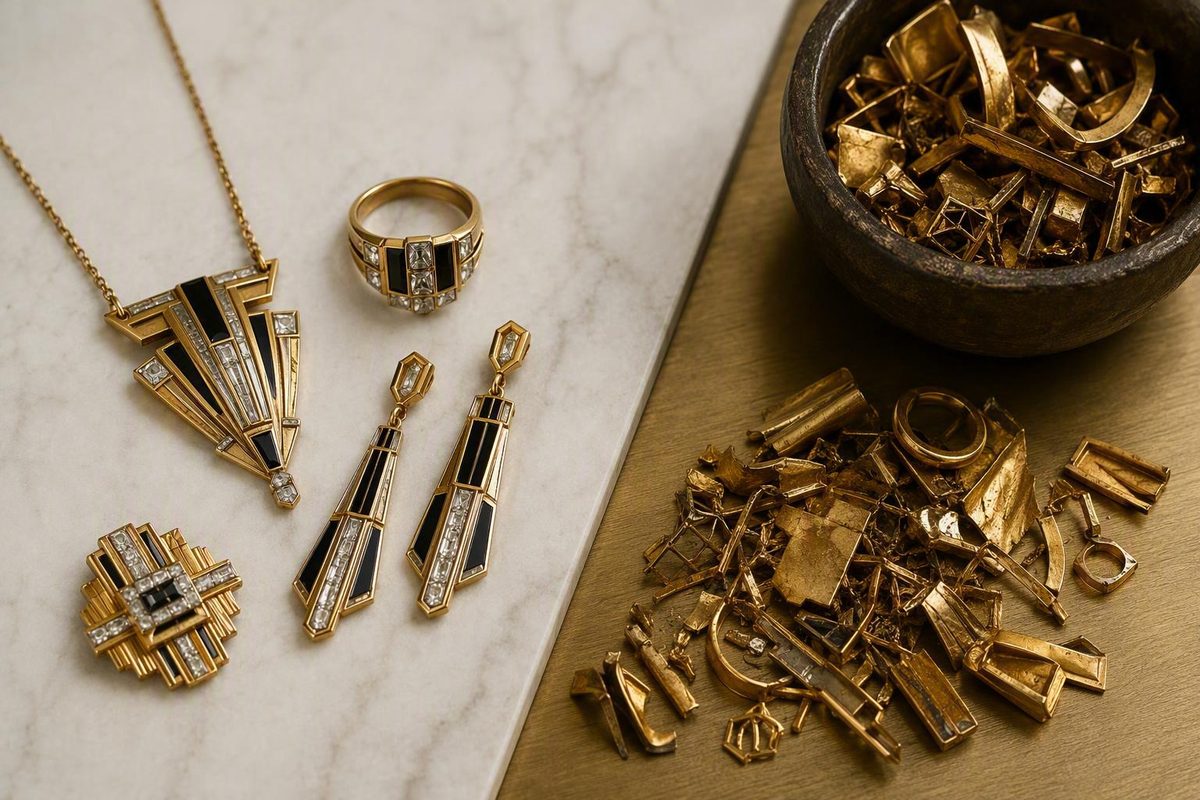
Gold’s 39.9% one-year rise has pushed the melt value of some common unsigned Art Deco gold jewelry up to what an intact-jewelry dealer might pay. December futures opened at $4,710.10 per troy ounce on August 25, 2026, while a 3.5-gram 14K ring at a $4,700 benchmark contains about $308 in theoretical gold value (Yahoo Finance). At the reported 70%–95% payout range for reputable scrap buyers, that implies roughly $216–$293 in cash—enough to surround a hypothetical $250 intact offer (scrap-buyer review). The antique premium has not disappeared, but ordinary pieces can now sit directly on the melt line.
The Received Wisdom Is Right About Irreplaceable Pieces
The conventional advice is that antique jewelry should not be melted because an intact object can be worth more than its gold. That is correct whenever a piece has a significant maker, important gemstones, exceptional workmanship, provenance, rare construction, or strong collector demand. Melting destroys all of those attributes and cannot be reversed.
The top of the market demonstrates the point. An Art Deco brooch with a 5.69-carat Kashmir sapphire and 6.50 carats of old-cut diamonds sold for EUR 406,400 at Christie’s Joaillerie Paris in June 2026, more than five times its EUR 80,000 high estimate (Rapaport). The report does not disclose the brooch’s gold weight or purity, whether the result includes buyer’s premium, or the consignor’s net proceeds. It cannot be used as a comparable for an unsigned filigree ring. It does show why an exceptional jewel should never be reduced to a metal calculation.
Where the received wisdom fails is in treating every old geometric jewel as collectible. Age and Art Deco styling do not alter the amount of gold in an alloy, and neither guarantees enough retail demand to support a dealer’s acquisition, repair, cataloguing, and holding costs. Financial reporting has documented vintage gold watches and bracelets going to the furnace as metal prices rise, although the supplied report gives no frequency data or Art Deco-specific breakdown (Yahoo Finance video).
Nor does the available evidence prove that only signed jewelry retains an antique premium. Unsigned pieces can have important stones, unusual construction, fine workmanship, or documented provenance. The narrower dealer-side verdict is defensible: at current high gold inputs, a common unsigned piece may be worth as much through a competitive scrap channel as through an intact wholesale offer, while exceptional jewelry remains governed by the collectible market.
Enter the net gold-alloy weight, purity, gold benchmark, and intact offer; the calculator shows which side wins.
Melt-vs-Market Calculator
Use net gold-alloy weight, not the complete weight of a stone-set or mixed-material jewel. The $4,700 default is an illustrative per-troy-ounce input.
3.5 g ÷ 31.1035 × 0.5833 × $4,700 = ~$308 theoretical melt value.
Default Comparison
| Outcome | Basis | Estimated Value | Vs. Intact |
|---|---|---|---|
| Theoretical melt | 100% | ~$308 | +$58 |
| Low scrap payout | 70% | ~$216 | −$34 |
| Midpoint payout | 82.5% | ~$255 | +$5 |
| High scrap payout | 95% | ~$293 | +$43 |
| Intact route | Entered net | $250 | Baseline |
How Purity Changes the Same Jewel
| Purity | Fine Gold | Theoretical Melt | Scrap Range |
|---|---|---|---|
| 9K / 375 | ~1.31 g | ~$198 | $139–$188 |
| 10K / 417 | ~1.46 g | ~$221 | $154–$210 |
| 14K | ~2.04 g | ~$308 | $216–$293 |
| 18K / 750 | ~2.63 g | ~$397 | $278–$377 |
| 22K / 916 | ~3.21 g | ~$485 | $339–$461 |
| 24K / 999 | ~3.50 g | ~$528 | $370–$502 |
At the midpoint payout, the default $250 offer reaches break-even at a gold price of approximately $4,617 per troy ounce.
Sources: Yahoo Finance gold report for the $4,710.10 futures reference; Jewelry By Designs review for the reported 70%–95% scrap-payout range. Calculations use 31.1035 grams per troy ounce. Values are estimates, not appraisals or guaranteed settlements.
The default is an illustrative 3.5-gram unsigned 14K filigree ring with a $250 dealer offer. No supplied source establishes $250 as a market-wide typical offer, so it should not be treated as one. It is a test case showing how quickly the metal floor can catch a modest wholesale price.
Calculate the Metal Floor Without Pricing Stones as Gold
Estimated theoretical melt value equals net gold-alloy weight in grams divided by 31.1035, multiplied by the purity factor and the gold price per troy ounce.
One troy ounce is 31.1035 grams, not the 28.3495-gram avoirdupois ounce used for ordinary goods. Substituting the ordinary-ounce conversion produces the wrong result (unit guide).
Each input has a specific meaning:
| Input | What Belongs In It | What Does Not |
|---|---|---|
| Net alloy weight | Gold-bearing alloy | Stones, enamel, steel |
| Purity factor | Established fineness | Assumed age or style |
| Gold price | Dated price per troy ounce | An unlabeled quote |
| Melt value | Contained-gold estimate | Guaranteed cash payment |
For the calculator’s default ring, 3.5 grams multiplied by a 0.5833 purity factor gives approximately 2.04 grams of calculated fine-gold content. At $4,700 per troy ounce, that produces theoretical melt value of about $308.
The result is not an appraisal or guaranteed settlement. A buyer still has to verify the material, decide which weight is payable, recover the metal, and cover processing costs and margin.
Use Net Alloy Weight, Not Gross Jewelry Weight
A scale reading for a complete jewel may include gemstones, enamel, steel springs, watch movements, fabric, leather, foils, non-gold pins, replacement clasps, and internal reinforcements. None of those components belongs in the gold-weight input.
A 20-gram brooch marked 750 cannot simply be entered as 20 grams of 18K alloy if it also contains stones, enamel, and a steel pin. Its defensible record would show a 20-gram gross weight, a 750 mark, and an unknown net alloy weight. The melt calculation should remain deferred until that missing input can be estimated responsibly.
Do not remove stones, scrape enamel, cut links, bend a brooch fitting, or disassemble a watch to make a home estimate look more exact. Record the gross weight, photograph the construction and marks, identify obvious non-gold components, and ask a specialist or buyer to explain the estimated net alloy weight. The buyer should separately disclose the weight on which it will actually pay.
Match the Purity Factor to the Evidence
Common initial factors are:
| Mark | Nominal Gold | Initial Factor |
|---|---|---|
| 9K or 375 | 37.5% | 0.375 |
| 10K or 417 | About 41.7% | 0.417 |
| 14K | About 58.33% | 0.5833 |
| 585 | 58.5% | 0.585 |
| 18K or 750 | 75% | 0.750 |
| 22K or 916 | About 91.7% | 0.917 |
| 24K or 999 | About 99.9% | 0.999 |
The distinction between 14K and a literal 585 stamp is small but real. Fourteen divided by 24 is approximately 0.5833; a 585 mark denotes 0.585. Record which basis was used. If an assay or settlement contract establishes another factor, use that verified basis.
A hallmark is evidence, not conclusive proof. It may apply to only one component, be worn or misread, or conflict with plating, solder, replacement findings, and later repairs. A maker’s signature, retailer’s mark, assay mark, patent mark, or inventory number also must not be mistaken for a purity mark.
Mixed-purity parcels require separate calculations. Calculate the 9K, 14K, and 18K groups independently, then add their values. Averaging unlike purities for convenience conceals rather than resolves uncertainty.
A Scrap Offer Is a Percentage of Specific Assumptions
Theoretical melt value prices the estimated fine-gold content at a selected benchmark. A cash offer reflects recoverable metal after the buyer accounts for testing, assay, refining, processing, shipping, insurance, price movement, operating costs, and margin. Refinery estimators may apply karat and spot-price assumptions before deducting refining rates and treatment charges; final settlement can instead depend on actual melt and assay results (refinery explanation).
The cited 70%–95% range is useful for testing possible outcomes, not a promise that every buyer pays within it. The draft contains no market-wide transaction dataset covering pawnshops, dealers, mail-in buyers, and refiners. Material quantity, confidence in purity, fees, settlement timing, and local competition can all change a bid.
A percentage is meaningful only when its basis is disclosed. For every quote, obtain these figures in writing:
| Quote Basis | Figure To Request |
|---|---|
| Weight | Gross and payable grams |
| Purity | Tested factor and method |
| Benchmark | Price, unit, time, type |
| Settlement | Fees and final payment |
A buyer advertising a higher percentage can still pay less if it assigns a smaller payable weight, tests at a lower purity, uses a stale benchmark, or deducts larger fees. Compare final payments under matched assumptions, not percentages in isolation.
The futures figure that opened at $4,710.10 was a December contract, not proof of the spot benchmark a jewelry buyer would use. Yahoo Finance also reported that contract at $4,697.60 at 7:52 a.m. ET on the same date. Ask whether an offer uses spot, a fixing, futures, or an internal settlement price, and whether that price is locked when the jewelry changes hands.
The Intact Price Must Be Net To the Seller
The comparison is not melt value against an ambitious retail listing. It is expected scrap payment against expected net proceeds from keeping the jewel intact.
A dealer’s retail asking price includes overhead, margin, inventory risk, and possible negotiating room. An auction result may be reported as hammer price or as a price including buyer’s premium. Neither necessarily equals the consignor’s proceeds after commission, insurance, taxes where applicable, and other charges. Insurance replacement values answer yet another question.
Use the calculator’s intact-price field for a firm dealer purchase offer or a realistic estimate of net seller proceeds. If entering a listing price, first subtract the costs and uncertainty required to turn that listing into cash. Otherwise the comparison favors the intact route with money the seller may never receive.
The default calculation illustrates the pressure clearly. The ring’s theoretical metal value is about $308. A 70% payout is approximately $216, the midpoint of the cited band is about $255, and a 95% payout is approximately $293. Against a $250 intact offer, the midpoint scrap outcome is ahead by only about $5. That is not a command to melt; it is evidence that the object has reached the decision line.
Signatures, Stones, and Construction Override the Calculator
The calculator deliberately ignores every non-metal source of value. Before accepting scrap terms, inspect the jewel for evidence that could move it into a specialist market.
A maker’s or retailer’s signature is the clearest reason to pause, but it is not the only one. Important old-cut stones, natural gemstones, enamel, unusual hinges or settings, exceptional handwork, rare forms, original boxes, receipts, design drawings, and documented ownership can all matter. So can evidence that a brooch was converted, a bracelet shortened, or a setting altered from another form.
Condition cuts both ways. Damage can make a common unsigned jewel difficult to retail, allowing melt value to catch it. A broken signed bracelet or incomplete rare brooch may still preserve attribution, valuable stones, or construction evidence. Damage alone does not settle the question.
Testing also requires judgment. Acid testing is approximate and slightly destructive. X-ray fluorescence can evaluate surface composition without cutting into the object, but plating, solder, repairs, and mixed metals can make a surface reading misleading (testing limitations). A refinery melt and assay answers a different question only after destroying the piece.
Photograph the front, back, sides, fastenings, damage, and every mark before cleaning or testing. Keep detached links, loose stones, old clasps, boxes, receipts, and family notes together. Do not polish away patina, softened marks, tool evidence, or plated detail before a specialist has examined them.
The Melt Route Wins Only After the Preservation Screen
A melt-based sale can be rational when a piece is common, unsigned, broken or heavily altered, lacks important stones, and has no identified construction, provenance, or design distinction. Even then, obtain itemized competing offers and compare actual settlement terms.
A specialist review should come first when the piece is signed, gem-set, unusually well made, plausibly period, accompanied by documentation, or uncommon in form or materials. The review should address authenticity, maker, gemstone identity, repairs, condition, comparable sales, and likely net proceeds—not merely provide an insurance figure.
The practical decision is a barbell rather than a universal rule. At one end, exceptional Art Deco jewelry can produce auction results many times estimate because buyers are purchasing rarity, stones, workmanship, and history. At the other, an ordinary unsigned gold jewel may encounter a metal floor high enough to meet its intact wholesale value.
Melt value establishes that floor. It does not grant permission to destroy the object. Once the calculation catches the intact offer, the correct next step is a preservation screen followed by matched, written bids—not an automatic trip to the furnace.