
Art Deco Glass: Period Originals vs Modern Designs
Technique, dimensions, pattern evidence, provenance and documented comparisons show whether claims about a piece's maker and date deserve confidence.
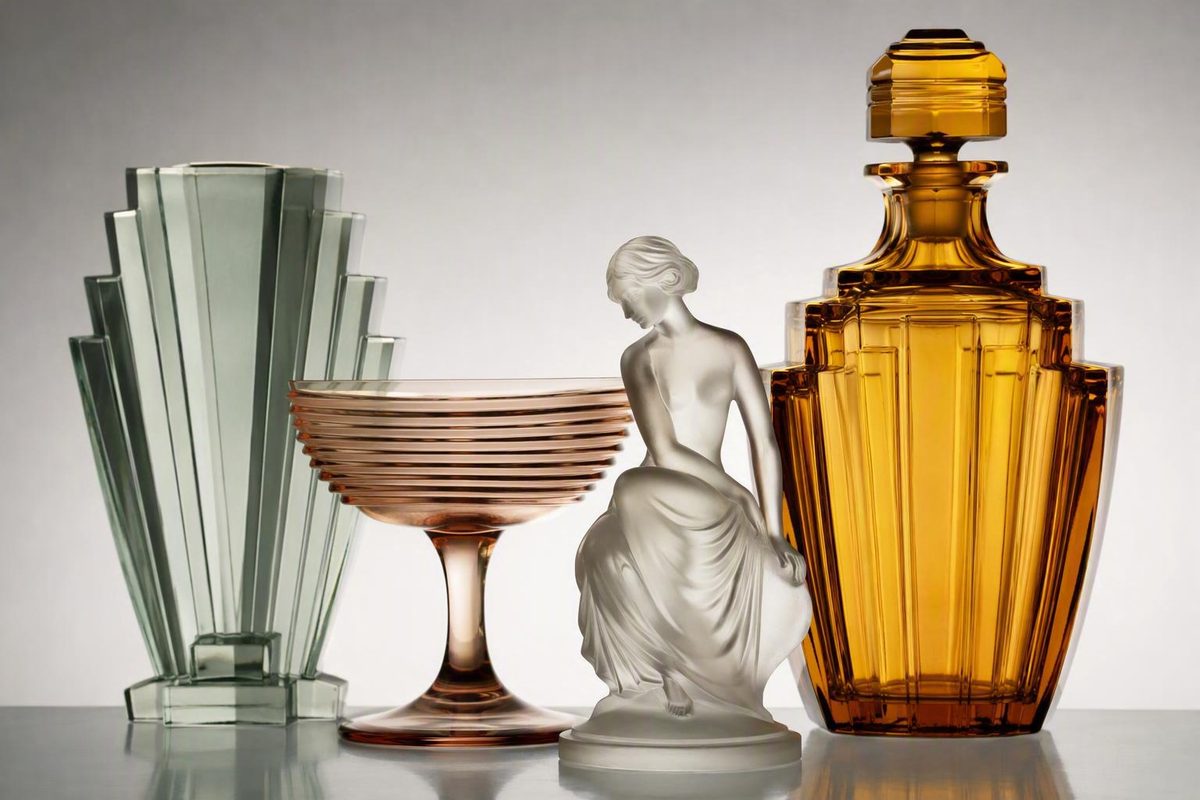
Art Deco glass is easy to recognize broadly and difficult to identify precisely. A stepped vase, frosted figurine, ribbed coupe, or amber decanter may look convincingly Deco, but appearance alone cannot establish who made it, when it was made, or whether it is an original period object.
Reliable identification begins with disciplined description. Establish the object’s complete form, dimensions, color, manufacturing method, marks, and condition before proposing a maker or date. Then test that proposal against pattern records, patents, provenance, museum examples, and other documented comparisons.
The goal is not to force every object into a confident attribution. It is to determine what the available evidence permits you to say.
What Art Deco glass means—and what the label does not prove
In its primary historical sense, Art Deco describes the interwar design movement that flourished during the 1920s and 1930s and gained international prominence in connection with the 1925 Exposition Internationale des Arts Décoratifs et Industriels Modernes in Paris. It extended across architecture, interiors, furniture, jewelry, metalwork, ceramics, and glass—not merely the cocktail culture now used to market the period. The Museum of Glass places Art Deco glass within this early-20th-century design context.
The museum offers a concise visual starting point: smooth lines, geometric shapes, and bright colors. These characteristics help define the field, but they are not an authentication formula. Smoothness, geometry, and strong color have appeared in glass made before, during, and after the interwar period. Readers seeking broader design context can also compare these features with this overview of Art Deco’s defining elements and historical evolution.
The category includes both functional and decorative glass. Vases, bowls, centerpieces, powder boxes, perfume bottles, figurines, lamps, car mascots, architectural panels, decanters, goblets, and tumblers may all fall within it. Some objects combine utility and sculpture: a flower holder may be organized around a molded figure, while a bowl may incorporate fish, birds, fruit, or architectural relief.
A useful identification system separates style from chronology:
| Confidence label | Typical supporting evidence | Important gaps or contradictions | Appropriate wording |
|---|---|---|---|
| Documented period work | Authoritative museum record, period catalog, patent, factory archive, firmly established provenance, or well-supported catalogue raisonné match | Significant conflict in dimensions, technique, mark, or model | “Documented period Art Deco glass by…” |
| Probable period work | Close agreement in form, dimensions, technique, color, marks, and known production | No decisive period record or secure provenance | “Probably made by…” or “Probable period work” |
| Tentative attribution | One or more promising clues, such as a reported mark or pattern resemblance | Missing documentation, incomplete comparison, or contradictory evidence | “Tentatively attributed to…” |
| Later production or reproduction | Evidence that an earlier design was produced again or copied after the original period | Uncertainty about authorization, producer, or exact production date | “Later production of…” or “Reproduction of…” |
| Modern Deco-inspired design | Contemporary retail record, current branding, packaging, or explicit revival language | No historical manufacturing claim | “Modern Art Deco-inspired glassware” |
These labels prevent several common mistakes. A new ribbed glass with a gold rim can be an effective Art Deco-inspired design. A plain household vessel manufactured during the interwar years is not automatically Art Deco merely because of its date. Likewise, an angular or geometric object is not necessarily historical Art Deco.
Current commerce makes the distinction particularly important. Retailers openly sell new glassware described as vintage-inspired, using geometric lines, ribbing, ornamental stems, clear glass, colored tints, and gold accents to evoke the period. Such language is evidence of contemporary manufacture rather than evidence of deception; one current Deco drinkware collection explicitly presents itself as vintage-inspired.
Marketplace categories are broader still. An “Art Deco” filter can group used objects, new products, seller-dated antiques, and recent merchandise. The label may describe appearance, marketing category, or seller opinion. It does not establish a manufacturing date.
When reading a listing or label, ask two separate questions:
- Does this object use an Art Deco visual vocabulary?
- What evidence establishes when and by whom it was made?
The first concerns style. The second concerns attribution and authenticity. They often overlap, but they are not interchangeable.
The visual vocabulary: shape, symmetry, color, finish, and motif
A visual inspection becomes more useful when divided into five categories: silhouette, geometric structure, symmetry, surface treatment, and subject matter. Record each independently before trying to name a maker.
Silhouette
Begin with the outline. Art Deco glass may be:
- Angular or sharply faceted
- Stepped or tiered
- Tall and streamlined
- Broad-shouldered and tapering
- Cylindrical, conical, or architectural
- Ribbed vertically or horizontally
- Smooth and rounded
- Figurative or sculptural
A so-called rocket vase may rise in a tapered architectural profile. A powder box may have a low circular body supporting a highly modeled lid. A decanter may be geometrically severe, while a vase from the same broad period may have a soft, elongated contour.
Silhouette is especially useful when comparing an unknown object with a catalog illustration. Look beyond general resemblance. Compare the proportions of the body, neck, foot, handles, opening, and base.
Geometric structure
Geometry may appear in the object’s overall construction or only in its decoration. Common effects include:
- Facets and repeated planes
- Stepped shoulders
- Zigzags, fans, and radiating lines
- Vertical ribs or flutes
- Concentric bands
- Repeated arches
- Angular handles
- Molded panels
- Symmetrical cut patterns
Crisp barware makes these features immediately legible: a tumbler can be organized as a cylinder broken by vertical flutes, while a stem may use a faceted knop. Sculptural glass often integrates geometry less literally. The folds of a figure’s dress, for example, may become rhythmic repeated planes.
Symmetry
Many Art Deco compositions create order through bilateral, radial, or repeated symmetry. Paired birds may face one another across a central axis. A bowl may radiate ribs from its base. A figure may stand at the center of a balanced arrangement of dishes or flower holders.
Symmetry does not require complete abstraction. Natural and human subjects can be simplified, repeated, or aligned to produce a controlled composition. Examine whether the decorative scheme follows the object’s form or appears to have been applied without regard to it.
Surface treatment and color
Art Deco glass can be transparent, translucent, opaque, frosted, polished, etched, iridescent, or partly matte. A single object may contrast a polished background with frosted relief or combine clear glass with colored or reflective inclusions.
Appearances encountered in documented, attributed, or marketed examples include:
- Clear and colorless glass
- Opal or opalescent glass
- Frosted surfaces
- Amber and smoke tones
- Pink
- Blue
- Green
- Opaque jade-like colors
- Iridescent surfaces
- Yellow-green or “uranium-colored” glass
Color names are descriptions, not chemical analyses. A green or yellow-green object should not be assumed to contain uranium solely because of its appearance or a seller’s terminology. Color also cannot date a piece by itself.
Examine color in ordinary reflected light and with light passing through the object. Record whether it is even, cased, streaked, concentrated near the rim, or varied by wall thickness. Note which areas are polished and which are matte. On molded objects, differences between raised and recessed surfaces may reflect deliberate finishing, wear, or both.
Subject matter
Art Deco did not eliminate nature or figuration. It stylized them. Recurring subjects include:
- Women, dancers, and ballerinas
- Fish and aquatic forms
- Herons and other birds
- Panthers, horses, dogs, and other animals
- Flowers, leaves, and fruit
- Mythological or theatrical figures
- Masks and heads
The Museum of Glass documented Marius-Ernest Sabino’s Groupe de Pantheres, dated circa 1928–1938, as press-molded opal glass. It also documented a circa-1925–1929 Muller Frères panther vase combining mold blowing, interior silver-foil inclusions, and surface etching. These works show that Art Deco imagery could remain naturalistic or figural while relying on stylized contours and sophisticated surfaces. Both objects are recorded in the museum’s exhibition archive.
This breadth matters because modern marketing often reduces Art Deco glass to cocktails and Gatsby-themed entertaining. Period work also includes sculptural vases, luminous animals, molded figures, powder boxes, architectural glass, and complex centerpieces.
Conversely, modern ribbing, faceted cutting, smoke tinting, and gold rims can reproduce the mood convincingly. They show that a designer used a Deco vocabulary; they do not document interwar manufacture.
Object types: from monumental vases to powder boxes and barware
Before researching a maker, decide what the object is—and whether it is complete. A misidentified object type sends research in the wrong direction. A “small bowl” may be the base of a centerpiece; a “figurine” may originally have supported a cake stand; an apparently complete bottle may lack its fitted stopper.
| Object group | Typical forms | Evidence to seek |
|---|---|---|
| Vessels | Vases, bowls, pots, jardinières | Profile, rim, foot, handles, mold pattern, documented dimensions |
| Figural glass | Statuettes, dancers, animals, fish, car mascots or hood ornaments | Base fitting, mounting holes, molded inscription, pattern number |
| Table decoration | Centerpieces, flower holders, flower frogs, cake stands | Matched components, metal mounts, bowl diameter, assembly method |
| Vanity glass | Powder boxes, trinket pots, perfume bottles | Original lid or stopper, fitted neck, matching technique and motif |
| Lighting and architecture | Lamps, shades, windows, panels | Mounting hardware, frame, dimensions, installation history |
| Candlesticks | Single sticks, pairs, multipart holders | Socket dimensions, foot shape, matched height and color |
| Barware | Decanters, goblets, tumblers, coupes, cocktail glasses | Set composition, stopper, capacity, etched pattern, matching stems |
| Serving glass | Dishes, trays, comports, covered bowls | Lid fit, handles, feet, complete service pattern |
Pressed glass should not be dismissed as merely utilitarian. Molded production can create elaborate relief, alternating polished and frosted areas, complex figures, and ambitious multipart displays. Repeatable manufacture does not preclude artistic sophistication.
A multipart centerpiece as a research model
A specialist commercial gallery attributes a green pressed-glass Poisson Volant centerpiece to Josef Inwald. Its listing assigns pattern number 9830 to the fish, 12865 to the flower frog, and 12868 to the bowl. Those numbers are potentially useful research leads because they distinguish the components of what might otherwise appear to be one object. They remain gallery-supplied attribution evidence rather than independent verification of the complete set. The gallery records the attributed centerpiece and its reported component numbers.
The case illustrates why completeness matters. If only the fish survives, searching for “glass fish figurine” may produce many unrelated objects. A fitting underneath, incomplete mounting arrangement, or corresponding bowl can reveal that it belonged to a larger assembly.
Apply the same logic elsewhere:
- Assess a perfume bottle with its stopper, checking whether the fit, color, technique, and motif correspond.
- Research a powder box with the correct lid—or account explicitly for its absence.
- Determine whether a figurine was freestanding, mounted as a car mascot, used in a centerpiece, or incorporated into a cake stand.
- Check whether a flower holder originally included a frog, bowl, stand, or metal fitting.
- Consider whether a decanter stopper has been replaced, altered, or borrowed from another vessel.
- Examine whether a lamp or architectural panel retains its original mounting components.
Modern retail barware offers a useful contrast. New coupes, Nick & Nora glasses, lowballs, highballs, goblets, gin balloons, wine glasses, martini glasses, and decanters may all be designed to create a Deco atmosphere. Their form names and historical styling do not turn them into antiques.
Complete the object-type identification first. Only then ask which makers produced that form, in which dimensions and colors, and by which techniques.
How Art Deco glass was made: a technique-to-appearance guide
Manufacturing technique can narrow an attribution, particularly when it agrees with a documented model. It cannot establish age by itself. The same broad methods may appear in period originals, later production, revivals, and reproductions.
Press molding
The process supports repeatable forms and organized relief, making it suitable for bowls, dishes, boxes, figures, animals, plaques, and other molded objects.
Visible effects can include:
- Repeated relief
- Molded lettering or numbers
- Consistent ribs or facets
- Figural detail
- Mold seams
- Contrasts between matte recesses and polished high points
Press-molded glass may be clear, colored, opaque, opal, or frosted. A seam indicates molded manufacture, not a date.
Mold blowing
Mold-blown glass begins with a gathered or preliminary glass form inflated into a mold. The mold establishes all or part of the outline and may create exterior relief. The object can then be etched, cut, carved, or polished.
A mold-blown vessel retains a hollow vessel structure, but distinguishing mold blowing from other techniques by sight is not always straightforward, especially where finishing has obscured production evidence.
Acid etching and acid cutting
Acid decoration protects selected areas with a resistant coating or mask while exposed glass is attacked. Repeated masking and treatment can produce different depths, creating a matte field, shallow relief, or layered composition.
Because acid treatment can be combined with molding, carving, cutting, polishing, or applied decoration, “acid-etched” may not be a complete technical description. Record which areas are recessed, frosted, glossy, or carved.
Cameo glass
Cameo glass consists of two or more layers of differently colored glass. The outer layer is selectively carved or etched away, leaving a shallow-relief design against the layer beneath.
Do not infer cameo construction from surface color alone. Examine rims, bases, and worn edges for evidence that the colors belong to distinct glass layers rather than paint, stain, or another surface treatment.
Frit decoration
Frit is crushed or powdered glass incorporated for color, texture, or patterned effects. It may appear granular, mottled, clouded, or layered within a vessel.
Charles Schneider’s circa-1919–1923 Pichet Spirale is documented as mold-blown glass with crushed and powdered frit applied on the interior and exterior, together with acid cutting. The combination demonstrates why a complex object should not be reduced to a single technique.
Foil inclusion and surface etching
The circa-1925–1929 Muller Frères panther vase documented by the Museum of Glass combines interior silver-foil inclusions with surface etching. The foil and etched decoration occupy different physical levels and create separate visual effects.
| Technique | Visible effect | Evidence example or technical reference | What it cannot establish |
|---|---|---|---|
| Press molding | Repeatable relief, figures, ribs, molded decoration | Sabino’s Groupe de Pantheres and Lalique’s Vase Bacchantes | Maker, production date, or originality by itself |
| Mold blowing | Hollow vessel inflated into a shaped or patterned mold | Schneider’s Pichet Spirale | Whether the piece is period or later |
| Acid etching or cutting | Matte areas, recessed designs, varied depths | Schneider’s Pichet Spirale | A specific workshop without corroboration |
| Cameo construction | Layered colors exposed in shallow relief | Technical definition; no object-specific example established here | Date, workshop, or authenticity |
| Frit decoration | Granular, mottled, or layered color | Schneider’s Pichet Spirale | Exact composition or maker by sight alone |
| Foil inclusion | Reflective material enclosed within the glass | Muller Frères panther vase | Period origin without a documented match |
| Surface frosting | Matte or softened surface emphasizing form or relief | General production effect; no single model required | Whether the frosting is original or later |
| Surface etching | Matte or patterned exterior decoration | Muller Frères panther vase | The object’s complete manufacturing history |
A commercial glassmaking glossary explains mold blowing, acid etching, and cameo construction, making it a useful terminology aid rather than an object-specific authentication authority.
Finally, distinguish two frequently overinterpreted features:
- A mold seam records an aspect of molded manufacture.
- A pontil scar records where a blown object was detached from a working rod.
Neither independently identifies a maker, establishes a date, or authenticates an object.
Makers and production traditions collectors encounter
A beginner benefits from recognizing names, but name recognition creates its own risk: unidentified glass is often assigned to a famous maker merely because it resembles that maker’s style.
The Museum of Glass exhibition represented René Lalique, Daum Frères, Pierre d’Avesn, Charles Schneider, Muller Frères, Marius-Ernest Sabino, and Steuben Glass Works. That museum-supported group is a sound starting point, though it does not exhaust the international field.
René Lalique
Lalique is associated in the documented examples with press-molded opal glass and molded relief. Vase Bacchantes demonstrates how repeated figures can be integrated around a vessel rather than treated as independent ornament. Frosted surfaces and contrasts between matte and polished areas are also associated with Lalique glass.
“Lalique-style” is not an attribution. Opalescence, female figures, birds, fish, flowers, or frosted relief can appear in work by other makers and in later imitations. A proposed attribution should agree with a documented model, dimensions, production method, mark, and known variations.
Marius-Ernest Sabino
Sabino’s museum-documented Groupe de Pantheres provides an example of press-molded opal glass. It is useful for understanding how animal sculpture, translucency, and repeatable molded production can coexist in a period Art Deco object.
Charles Schneider
Schneider’s documented Pichet Spirale combines mold blowing, frit applied on the interior and exterior, and acid cutting. That combination points toward a workshop practice and model more strongly than any one visible trait would.
Muller Frères
The museum-documented panther vase combines mold blowing, interior silver-foil inclusions, and surface etching. Its attribution rests on the complete documented object, not on the presence of foil or a panther alone.
Daum Frères, Pierre d’Avesn, and Steuben
These names were represented in the museum exhibition and belong within the wider study of early-20th-century art glass. The evidence available here does not support reducing each maker to a checklist of signatures, colors, or forms. Their names should prompt model-specific research rather than attribution by reputation.
Gallery-attributed pressed-glass makers
A specialist commercial identification gallery associates objects with Josef Inwald, Cambridge Glass, Rosice, Ankerglas Bernsdorf, Sindorf, and S. Reich. Because the gallery also includes commercial listings, unidentified pieces, and tentative entries, these maker names and numbers should be treated as reported leads rather than independently verified factory records.
Reported examples include Josef Inwald numbers 9830, 12865, and 12868 for the components of the Poisson Volant centerpiece; Rosice pattern 1948 for a pink rocket vase; S. Reich pattern 8800 for a jade-like trinket pot; S. Reich pattern 8774 for a frosted pink lidded bowl; and the molded or inscribed wording “Pat No 645577” on an amber Cambridge Glass “Draped Lady.” These numbers and identifications are reported by the commercial gallery.
A pattern or patent number can narrow research substantially, but it must agree with the object. A number may be misread, incorrectly reported, or associated with only one component of a larger assembly. Compare its letter forms, placement, dimensions, and relationship to documented examples.
Tiffany requires object-specific caution
Tiffany is often included in wide-ranging discussions of collectible Art Deco glass, but some cited Tiffany works date to around 1900 and are strongly associated with Art Nouveau, naturalistic design, and iridescent Favrile glass. A maker active across adjacent stylistic periods cannot be assigned wholesale to Art Deco. Classification requires evidence from the individual object—its date, design, production context, and documented model. A dealer’s collecting guide illustrates this overlap by discussing circa-1900 Tiffany alongside later Art Deco material.
The governing rule is simple: do not move from “this resembles work associated with this maker” to “this maker produced it” without intervening evidence.
A step-by-step framework for investigating an unknown piece
A repeatable workflow reduces confirmation bias and makes it easier to compare opinions from dealers, collectors, appraisers, and museums.
Record dimensions and weight
Measure:
- Overall height
- Maximum width
- Rim diameter
- Base diameter
- Depth or bowl diameter
- Stopper height, if separate
- Weight of the whole object and separate components
Use consistent units and enough precision to distinguish nearby models.
Photograph the complete profile
Take level photographs against a plain background from the front, back, sides, and above. Include a scale in at least one image without obscuring the profile.
Then photograph:
- Base
- Rim
- Interior
- Mold seams
- Pontil area
- Marks and labels
- Fittings and mounting holes
- Chips, cracks, polishing, and repairs
- Stopper, lid, frog, stand, or other separate parts
Identify the complete object type
Decide whether the object is a vase, bowl, figurine, centerpiece element, perfume bottle, lamp component, flower holder, car mascot, or part of another assembly.
Ask whether anything is missing.
Describe color and surface before interpreting them
Write observations such as:
- “Transparent amber body”
- “Opaque pale-green lid”
- “Matte recessed areas with polished raised relief”
- “Color appears darker at the base”
- “Reflective fragments appear enclosed beneath the surface”
Avoid converting descriptions immediately into maker or material claims. “Yellow-green glass” is an observation. A particular chemical composition is a conclusion requiring appropriate evidence.
Identify visible production clues
Record seams, grinding, cutting, etching, molding, applied parts, internal inclusions, and polished areas. Notice whether repeated details are crisp or softened, but do not assume softness necessarily indicates age; it may result from the mold, finishing, wear, or later alteration.
Separate observation from interpretation:
- Observation: “Circular scar at the center of the base.”
- Interpretation: “Possibly a pontil scar from blown manufacture.”
- Unsupported leap: “Hand-blown during the Art Deco period.”
The first is directly visible. The second may be reasonable. The third requires corroboration.
Transcribe marks exactly
Do not correct spelling or expand initials. Record capitalization, punctuation, line breaks, orientation, and whether the mark is molded, engraved, acid-stamped, painted, or applied on a label.
Photograph the mark as found and under angled light. If a character is uncertain, search several plausible readings rather than choosing the one that best supports a preferred attribution.
Treat sensory tests as clues, not verdicts
Weight, brilliance, prism effects, ringing tone, bubbles, irregularity, wear, and pontil scars may contribute to an investigation. None proves age or authenticity. Commercial antique-glass guides also acknowledge that modern or reproduced glass can share characteristics associated with older objects. Westland London describes these clues while cautioning that they require comparison and cross-referencing.
Do not deliberately strike a fragile object to test its tone. Whatever information the sound might provide is too limited to justify risking damage.
Compare with documented examples
Useful evidence may come from:
- Museum collection records
- Period catalogs and advertisements
- Patents and registered designs
- Factory pattern books and archives
- Scholarly monographs and catalogues raisonnés
- Well-documented auction archives
- Specialist galleries and collector references
- Marketplace listings and image matches
This is not an absolute ranking. A detailed specialist record may be more useful than a minimal museum caption, while an auction attribution may repeat an earlier error. Examine what evidence each source actually supplies.
For the attributed Inwald centerpiece, the reported component numbers create a structured comparison: fish, flower frog, and bowl should each agree with the proposed model. For the Cambridge “Draped Lady,” the reported patent wording provides a targeted search term, but the figure’s dimensions, material, molding, base, and documented variants must also agree.
Look for convergence
Attribution becomes stronger when independent features align:
- Form
- Dimensions
- Color
- Technique
- Pattern number
- Mark
- Component fit
- Period documentation
- Provenance
One match may be coincidental. Agreement across multiple independent features is more persuasive. Contradictions deserve as much attention as matches. A plausible mark on an undocumented form, or a familiar pattern in a color unsupported by reliable records, should lower confidence.
State the result proportionately
Useful concluding language includes:
- “The object is consistent with documented interwar pressed glass.”
- “The form is consistent with examples attributed to Josef Inwald.”
- “The mark is reported on Cambridge ‘Draped Lady’ figures.”
- “The attribution remains tentative because no pattern record or provenance has been located.”
- “The object appears to be a later production of a period design.”
- “The piece is best described as modern Art Deco-inspired glass.”
This workflow cannot authenticate every original, later issue, revival, reproduction, or counterfeit. Its value lies in making the reasoning visible and preventing one attractive clue from becoming an unsupported conclusion.
Period glass versus modern Deco-inspired glassware
Modern designers deliberately reuse Art Deco forms. Ribbed bowls, geometric cutting, ornamental stems, clear glass, smoke and amber finishes, and gold rims all create an immediate period association. The result may be attractive and well made while remaining entirely contemporary.
Use explicit retailer wording constructively. If a collection calls itself “vintage-inspired,” that is positive evidence that it is a modern interpretation. It is not an admission that something is wrong with the product; it distinguishes design inspiration from historical manufacture.
| Question | Period Art Deco claim | Modern Deco-inspired product |
|---|---|---|
| Claimed date | Should identify a defensible interwar date or range | Usually current production or undated retail stock |
| Provenance | May include ownership history, old receipts, labels, or publication history | Retail receipt and manufacturer packaging document modern purchase |
| Maker evidence | Period mark, catalog match, archive, or documented model | Current brand name or product page |
| Pattern documentation | Period pattern book, patent, registered design, or museum comparison | Contemporary style or product name |
| Construction observations | Must agree with the proposed maker and period | Reflect current manufacturing choices and may imitate historical effects |
| Condition | May show use, restoration, loss, or component replacement | Usually expected to be new unless sold as used |
| Intended use | Decorative, architectural, vanity, lighting, serving, or drinking | Often designed for current home bars and entertaining |
| Seller terminology | “Period,” “circa,” “attributed to,” or “signed” requires evidence | “Vintage-inspired,” “Gatsby,” “revival,” or “Deco collection” usually describes style |
| Appropriate description | “Period Art Deco glass,” if documented | “Modern Art Deco-inspired glassware” |
Contemporary forms include coupes, Nick & Nora glasses, lowballs, highballs, goblets, gin balloons, wine glasses, martini glasses, and decanters. Some retailers use phrases such as “1920s” or “Gatsby” as visual shorthand while selling new products. Retail context and product documentation are therefore more informative about age than ribbing or stem shape.
Online marketplaces collapse these distinctions. The same Art Deco category can contain new and used inventory, seller-assigned historical dates, period-associated objects, and listings assigned to 2020–Now. The eBay category illustrates why a marketplace style filter is not an age guarantee. Dynamic totals and overlapping filters should not be treated as reliable measures of market size.
Prefer vocabulary that communicates evidence rather than enthusiasm:
- Period Art Deco glass: documented historical work
- Attributed to: supported but unconfirmed identification
- Probably by: strong but incomplete evidence
- Tentatively attributed to: substantial uncertainty remains
- Later production: subsequent production of an earlier form
- Reproduction: copying of an earlier object, where established
- Art Deco-inspired: contemporary design using the historical vocabulary
When possible, identify the later production period. “Late-20th-century Art Deco revival vase” is more informative than an unqualified “Art Deco vase.”
Buying and condition: what to inspect and what to ask
Buying well begins with obtaining enough information to evaluate identity and condition. A polished listing title is not a substitute for photographs, measurements, and attribution evidence.
Questions to ask the seller
Request:
- Exact height, width, rim diameter, base diameter, and weight
- Sharp photographs of every side
- A full-profile photograph taken at object level
- Close-ups of the base, rim, interior, and seams
- Clear images of every signature, number, label, and inscription
- Photographs of the stopper, lid, flower frog, stand, or mounting hardware
- Images of chips, cracks, scratches, clouding, and worn decoration
- Disclosure of repairs, polishing, recutting, and replaced parts
- Confirmation that components fit correctly
- Any box, receipt, label, or earlier documentation
Then ask for the basis of the maker and date attribution:
- Is there documented provenance?
- Has the object appeared in a publication or exhibition?
- Is there a pattern, patent, or registered-design reference?
- Which museum, catalog, or archive comparison supports the identification?
- Is the mark documented for this model and production period?
- Is the date based on evidence or visual estimation?
- Is the object offered as period, later production, reproduction, or merely Deco-inspired?
A seller may not know every answer. Uncertainty is not automatically disqualifying, but it should be reflected in the description and any purchasing decision.
Condition checklist
Inspect or request disclosure of:
- Chips: especially at rims, feet, corners, relief edges, and stopper tips
- Cracks: including hairlines around handles, mounts, and thick molded sections
- Repairs: adhesive joins, filled losses, rebuilt corners, or reattached figures
- Polishing: smoothed chips, altered contours, or loss of original surface
- Recut rims: reduced height, uneven profile, or a rim inconsistent with documented examples
- Clouding: internal haze, staining, abrasion, or deterioration
- Flaking or glass disease: unstable surfaces, cracking, or progressive deterioration
- Lost decoration: missing gilding, enamel, paint, stain, or frosting
- Replaced stoppers or lids: incorrect fit, color, pattern, or wear
- Mismatched components: bowls, figures, stands, or frogs assembled from different models
- Unstable mounts: loose metalwork, corrosion, distortion, or stress around fittings
Clouding and flaking can have different causes. A commercial appraisal guide describes glass disease as irreversible deterioration that may produce cloudiness, flaking, or cracking, while also identifying condition, restoration, provenance, and maker evidence as factors affecting collectibility. Its discussion is useful as general appraisal guidance rather than a material-specific diagnosis.
Chips, cracks, repairs, altered rims, and deterioration can affect collectibility, but there is no responsible universal percentage adjustment. The significance depends on the object, the location and visibility of the damage, component completeness, and the quality of any restoration.
Price evidence and specialist advice
Dealer asking prices and active marketplace listings show what sellers are requesting. They do not establish authentication or, by themselves, determine what a particular object would sell for. A high asking price does not authenticate an attribution, and a low one does not prove that an object is a reproduction.
Pause and seek appropriate specialist help when:
- The proposed maker materially changes the purchase decision
- The object appears repaired, altered, or composite
- A signature conflicts with the form or technique
- A claimed model or color lacks documentation
- A multipart object may contain mismatched components
- A formal appraisal is required for a specific administrative purpose
- The surface appears unstable
- The material or production method requires specialized analysis
Care guidance must be object-specific. Do not assume that a generic cleaning method is safe; consult a qualified conservator about fragile, unstable, decorated, or valuable glass.
One-page pre-purchase checklist
Identity
- [ ] I know the complete object type.
- [ ] I have checked whether a lid, stopper, stand, frog, bowl, or mount is missing.
- [ ] The seller distinguishes period glass from later or Deco-inspired production.
- [ ] The maker and date are supported by more than visual resemblance.
Measurements and photographs
- [ ] Exact dimensions are provided.
- [ ] Weight is provided.
- [ ] I have clear photographs of every side.
- [ ] I have close-ups of the base and rim.
- [ ] I can see seams, the pontil area, fittings, and contact surfaces.
- [ ] Every mark, number, and label is legible.
- [ ] Damage is shown under useful lighting.
Attribution
- [ ] The mark has been transcribed exactly.
- [ ] The form matches a documented model.
- [ ] Dimensions agree with the comparison.
- [ ] Color and technique agree with documented production.
- [ ] Any reported pattern or patent number has been corroborated.
- [ ] Provenance or publication history is available where claimed.
- [ ] Contradictory evidence has been considered.
Condition
- [ ] Chips and cracks are disclosed.
- [ ] Repairs and adhesive joins are disclosed.
- [ ] I have checked for polishing and a recut rim.
- [ ] Clouding, flaking, and deterioration are visible or described.
- [ ] Gilding, enamel, paint, and frosting have been checked.
- [ ] The stopper or lid fits and appears consistent.
- [ ] Multipart components match.
- [ ] Mounts appear stable.
Decision
- [ ] I am not relying on active asking prices as proof of identity.
- [ ] I understand the stated condition and component completeness.
- [ ] The seller’s certainty is proportionate to the evidence.
- [ ] I will seek specialist advice if attribution materially affects my decision.
- [ ] My own description uses an appropriate confidence label.
Frequently asked questions
How can I tell whether Art Deco glass is genuinely from the 1920s or 1930s?
Look for agreement among the object’s form, dimensions, color, technique, mark, pattern number, and documented model. Provenance, period catalogs, patents, museum records, and securely attributed comparisons can strengthen the conclusion.
Wear, bubbles, geometric shape, or a seller-selected date are insufficient by themselves. If the physical evidence agrees closely but no decisive period record survives, “probable period work” is more accurate than an unqualified attribution.
Does a signature, pontil mark, mold seam, or trapped bubble authenticate Art Deco glass?
No. Each may contribute information, but none authenticates a piece independently.
A signature may require verification against the model and production period. A pontil scar records an aspect of blown manufacture, while a mold seam records molded manufacture. Bubbles can occur in glass from different dates and production methods. All must be considered with the form, technique, documentation, and provenance.
Which Art Deco glassmakers should collectors know?
A useful museum-supported starting group is René Lalique, Daum Frères, Pierre d’Avesn, Charles Schneider, Muller Frères, Marius-Ernest Sabino, and Steuben Glass Works.
Collectors of pressed glass may also encounter commercial-gallery attributions to Josef Inwald, Cambridge Glass, Rosice, Ankerglas Bernsdorf, Sindorf, and S. Reich. Learn documented models rather than memorizing style stereotypes: resemblance to Lalique, Schneider, or another maker is not proof of authorship.
Is modern Gatsby-style glassware the same as period Art Deco glass?
No. It may use ribbing, geometric cuts, ornamental stems, colored tints, smoke finishes, or gold rims.
That does not make it inferior or deceptive. It simply belongs in a different category. Use “period Art Deco glass” for documented historical objects and “Art Deco-inspired glassware” for contemporary products unless evidence establishes otherwise.
How do I determine what a piece of Art Deco glass is worth?
Begin by establishing what the object is and how confident its attribution should be. Identity, condition, provenance, restoration, replaced components, and completeness may all affect how a specialist assesses it.
Do not treat active listings or dealer asking prices as verified sale evidence. If the proposed maker materially affects the purchasing or appraisal decision—or if the object is unusual, repaired, composite, or poorly documented—consult a specialist familiar with that maker or production tradition.
Conclusion
The central discipline is to describe first and attribute second. Test the proposed maker and date against technique, dimensions, pattern evidence, provenance, and documented comparisons. A geometric profile or old-looking base can begin an investigation, but it cannot finish one.
The responsible conclusion may be documented period work, probable period work, a tentative attribution, later production or reproduction, or modern Deco-inspired design. What matters is not choosing the most prestigious label. It is stating clearly what the evidence supports.