
Art Deco Bracelet: Style, but Age Needs Proof
Check its form, reported materials, construction, repairs and marks. Photos can expose questions, but not conclusively establish its date or mechanical safety.
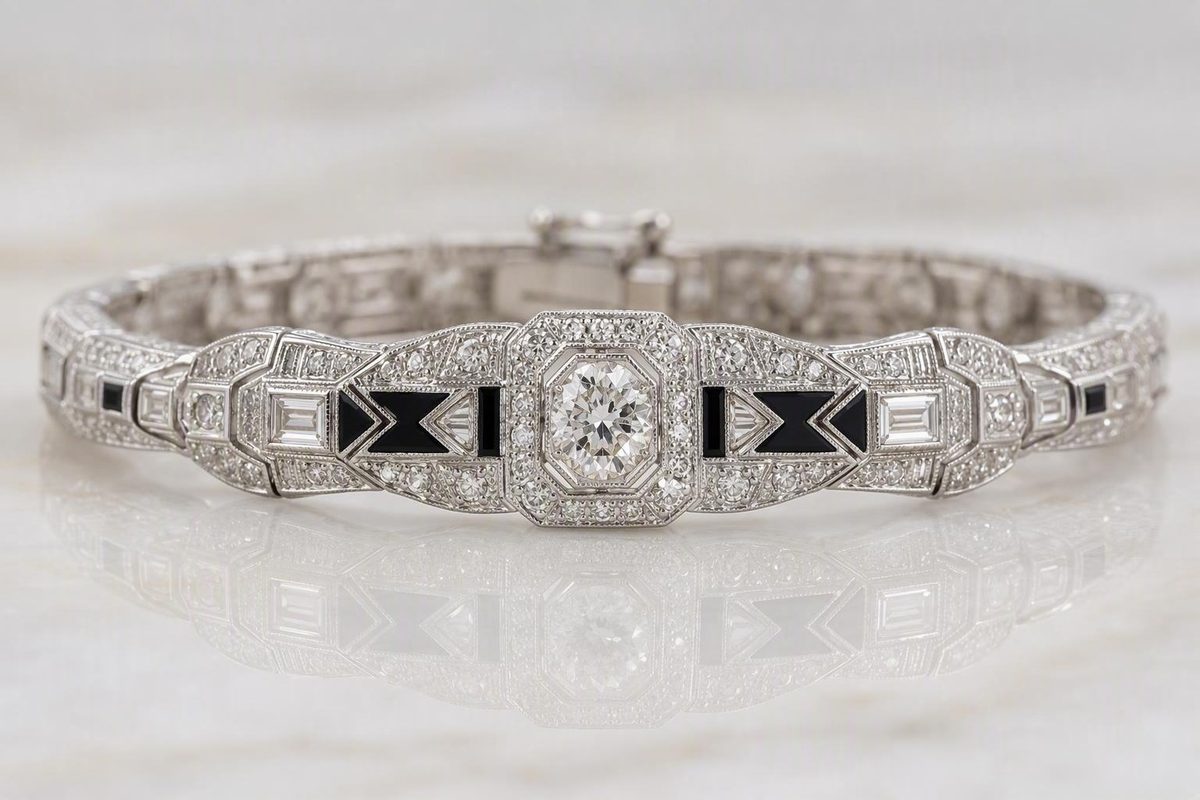
An Art Deco bracelet is often easy to recognize in broad outline and difficult to authenticate in detail. Geometry, symmetry, white metal, old-style diamond cuts, milgrain, or a box clasp may support an attribution, but none proves that a bracelet was manufactured during the historical Art Deco era.
A useful evaluation separates several questions:
- What design language does the bracelet use?
- What physical form does it take?
- Are its reported materials, stone cuts, construction, findings, and marks compatible with the proposed date?
- Has it been repaired or altered?
- What documentation supports the seller’s description?
- What remains an unverified seller opinion?
This is an introductory screening and buying guide, not a remote-authentication method. Photographs can expose questions, but they cannot conclusively establish manufacturing date, gemstone identity, mechanical safety, maker attribution, or originality. Expensive, signed, materially ambiguous, or heavily repaired bracelets warrant independent hands-on examination.
What Does “Art Deco Bracelet” Actually Mean?
The quick answer is that Art Deco bracelets are generally associated with the 1920s and 1930s. Commercial sources do not use one universal endpoint: some apply approximately 1920–1935, while others extend the jewelry period to 1939. These are working conventions rather than dates capable of settling the attribution of an individual bracelet. Filigree Jewelers, for example, uses 1920–1935 and divides that span into early Art Deco from 1920–1925 and later Art Deco from 1925–1935 in its era guide.
The phrase Art Deco bracelet can describe at least four different things:
- Period Art Deco: A bracelet credibly attributed to the historical era through a coherent combination of physical evidence and documentation.
- Revival: Later jewelry that deliberately revisits Art Deco design.
- Reproduction: A newly made bracelet intended to resemble older work, sometimes closely.
- Art Deco-style or Art Deco-inspired: A design description that signals geometry, contrast, or other Deco vocabulary without claiming historical manufacture.
These categories concern origin, not quality. A recent Art Deco-inspired bracelet may be beautifully made, while a period bracelet may be damaged, altered, or modest in materials. The essential buying question is whether the seller has represented the category clearly.
Age and style are separate questions. A bracelet can use convincing Art Deco design language without having been made during the historical period. Conversely, a bracelet manufactured during the period need not display every feature now treated as stereotypically Deco.
Current retail language illustrates the distinction. A. Brandt + Son lists a custom platinum French-cut diamond bracelet explicitly as “Art Deco Style” within a collection that also contains products presented as Art Deco bracelets. Its inventory covers line, link, bangle, chain, and charm forms rather than treating “Art Deco” as one narrow product specification on the collection page.
Read listing titles literally but not uncritically. “Art Deco,” “circa 1930,” “in the Deco manner,” “style of,” “revival,” and “inspired by” are not equivalent claims. Ask the seller to state in writing whether the bracelet is represented as period-made, later vintage, or contemporary—and what evidence supports that description.
The Visual Language: Geometry, Symmetry, and Contrast
Art Deco bracelet design commonly begins with an organizing grid. Straight lines establish structure, repeated shapes carry a pattern around the wrist, and bilateral symmetry creates order. Changes in stone orientation, surface height, or color introduce rhythm. A broad panel bracelet may resemble a miniature architectural elevation, while a narrow line bracelet can express the same principles through alternating rectangular and square units.
For a broader design context beyond jewelry, see Art Deco Design: The Defining Elements, Decade by Decade.
Motif checklist
Look for combinations of:
- Chevrons and V-shaped units
- Zigzags
- Sunbursts and radiating lines
- Fan forms
- Hexagons and octagons
- Lozenges or elongated diamond shapes
- Trapezoids
- Stepped outlines
- Skyscraper-like profiles
- Repeated rectangles, grids, or blocks
- Stylized Egyptian-revival imagery
- Machine-inspired patterns
These motifs are most persuasive when integrated throughout the object. A single chevron added to an otherwise generic bracelet says less than a coherent relationship among the outline, links, stone layout, side profile, and clasp.
Contrast is equally important. Diamonds against black onyx create a sharp light-dark division. Sapphires, rubies, or emeralds against a white-metal and diamond ground can create blocked fields of color. Contrast may also come from pierced and solid surfaces, transparent rock crystal beside opaque material, or dark enamel framed by bright metal.
Art Deco did not eliminate natural imagery. The more useful distinction is not “nature versus no nature,” but free organic movement versus disciplined repetition.
At a high level, Art Nouveau is commonly described through flowing lines, asymmetry, plants, flowers, insects, and the human form. Art Deco more often favors angular order, symmetry, streamlined geometry, and strong color contrast. The traditions overlap, however, so stylistic comparison should narrow an inquiry rather than dictate a manufacturing date. Arden Jewelers’ commercial comparison makes the same broad distinction while acknowledging that overlap between the two movements.
Characteristic is not conclusive
Later makers can reproduce geometry, symmetry, stepped outlines, milgrain, white-metal settings, old-style stone layouts, and period-looking clasps. A bracelet that “looks Deco” has passed a style screen—not an authentication test. Continue by documenting its reverse, construction, findings, marks, wear, alterations, and supporting records.
Bracelet Types: From Diamond Lines to Articulated Panels
“Art Deco bracelet” describes a design family, not one construction. Recognizing the form helps determine how the bracelet is intended to move and what information a buyer should request.
| Form | Typical construction | Visual effect | Flexibility | Inspection priorities |
|---|---|---|---|---|
| Line bracelet | Continuous or near-continuous sequence of stone-set links | Narrow, uninterrupted line of brilliance or color | Usually highly flexible | Even articulation, stone security, channel alignment, clasp integration |
| Articulated panel or strap bracelet | Connected plaques or panels, often with concealed joints | Broad geometric surface wrapping around the wrist | Flexible, but less fluid than a narrow line | Reverse construction, plaque alignment, joints, galleries, repairs |
| Narrow link bracelet | Repeated plain-metal or stone-set geometric links | Rhythmic, modular pattern | Moderate to high | Consistency of repeated units, connecting points, kinks, disclosed repairs |
| Hinged bangle | Rigid or semi-rigid body divided by one or more hinges | Architectural outline | Little flexibility | Hinge and closure operation, internal dimensions, distortion, repair history |
| Cuff | Broad open or hinged body | Strong statement surface | Usually rigid | Fit, edge condition, closure if present, evidence of alteration |
| Filigree bracelet | Pierced, open, or lace-like metal units | Light surface with substantial negative space | Varies | Damaged or repaired openwork, snagging points, setting condition |
| Charm or chain bracelet | Chain or links carrying suspended elements | Mobile, narrative, or eclectic | Highly flexible | Attachments, jump rings, chain wear, replacement elements |
| Statement bracelet | Multirow, oversized, or materially bold construction | Dramatic color, scale, or relief | Varies widely | Weight distribution, closure, projecting settings, fit and comfort |
A line bracelet uses a continuous or nearly continuous row of stones. The stones may be uniform, alternate by color, or shift among square, rectangular, and round forms. The format preceded the jewelry now commonly called the tennis bracelet; the modern term does not imply that a bracelet is old or Art Deco.
An articulated panel or strap bracelet is broader. Linked plaques create a nearly continuous decorative surface while allowing the bracelet to drape around the wrist. Because the joints may be visually concealed from the front, photographs of the reverse are particularly important. Filigree Jewelers’ bracelet guide likewise distinguishes continuous line bracelets from articulated plaque constructions in its discussion of period-associated forms.
Narrow link bracelets build rhythm from repeated units. They may alternate diamond-set links with sapphire, onyx, enamel, or plain-metal components. Check whether repeated links match in scale and design. If one appears different, ask whether it was repaired, rebuilt, or substituted rather than trying to diagnose the work from a photograph.
Hinged bangles and cuffs require different measurements from flexible bracelets. Overall length may be less useful than internal circumference, diameter, opening, and shape. Ask for photographs or video showing the hinge and closure in operation, but do not treat visual evidence as proof that the mechanism is safe for wear.
Filigree bracelets use open, lace-like, pierced, or thread-like metalwork. Their motifs may be geometric, floral, or vine-based. Filigree is a construction or decorative vocabulary, not a date stamp: it appears outside the Art Deco era and can be reproduced.
Charm, chain, bangle, and statement bracelets also appear in present-day retail collections categorized as Art Deco. These inventories demonstrate the breadth of current commercial labeling, but they do not prove that every listed item is period-made.
Metals, Stones, Cuts, and Decorative Techniques
Platinum and diamonds are prominent in commercial descriptions of high-end Art Deco bracelets, and white gold is also repeatedly associated with the period. The supplied commercial guides differ on precisely when one metal became more prevalent than another, so formulas such as “platinum means early” or “white gold means late” are unsafe. Metal must be identified rather than guessed from color, and composition does not independently establish age.
Current retailer inventories categorized as Art Deco include:
- Platinum
- White and yellow gold
- Sterling and other silver alloys
- Diamonds
- Sapphire, ruby, and emerald
- Onyx and rock crystal
- Jade, coral, and turquoise
- Amber
- Enamel and glass
- Bakelite and other molded materials
- Wood
This list primarily documents the breadth of contemporary commercial categorization. It should not be treated as proof that every material—or every bracelet in those inventories—has a verified period attribution.
Reading stone cuts
Several cuts recur in Art Deco descriptions:
- Baguette cut: A narrow rectangular step cut. Baguettes can form borders, bars, rays, or linear transitions.
- Emerald or step cut: A rectangular or polygonal form with parallel, terrace-like facets and broad flashes.
- Old European cut: An older-style round brilliant with facet character and proportions that can differ from many modern round brilliants.
- Calibré cut: A stone custom-cut to fit a particular channel, curve, or compartment. Its outline may be square, rectangular, tapered, curved, or irregular because the design space dictates the shape.
These cuts may be compatible with a proposed period attribution, but none proves age. Older stones can be reset into later mountings, and replacement stones can be fitted into older bracelets.
Calibré layouts deserve careful documentation when repairs are suspected. A stone that leaves a visible gap, interrupts the color band, or sits differently from its neighbors is a reason to ask about replacement history. Whether that difference establishes a repair, and when the work occurred, requires informed examination.
Metalwork and settings
Milgrain is a border of tiny bead-like metal detailing, often used to outline stones or separate sections. Filigree is delicate open or thread-like metalwork that creates a lace-like effect. Their presence supports a stylistic description but cannot authenticate a bracelet.
Settings are most useful as points to document:
- Channel setting: Stones sit between continuous metal walls. Record visible gaps, uneven stone height, or irregular alignment.
- Pavé setting: Numerous small stones cover a surface with relatively little visible metal. Ask a professional to assess worn or insecure retaining metal.
- Box setting: A stone sits within a box-like geometric unit. Photograph the corners, walls, and connections.
- Bezel setting: A rim surrounds all or part of the stone. Note visibly lifted, split, or reworked-looking areas for professional review.
- Bead setting: Small metal beads hold the stones. Differences in bead size or wear should be documented rather than interpreted conclusively from images.
A mystery setting is intended to minimize visible metal from the front, creating a more continuous gemstone surface. The term describes a visual and structural objective; disputed claims about invention or “perfection” are unnecessary when evaluating a bracelet.
Synthetic material requires nuance. Synthetic ruby and sapphire were available during the Art Deco period and could appear in small colored-stone suites. Their presence alone neither authenticates a bracelet nor proves that it is a later reproduction. A synthetic stone could be original to an older mounting or a later replacement. Argo & Lehne’s commercial guide specifically notes early laboratory-grown corundum in small calibré suites associated with Art Deco jewelry in its overview.
Read material descriptions word by word. Quotation marks around “sapphire” or “emerald,” unexplained asterisks, “simulated,” “created,” “paste,” “composite,” and “colored stone” all require clarification. A Lang Antiques listing titled as a diamond and “emerald glass” bracelet demonstrates why the exact material wording matters more than the headline impression in its catalog.
Period Piece, Revival, or Reproduction? A Confidence Framework
Four conclusions are often collapsed into one:
- Style identification: The bracelet uses Art Deco design language.
- Approximate dating: Its observable and reported features appear compatible with a proposed period.
- Maker attribution: Marks, documentation, or informed comparison connect it to a particular maker or workshop.
- Authentication of the complete bracelet: The mounting, stones, findings, signatures, and alterations have been evaluated together.
Success at the first level does not guarantee the second, third, or fourth. An older diamond may sit in a later mounting. A replacement stone may appear in an older bracelet. A period-compatible mounting may have acquired a later clasp, safety chain, or repaired link. Stones, mounting, and findings should therefore be considered separately before their histories are combined.
| Supportive evidence when coherent | Inconclusive in isolation | Reasons to request further investigation |
|---|---|---|
| Compatible design across front, profile, and reverse | Geometric pattern | Front and reverse appear materially or structurally inconsistent |
| Metal identity supported by appropriate testing | Platinum color or a platinum mark | A marked component may be a replacement |
| Stone cuts and layout compatible with the proposed attribution | One old-style diamond | One or more stones differ conspicuously in fit or appearance |
| Settings and galleries that appear consistent throughout | Milgrain or filigree | Repeated units show unexplained differences |
| Links, hinge, clasp, and safeties that make sense as an assembly | Box clasp or safety chain | Findings appear different in wear or workmanship |
| Marks researched in their jurisdictional and physical context | A hallmark viewed alone | Signature format, placement, or quality raises questions |
| Comparable wear at corresponding contact points | Patina or surface wear | Connected parts display markedly different wear |
| Disclosed repairs and replacement stones | Seller-provided date | Provenance or originality claims lack documentation |
This matrix is not a do-it-yourself authentication test. Apparent casting texture, solder, tool marks, link rebuilding, or manufacturing differences can be difficult to interpret. A buyer should photograph and record those features, then ask a qualified examiner whether they are consistent with the seller’s account.
Alterations complicate originality without automatically redating the entire object. A later clasp may be a security replacement. A missing stone may have been replaced during repair. A damaged link may have been rebuilt. Such changes can affect condition, historical integrity, wearability, attribution, and price, but they do not prove that every other component is modern.
Missing marks are equally inconclusive. A bracelet may not have been marked where a buyer expects, while wear, polishing, repair, or component replacement can obscure or remove marks. Conversely, a visible mark may sit on a replacement clasp rather than the principal mounting.
A sound identification process begins with the object rather than the stamp. Record its form, reported materials, construction, condition, and possible alterations before researching marks. Antique Jewelry University recommends examining the front, back, edges, links, clasps, and findings and documenting the complete object as well as its marks in its identification methodology.
A practical confidence ladder
Art Deco-inspired Use this description when geometry, symmetry, contrast, or other stylistic features are evident but reliable evidence of historical manufacture is absent. Contemporary Art Deco-style bracelets belong here.
Consistent with the period Use this when the observed design, reported materials, stone cuts, and construction present no obvious conflict with the proposed attribution. This is a compatibility judgment, not authentication.
Attributed to the period with supporting evidence This requires coherent physical evidence plus meaningful support such as researched marks, documented provenance, gemological information, period-compatible findings, or a specialist’s written assessment. Known alterations should be stated.
Independently authenticated Reserve this for a conclusion reached through appropriate hands-on examination, with testing or mark research where relevant. The written conclusion should define its scope: mounting date, maker attribution, gemstone identity, treatments, and originality are related but separate questions.
How to Inspect an Art Deco Bracelet Before Buying
Use the same sequence every time. The purpose is to document the bracelet systematically and identify questions—not to make specialist manufacturing or safety judgments from appearance alone.
- Overall form: Identify whether the bracelet is a line, panel, link, bangle, cuff, filigree, charm, or hybrid form.
- Front surface: Record symmetry, motif repetition, stone spacing, enamel, engraving, milgrain, and conspicuous differences among repeated units.
- Side profile: Photograph stone height, galleries, link alignment, and any setting that projects differently from its neighbors.
- Reverse: Document joints, seams, galleries, residue, repairs disclosed by the seller, and visible differences among repeated sections.
- Edges: Record chips, openings, thinning, sharp areas, or apparent repairs for professional review.
- Links or hinges: Observe whether flexible sections articulate evenly and whether a hinge and closure operate without forcing.
- Settings: Note missing stones, visible movement, gaps, irregular channels, or visibly worn retaining metal.
- Clasp: Photograph the tongue, box, button, catch, or other primary closure open and closed.
- Safety mechanism: Record figure-eight safeties, secondary catches, safety chains, and their attachment points.
- Marks: Photograph every stamp together with its location, orientation, surrounding shape, and neighboring marks.
- Wear: Compare corresponding contact points without treating patina as proof of age.
- Alterations: Ask specifically about replacement stones, added safeties, resized sections, repaired links, altered clasps, solder work, and polishing.
Use diffuse lighting and, where appropriate, a 10× loupe or magnified photography. Antique Jewelry University recommends good lighting, magnification, and images that show both small marks and their location on the complete object for jewelry identification.
For a flexible bracelet, ask the seller to show it resting flat and draping in a natural curve. Isolated rigid sections, conspicuous kinks, or visibly uneven movement are reasons to request a professional condition assessment. Do not repeatedly flex an older or fragile-looking bracelet to test it.
For a hinged bracelet, request photographs and a short video showing the hinge and closure operating normally. Video may reveal hesitation or misalignment, but neither video nor still images establish mechanical safety.
Clasp styles are clues, not clocks. Box clasps, tongue inserts, figure-eight or push-button safeties, and safety chains can be compatible with older bracelet construction, but they can also be replaced or reproduced. Ask whether the clasp is believed to be original and what evidence supports that conclusion.
Marks may appear on the reverse of a link, the tongue of a clasp, an edge, or another protected surface. Distinguish among:
- Maker’s or workshop marks
- Metal-fineness marks
- Assay marks
- Import or export marks
- Date letters
- Inventory, repair, or later service marks
Meaning depends on jurisdiction and marking system. A date letter may identify an assay or stamping event rather than the bracelet’s exact manufacturing date. A metal mark may support a fineness claim only after the mark and the component carrying it have been evaluated.
Minimum information to request remotely
Before committing to an online purchase, ask for:
- Usable length or internal circumference
- Maximum and minimum width
- Weight
- Metal identification and the testing method used
- Stone identities and whether they are seller opinions or laboratory-supported
- Clear photographs of every hallmark and mark
- Front, reverse, side, clasp, safety, hinge, and link photographs
- A current condition report
- Specific repair, resizing, and replacement disclosures
- Known provenance and supporting documents
- Relevant laboratory reports and report numbers
- Written return terms, including deadlines and exclusions
Ask direct questions. “Is it in good condition?” is less useful than “Are any stones loose, replaced, chipped, synthetic, treated, or secured with adhesive?” Likewise, follow “Is the clasp original?” with “What evidence supports that conclusion?”
Arrange independent examination when a bracelet is expensive, materially ambiguous, heavily repaired, purportedly signed, difficult to fit, or intended for frequent wear. Different questions may require different expertise in metal, gemstones, marks, construction, conservation, or valuation.
Prices, Signatures, and What Buyers Are Really Paying For
Two bracelets can look similar in a thumbnail while differing substantially in materials, scale, gemstone documentation, workmanship, condition, and seller services. Asking prices may reflect:
- Reported metal identity and weight
- Natural, synthetic, treated, composite, or imitation stone identity
- Gemstone size, quality, matching, and total weight
- Design complexity
- Quality of execution
- Condition and wearability
- Extent and quality of repairs
- Reported originality of stones, links, clasp, and safeties
- Documented provenance
- Rarity of the particular configuration
- Credible maker attribution
- Guarantees, return rights, and other seller services
A signature should never be evaluated as a name alone. Its format, placement, orientation, surrounding cartouche, and relationship to other marks all matter. The bracelet’s construction and finishing should also be assessed against what the attribution implies. A signed clasp or plaque could be a replacement component. A prestigious name in a listing—or even a stamped name—is not independent verification.
Snapshot of retailer asking prices
The figures below are retailer asking prices shown in the supplied catalog snapshots, not appraisals, completed-sale results, fair-market values, or predictions of resale performance. Dynamic inventory pages can change, so these examples should be treated as time-sensitive illustrations rather than permanent comparables.
A. Brandt + Son’s collection begins at $695 and includes an 800-silver butterscotch-amber link bracelet listed at $795. The same catalog lists a 14k diamond-and-sapphire line bracelet at $4,595, a platinum diamond-and-sapphire line bracelet at $11,995, and a custom platinum French-cut diamond bracelet at $59,995. The last is explicitly described as “Art Deco Style,” demonstrating why price cannot establish period origin on the retailer’s collection page.
Beladora’s broader Art Deco inventory lists a platinum emerald-diamond-onyx bracelet at $28,500 and a platinum diamond-and-emerald bracelet at $69,200 on its collection page.
These figures are not directly comparable. Listings may differ in dimensions, total stone weight, gemstone documentation, condition, repair history, attribution, availability, guarantees, and return services. Even similar wording can conceal substantial differences in construction or stone quality.
Do not infer rarity, demand, investment merit, or fair value from a collection’s item count or visible price range. Inventory reflects what a seller has chosen to offer at a particular moment. An asking price shows what the seller requests, not what a buyer ultimately pays.
For a defensible valuation, seek traceable completed-sale records involving genuinely comparable bracelets. Confirm the sale date, lot, dimensions, materials, stone weights, condition, attribution, documentation, and whether the reported figure includes buyer’s premium or other charges. The supplied evidence does not contain enough verified auction records to support a market-value table.
For a substantial purchase, insurance decision, estate matter, or contemplated sale, obtain an independent appraisal prepared for that specific purpose.
Fit, Security, Cleaning, and Long-Term Care
Fit is both a comfort and security consideration. A generic label such as “small” or “7 inches” may not show how a broad panel or rigid bangle will sit. Request usable internal length or circumference and account for thick links, curved plaques, or space occupied by the clasp. For a bangle, internal diameter and shape may be more informative than nominal circumference.
Filigree Jewelers suggests approximately one finger’s width of space above the wrist bone, but this is a retailer-authored guideline rather than a universal fitting rule. Wrist shape, bracelet width, articulation, setting projection, and closure design can all affect fit in its bracelet guide.
Before wear, check that the primary clasp and each secondary safety engage normally. Do not rely on a safety chain to compensate for a questionable clasp, hinge, or attachment point. If any mechanism appears worn, repaired, unreliable, or difficult to operate, stop and seek hands-on assessment rather than testing it repeatedly.
Cleaning must begin with material identification and condition assessment. Until the stones, enamel, adhesives, repairs, and structural condition are understood, the conservative choice is not to immerse, steam, chemically dip, ultrasonically clean, or aggressively brush the bracelet.
A retailer-authored guide recommends a soft brush and mild soap for some bracelets while advising against ultrasonic cleaning for pavé settings, enamel, and glued elements. That general advice is not a substitute for material-specific conservation guidance.
When the bracelet’s materials or condition are uncertain, ask a qualified jeweler, gemologist, or jewelry conservator to recommend a cleaning method for that particular object. The same caution applies to polishing and repair: unnecessary intervention can remove marks, change surfaces, or obscure evidence relevant to attribution.
Store the bracelet separately in a padded enclosure where it will not rub against harder jewelry or catch on chains and settings. Avoid placing weight on projecting stones or fragile openwork. For articulated pieces, use a natural resting position rather than pulling the bracelet taut.
Stop wearing, cleaning, or mechanically testing the bracelet and consult an appropriate professional if you notice:
- Movement in a stone
- Chipped or lifting enamel
- A hinge or clasp that does not operate normally
- A secondary safety that will not engage
- Cracked stone, glass, coral, molded material, or other component
- Unknown adhesive or visible residue
- Uncertain gemstone identity or treatment
- A visibly distorted setting
- A repaired link that appears to be separating
- Any condition change after wear
Frequently Asked Questions
What is the difference between an Art Deco line bracelet and a tennis bracelet?
An Art Deco line bracelet is a form historically associated with a continuous or near-continuous row of stones, often arranged in geometric links. Commercial jewelry guides describe it as a predecessor of the bracelet now commonly called a tennis bracelet.
“Tennis bracelet” is the broader modern term. A seller may use both terms for an older line bracelet, but “tennis bracelet” alone says nothing conclusive about age.
Does a platinum hallmark prove that a bracelet is genuinely Art Deco?
No. A platinum mark may support a metal claim if the mark is genuine, correctly interpreted, and located on a relevant component. It does not independently prove when the bracelet was manufactured.
The marked clasp or link could be a replacement, and later bracelets can also be made in platinum. Evaluate the mark alongside construction, stone cuts, findings, wear, repairs, and documentation.
Can an authentic period Art Deco bracelet contain synthetic sapphires or rubies?
Yes. Synthetic ruby and sapphire were available during the Art Deco era, so synthetic corundum can be compatible with a period attribution. Its presence does not automatically identify a reproduction.
Gemological identification may still be necessary, and stone identity alone cannot establish whether a stone is original to its mounting. A period-compatible synthetic sapphire could be original or a later replacement. Identity, setting, fit, wear, and repair evidence must be considered together.
Does a replacement clasp or stone mean the entire bracelet is a reproduction?
No. A later clasp, replacement stone, safety chain, repaired link, or rebuilt section may coexist with an older mounting. The alteration should be disclosed and may affect originality, condition, attribution, wearability, or price, but it does not automatically date the entire bracelet.
Assess components separately. Determine, as far as the available evidence permits, which elements are older, which are replacements, and whether the work affects structural security. Replacement stones should also be evaluated for identity, treatment, cut, and fit.
What photographs should I request before buying an Art Deco bracelet online?
Request sharp, well-lit images of:
- The complete front and reverse
- Both side profiles
- Every link or articulated panel
- The clasp open and closed
- The clasp tongue and box interior
- Every hinge and safety mechanism
- All hallmarks, maker’s marks, and number stamps
- Any repaired, resized, or replaced area
- Stones closely enough to show gaps, chips, and setting condition
- The bracelet beside a ruler or caliper for scale
Also request a short video showing natural articulation and normal operation of the hinge or clasp. Photographs and video can reveal questions, but they cannot authenticate the bracelet or establish mechanical safety by themselves.
A Practical Final Hierarchy
Begin with the bracelet’s design language and form. Decide whether it uses Art Deco vocabulary and whether it is a line, panel, link, bangle, cuff, filigree, charm, or hybrid construction.
Next, document its reported materials, stone cuts, front, profile, reverse, links, clasp, safeties, marks, wear, and alterations. Treat geometry, platinum, milgrain, filigree, patina, old-style cuts, hallmarks, and period-looking clasps as clues rather than proof.
Finally, evaluate the seller’s documentation, repair disclosures, gemstone and metal claims, price basis, and return terms. Distinguish seller descriptions from independently substantiated findings.
An Art Deco appearance begins the inquiry; it does not prove period manufacture. When authenticity, mechanical safety, or substantial value is at stake, independent hands-on examination is the prudent final step.