
Popular U.S. Mid-Century Modern Furniture Makers
Maps Herman Miller and Knoll as design leaders, Dunbar and Thayer Coggin as designer-linked specialists, and Lane, Drexel and Broyhill for case goods.
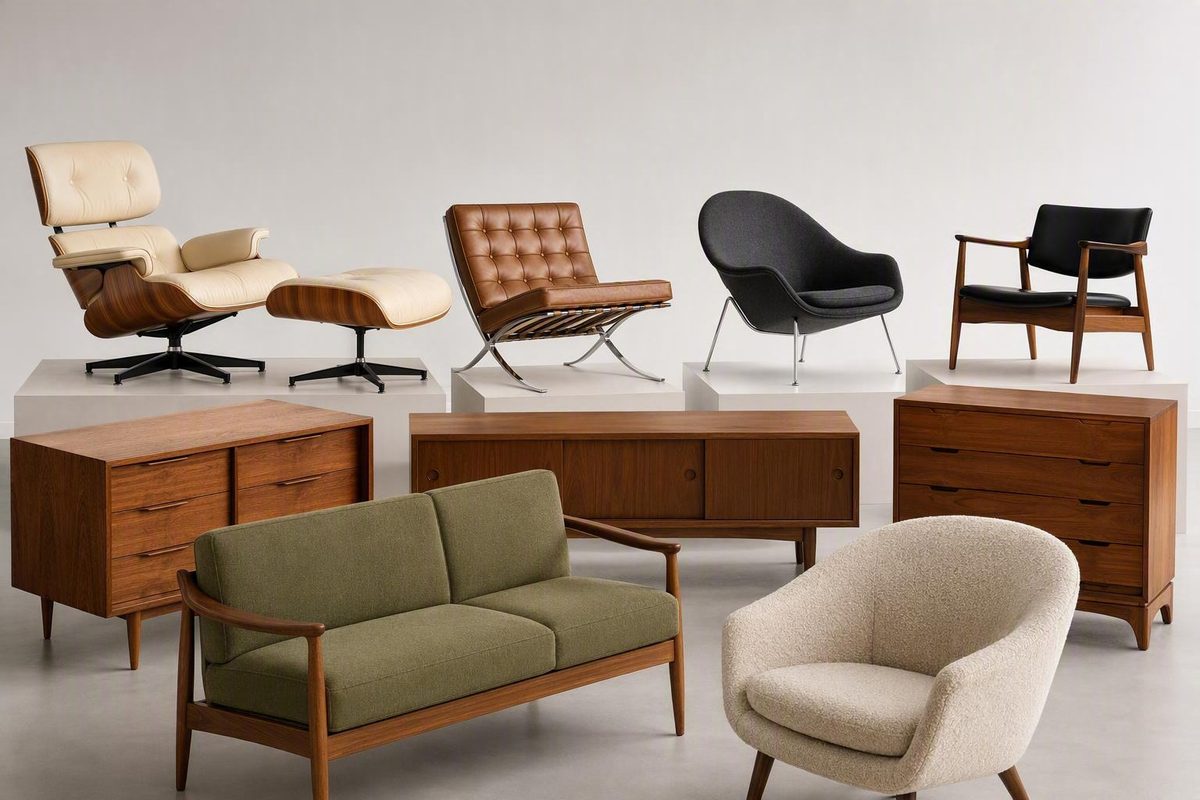
Searching for popular US mid-century modern furniture manufacturers quickly produces rankings, dealer lists, and shopping guides. What it does not produce is a consistent historical dataset showing which companies led in sales, production volume, market share, public recognition, or present-day demand.
A definitive top-ten ranking would therefore be misleading. “Popular” might mean historically influential, prestigious among collectors, commonly found in secondhand shops, widely distributed during the postwar era, or still familiar because selected designs remain on the market. Those measures can identify different manufacturers.
A more useful approach is to treat the field as a research map. Herman Miller and Knoll anchor the canonical design story in the available coverage. Dunbar, Thayer Coggin, and Craft Associates are closely associated with defining designers. Lane, Drexel, and Broyhill provide productive routes into vintage case goods. Heywood-Wakefield, Bassett, United Furniture, Hooker, American of Martinsville, and Kent Coffey broaden the search beyond the most familiar names.
The goal is not simply to recognize a style. It is to move from appearance to probable maker, from maker to collection or model, and from attribution to documented verification.
What “Popular” Means in This Guide
This guide covers U.S.-associated manufacturers that produced furniture connected to the original postwar mid-century modern period, approximately 1945 through the late 1960s or early 1970s. Historical boundaries vary, and the dates of individual designs and production runs must be established separately (Journal of Antiques and Collectibles).
The available sources do not contain comparable sales records, production totals, market shares, consumer surveys, search-demand figures, or completed-transaction data. Several are dealer, retailer, or shopping publications with commercial interests. Some also mix historical manufacturers with contemporary sellers.
This guide consequently uses five transparent proxies:
- Recurrence across multiple sources. A name appearing repeatedly is more defensible as broadly recognized than one found in a single commercial list.
- Historical design influence. Some manufacturers helped connect new materials, industrial processes, and influential designers with American homes and workplaces.
- Collector recognition. Certain makers are familiar because their labels, models, designers, or collections are comparatively well documented.
- Identifiable associations. Manufacturer-designer and manufacturer-collection pairings make research more precise.
- Visibility in the vintage market. Some brands are frequent research targets because their dressers, dining sets, cabinets, chairs, and bedroom furniture continue to circulate.
These proxies measure different things. A prestigious, design-led manufacturer may be less common at an estate sale than a company that produced broad bedroom or dining collections. Conversely, a frequently encountered dresser label does not necessarily indicate the same historical influence as an experimental molded chair.
The manufacturers are therefore organized into unnumbered groups:
- canonical design leaders;
- design-led specialists;
- widely recognized vintage case-goods makers;
- additional American names worth researching.
The categories are descriptive, not hierarchical. Their order does not represent sales, quality, rarity, value, or market share.
It is also important to distinguish manufacturers from adjacent entities. Charles and Ray Eames, Florence Knoll, Edward Wormley, Milo Baughman, Adrian Pearsall, Paul McCobb, and Vladimir Kagan are designers. Their names may be more familiar than those of the companies that produced particular pieces, but that does not make them manufacturing companies.
A retailer or distributor is not automatically a manufacturer, and a product line is not a company. Contemporary businesses serving U.S. customers do not become original American mid-century manufacturers merely by selling furniture with tapered legs, low profiles, or walnut-colored finishes. One broad dealer directory of mid-century makers, for example, includes U.S. and foreign manufacturers alongside retailers and companies associated with products beyond furniture.
Repeated inclusion establishes recognition across the available coverage. It does not prove that one company was objectively more popular than another.
The Features That Connect These Makers to Mid-Century Modern Design
Mid-century modern is both a historical period and a design language. In furniture, recurring characteristics include:
- clean, legible lines;
- restrained ornament;
- practical function;
- low or human-scale proportions;
- organic curves or controlled geometric forms;
- visual lightness;
- furniture suited to modern domestic and workplace settings.
These characteristics do not require every piece to look alike. A molded shell chair, rectilinear walnut credenza, wire chair, and sculptural lounge seat may all belong to the movement while using different materials and production methods.
Materials were similarly varied. Walnut, teak, oak, maple, and rosewood appeared alongside molded plywood, fiberglass, aluminum, chrome, and plastic. Manufacturers could emphasize natural grain, expose a metal frame, or use industrial processes to produce complex organic forms.
That mixture matters because mid-century modern should not be reduced to “warm wood plus tapered legs.” The movement combined craft knowledge with industrial production. Herman Miller’s account of the style highlights functional simplicity, organic forms, clean lines, and the combination of natural and industrial materials, including walnut, oak, molded fiberglass, and plastic (Herman Miller).
Not every vintage object is mid-century modern. A piece made during the 1950s may follow Colonial Revival, traditional European, or another historical style. A manufacturer’s activity during the period does not make its entire catalog modernist.
The reverse problem is equally common. Contemporary furniture can closely resemble period work. Tapered legs, rounded drawer fronts, low cabinets, molded seats, and walnut-toned veneers remain widely used. Those features may justify describing an object as mid-century-inspired, but they cannot identify its manufacturer or establish when it was made.
Visual analysis is a starting point. Attribution requires evidence connecting an object to a maker, collection or model, and production period.
The Consensus List at a Glance
Broyhill is also especially useful for vintage case-goods research. Additional manufacturers merit investigation where labels or collection characteristics point in their direction.
The table is not ranked. Its final column describes the most practical research context supported by the available evidence; it does not confirm the present ownership, licensing, factory location, or production status of every design.
| Manufacturer | Useful designer associations | Representative products or collections | Broad specialty | Likely research market |
|---|---|---|---|---|
| Herman Miller | Charles and Ray Eames, George Nelson, Isamu Noguchi | Eames Lounge Chair and Ottoman, Noguchi Table, Nelson Platform Bench | Seating, tables, storage, office and residential furniture | Vintage examples and selected designs offered in later production; verify each model |
| Knoll | Florence Knoll, Eero Saarinen, Harry Bertoia | Saarinen, Bertoia, and Florence Knoll designs | Seating, tables, storage, office and residential furniture | Vintage examples and later editions; verify current authorization by model |
| Dunbar | Edward Wormley | Wormley-associated seating, tables, and cabinets | Design-led residential furniture | Primarily vintage research |
| Thayer Coggin | Milo Baughman | Baughman-associated seating and case pieces | Modern seating and residential furniture | Vintage research; check current model information directly |
| Craft Associates | Adrian Pearsall | Sculptural walnut seating and tables | Sculptural residential furniture | Primarily vintage |
| Lane | Associations vary by collection | Perception, First Edition, Staccato, Tuxedo | Chests, storage, dining and bedroom case goods | Predominantly vintage |
| Drexel | Kipp Stewart for Declaration in collector coverage | Declaration | Dining, bedroom, storage, and other case goods | Predominantly vintage for period collections |
| Broyhill | Collection research is usually more useful than a single designer name | Brasilia, Premier Sculptra | Bedroom, dining, and storage furniture | Predominantly vintage |
| Heywood-Wakefield | Varies by period and collection | Blonde maple furniture; Champagne and Wheat finish terms | Bedroom, dining, seating, and case goods | Vintage |
| Bassett | Varies by collection | Mayan | Bedroom, dining, and storage furniture | Vintage for relevant lines |
| United Furniture | Requires collection-level research | Mid-century lines reported in secondary coverage | Production furniture and case goods | Vintage |
| Hooker | Collection-level research | Mainline by Hooker | Bedroom, dining, and storage furniture | Vintage for relevant lines |
| American of Martinsville | Varies by line | Model or collection identification required | Hospitality and residential case goods | Vintage |
| Kent Coffey | Collection-level research | Perspecta, Forum | Bedroom, dining, and storage furniture | Vintage |
Herman Miller and Knoll are the canonical design leaders in this framework. Dunbar, Thayer Coggin, and Craft Associates form a specialist group because the available coverage repeatedly connects them with Edward Wormley, Milo Baughman, and Adrian Pearsall. Lane, Drexel, and Broyhill are particularly actionable for shoppers examining dressers, credenzas, dining furniture, and bedroom sets.
Commercial rankings should still be read critically. One retailer-published comparison includes historical manufacturers, discontinued names, and contemporary sellers in the same list while identifying many of the manufacturers above as notable (SICOTAS). That recurrence is useful evidence of recognition, but the ranking and promotional judgments do not establish objective market leadership.
Canonical Design Leaders: Herman Miller and Knoll
Herman Miller and Knoll are the clearest recurring names across the available coverage. That does not make either one statistically “most popular.” It means that both repeatedly appear at the center of accounts of American mid-century furniture and are associated with recognizable designers and models.
Herman Miller
Herman Miller is strongly associated with Charles and Ray Eames, George Nelson, and Isamu Noguchi. The company also identifies Alexander Girard and Eero Saarinen among the designers connected to its broader mid-century history.
Those relationships are more useful than a generic brand attribution. A buyer researching a chair, table, bench, or storage piece should ask which designer, model, materials, and production version are involved.
Two model-level dates provide useful reference points: Herman Miller dates the Noguchi Table to 1948 and the Eames Lounge Chair and Ottoman to 1956 (Herman Miller). The dates identify the designs’ historical introductions; they do not prove that an example offered for sale was manufactured in those years.
The George Nelson Platform Bench is another recognized reference point. A collector guide dates its introduction to 1946 (Journal of Antiques and Collectibles).
These distinctions matter because a design can outlive its original period. A later example may be properly marked and legitimately produced while still not being a mid-century-period object. “Herman Miller chair” is therefore incomplete information: the phrase could refer to different designers, models, generations, materials, and specifications.
Knoll
Knoll is similarly associated with a network of designers rather than one house style. Florence Knoll, Eero Saarinen, and Harry Bertoia are the most consistently recurring names in the supplied coverage. One secondary overview also connects Knoll with Marcel Breuer and Ludwig Mies van der Rohe.
The productive research question is not merely, “Does this look like Knoll?” It is, “Which documented Knoll design does this resemble, who designed it, and do the dimensions, materials, construction, and markings agree?”
A visually similar pedestal table or wire chair, however, could be a later authorized example, an unlicensed reproduction, or a contemporary object borrowing a familiar silhouette.
A general thrift-shopping overview connects Herman Miller and Knoll with several of these designers, but it also demonstrates why broad editorial histories should be checked against model-specific documentation before being used to authenticate an object (House Digest).
For either manufacturer, separate three questions:
- Is the design attribution correct?
- Was the object made or authorized by the identified manufacturer?
- When was this particular example produced?
A positive answer to the first two questions does not make an object a period original. Conversely, resemblance to a famous design does not establish authorization.
Design-Led Specialists: Dunbar, Thayer Coggin, and Craft Associates
Some American manufacturers are especially productive research targets because their mid-century identities are closely connected with defining designers.
Dunbar and Edward Wormley
Dunbar recurs in collector and commercial coverage through its association with Edward Wormley. The Sweet Modern maker directory identifies Dunbar with Berne, Indiana.
That pairing makes a search for “Edward Wormley Dunbar sofa” or “Wormley Dunbar cabinet” more useful than a generic search for a mid-century sofa or walnut cabinet. It can lead to model-specific listings, catalog references, dimensions, and documented construction details.
The association must still be tested one object at a time. A seller’s attribution to Wormley does not become correct merely because a piece resembles documented Dunbar furniture.
Thayer Coggin and Milo Baughman
Thayer Coggin is repeatedly associated with Milo Baughman. Commercial coverage connects the company with North Carolina and with modern seating from the post-1950s era.
Baughman’s name is often more efficient than a broad style label when researching low-profile sofas, lounge seating, or geometric upholstered furniture. Even then, the name is only the beginning of the inquiry. A buyer still needs model information, measurements, materials, manufacturer markings, and production evidence.
Current-looking condition does not necessarily mean recent manufacture, just as an established design name does not prove that an object was made during the original mid-century decades. Upholstery and foam may also have been replaced long after the frame was produced.
Craft Associates and Adrian Pearsall
Craft Associates is strongly associated with its founder and designer Adrian Pearsall, particularly with sculptural walnut furniture. Pearsall was the designer and founder; Craft Associates was the company. Keeping those roles distinct helps clarify who designed an object and which business produced it.
The Sweet Modern directory reports that Pearsall created the original Craft Associates company in 1952 in Wilkes-Barre, Pennsylvania, and that Lane purchased it in 1968 (Sweet Modern). These are directory-reported dates rather than independently corroborated archival findings, so they should not by themselves determine the production year of an individual piece.
For all three manufacturers, paired searches are the practical advantage:
- Dunbar + Edward Wormley
- Thayer Coggin + Milo Baughman
- Craft Associates + Adrian Pearsall
Add the furniture type, suspected model, dimensions, or exact label wording when available. This is much more precise than searching for “vintage sculptural walnut chair,” which can return period furniture, later production, mistaken attributions, and new pieces sharing only superficial characteristics.
Widely Recognized Vintage Case-Goods Makers: Lane, Drexel, and Broyhill
Calling them production-furniture makers is not a judgment about quality. It describes a different route into mid-century furniture.
Lane
House Digest traces Lane to the Standard Red Cedar Chest Company in 1912 and describes its later expansion into furniture beyond cedar chests (House Digest). Useful collection-level search terms found across the supplied shopping and collector coverage include:
- Perception
- First Edition
- Staccato
- Tuxedo
Lane illustrates why a manufacturer name is only the first step. A Lane stamp may establish a corporate connection, but the company operated across multiple decades and styles. A traditional chest and a modernist credenza may bear the same manufacturer name without belonging to the same movement or production period.
When researching Lane, compare the suspected collection with documented case profiles, drawer arrangements, bases, pulls, veneers, and dimensions. Do not assign a piece to a named line solely because its general appearance is similar.
Drexel
The Sweet Modern directory reports that Drexel Furniture Company was created in Drexel, North Carolina, in 1903. Its long history makes broad attribution especially risky: the Drexel name alone does not mean that a piece is mid-century modern.
Declaration is the central collection-level search term in the available collector coverage, which associates the line with Kipp Stewart. A productive search therefore combines maker, collection, and designer: “Drexel Declaration Kipp Stewart.”
Compare an object’s dimensions, drawer configuration, pulls, base, veneers, and construction with documented examples. A streamlined Drexel dresser does not automatically belong to Declaration.
Broyhill
The available maker directory associates Broyhill with Lenoir, North Carolina. Two collection names recur in commercial guides:
- Brasilia
- Premier Sculptra
Not every cabinet with an arched motif or dark finish belongs to the collection. Replacement hardware, refinishing, and inaccurate seller titles can make identification more difficult.
A vintage dealer’s overview identifies Lane Staccato and First Edition, Drexel Declaration with Kipp Stewart, and Broyhill Brasilia among its collector search terms (Mod City Madness). Its rankings and price commentary are commercial opinions, not completed-sale evidence.
For Lane, Drexel, and Broyhill, the most useful research sequence is usually:
- manufacturer;
- collection or line;
- model or furniture type;
- probable production period;
- documented dimensions and materials;
- condition, completeness, and alterations.
That sequence is more reliable than buying on the strength of a brand name alone.
More American Names Worth Researching
The following manufacturers appear in collector, dealer, or shopping coverage but have thinner or less consistent support than the primary group. They are research leads, not the lower half of a ranking.
Heywood-Wakefield
Heywood-Wakefield is associated in collector coverage with blonde maple furniture and the finish names Champagne and Wheat. These terms can help narrow a search, but color alone is not enough to identify a finish or authenticate a piece.
Furniture can be stripped, bleached, stained, painted, or refinished. Compare the object’s form, dimensions, mark, wood, construction, and surface with documented examples before assigning a named finish.
Bassett
For Bassett, Mayan is a useful collection-level term found in collector coverage. As with Lane and Drexel, the company name covers more than one style and period.
Search the maker and collection together, then add the furniture type. A listing described as “Mayan style” may indicate visual resemblance rather than documented membership in the collection.
United Furniture
House Digest reports that United Furniture Corporation was founded in Lexington, North Carolina, in 1905 and produced mid-century lines during the 1950s and 1960s. Because this chronology comes from general shopping coverage rather than an archival company history, it should be independently confirmed before being used to date a particular object.
A United Furniture label can still provide a starting point. The next tasks are identifying a line, narrowing the production period, and finding a catalog or model match.
Hooker
Mainline by Hooker is the principal collection term in the supplied coverage. The same source associates Hooker with Martinsville, Virginia.
Searching for “Mainline by Hooker” is more useful than searching broadly for vintage Hooker furniture, which can encompass unrelated styles and periods. Exact label wording may help distinguish an actual line reference from a generic marketplace description.
American of Martinsville
American of Martinsville belongs in the broader history of the Martinsville–Henry County furniture industry. The available evidence supports that regional association more clearly than it supports a detailed corporate chronology.
A label bearing the name should prompt collection and model research, not an automatic conclusion that the item is modernist.
Kent Coffey
For Kent Coffey, useful collection names include:
- Perspecta
- Forum
These terms come from commercial collector coverage and should be treated as search leads. Compare case profiles, doors, bases, drawer layouts, hardware, labels, and catalog documentation before assigning a piece to either collection.
A brief note on Mengel
Mengel appears in thrift-shopping coverage, but the supplied profile is truncated before it establishes enough furniture history for a substantive account. Treat the name as a prompt for further research rather than relying on an incomplete summary.
More broadly, inclusion in a dealer directory or shopping article does not prove that a company was nationally prominent, that every product was made in the United States, or that a particular object belongs to the original mid-century period. Such lists are most useful for generating names and collection terms to test against stronger records.
How to Research an Authentic Piece Before Buying
The following process is preliminary screening, not a substitute for professional authentication. Before examining labels or construction, define which type of object you are trying to identify:
- Period original: an example produced during the design’s original mid-century production period.
- Later authorized or licensed production: a legitimate later example produced or sold under the relevant rights or authorization.
- Unlicensed reproduction: a copy of a recognized design made without the relevant authorization.
- Generic mid-century-inspired furniture: a later piece that borrows the style without claiming to be a specific historical model.
These categories concern historical and production status. They do not determine whether an object is attractive, comfortable, durable, or appropriate for a home. A later authorized edition may be accurately documented without being a period original. A generic contemporary piece can suit a room without carrying historical attribution.
Start with the mark—but do not stop there
Look for paper or foil labels, branded marks, ink stamps, impressed numbers, tags, patent information, and inspection markings. Common locations include:
- beneath a chair seat;
- under a table;
- inside or beneath drawers;
- on the back of a cabinet;
- behind removable cushions;
- beneath an upholstery dust cover;
- on metal frames or bases.
Photograph the mark before cleaning it. Record its full wording, typography, colors, dimensions, and exact location. Do not rely only on a seller’s transcription or cropped marketplace photograph.
Follow a repeatable verification sequence
1. Identify the probable manufacturer and collection. Begin with the mark, overall form, distinctive construction, and hardware. Form a testable hypothesis rather than a conclusion: “possibly Lane Perception” is more responsible than “rare Lane Perception” before comparison.
2. Compare the mark with dated references. Look for changes in logos, corporate wording, addresses, label materials, and model-number formats.
3. Check dimensions and materials. Measure overall height, width, depth, seat height, tabletop diameter, leg spacing, and relevant component thicknesses. Compare the wood, veneer pattern, metal finish, molded shell, upholstery, or plastic with dependable model references.
4. Inspect hardware and construction. Examine drawer slides, pulls, hinges, fasteners, edge treatments, joinery, glides, bases, mounting points, and internal framing.
5. Review the finish and upholstery. Determine whether the surface appears original, refinished, stripped, painted, or repaired. On upholstered furniture, inspect beneath cushions and in concealed areas for older fabric, tags, changed foam, new webbing, or alterations to the frame.
6. Seek provenance and catalog confirmation. Ask for receipts, dated photographs, estate records, prior ownership information, repair invoices, and correspondence. Historical catalogs, manufacturer archives, museum records, and qualified specialists can provide stronger model-level comparisons.
Search with paired terms
Broad style searches produce too much noise. Combine manufacturer, designer, and collection terms:
- Herman Miller + Eames
- Herman Miller + Noguchi Table
- Dunbar + Edward Wormley
- Craft Associates + Adrian Pearsall
- Thayer Coggin + Milo Baughman
- Broyhill + Brasilia
- Drexel + Declaration
- Lane + Perception
- Hooker + Mainline
- Kent Coffey + Perspecta
Add a model number, furniture type, dimension, or exact label phrase when possible.
Treat visual resemblance as a clue
Warm walnut, tapered legs, low cabinets, sculptural arms, molded shells, and geometric forms appear across numerous manufacturers and remain common in contemporary furniture. None of those traits identifies a maker.
Even close resemblance may not settle the question. Well-known designs have been copied, adapted, reissued, licensed, and loosely interpreted. Compare less conspicuous details: exact dimensions, underside construction, mounting points, seams, edge profiles, hardware, and internal framing.
Document alterations
Record:
- replacement pulls, hinges, feet, glides, or screws;
- stripping, painting, refinishing, or added coatings;
- replacement upholstery, foam, webbing, or dust covers;
- structural repairs;
- veneer patches;
- missing leaves, cushions, shelves, brackets, or connectors;
- components that may come from different production periods.
Avoid blanket conclusions about alterations. Their significance depends on the model, the extent and quality of the work, and how clearly it is documented. The immediate research task is to distinguish original components from later interventions.
Keep contemporary sellers in a separate category
Article, Joybird, Burrow, West Elm, AllModern, POVISON, and SICOTAS appear in commercial guides because they sell contemporary furniture to shoppers interested in mid-century-inspired design. They should not be included in a list of original mid-century-era manufacturers.
One retailer-authored guide, for example, combines historical companies such as Herman Miller, Knoll, Lane, Dunbar, Craft Associates, and Thayer Coggin with contemporary sellers including Article, Joybird, Burrow, and POVISON (POVISON). That may help with style shopping, but it does not establish that the contemporary companies manufactured furniture during the original postwar period.
It does not by itself claim a historical production date, famous designer, or connection with an original manufacturer.
Verify before paying an attribution premium
If a seller’s price depends on an object being a particular designer model, period original, or authorized edition, seek model-level confirmation before buying. Useful evidence may include:
- dated manufacturer catalogs;
- official manufacturer or rights-holder archives;
- museum collection records;
- documented label chronologies;
- patent or design-registration records where relevant;
- qualified specialist examination;
- strong ownership records.
Do not substitute asking prices for completed-sale evidence, and do not treat words such as “rare,” “iconic,” or “investment” as authentication.
The most useful answer to the question of popular U.S. mid-century modern furniture manufacturers is not a speculative countdown. It is a structured research map. Herman Miller and Knoll anchor the canonical design story. Dunbar, Thayer Coggin, and Craft Associates connect major designers with specialist production. Lane, Drexel, and Broyhill provide collection-level paths into American case goods. Heywood-Wakefield, Bassett, United Furniture, Hooker, American of Martinsville, and Kent Coffey widen the field.
Move from style to maker, from maker to collection or model, and from attribution to documented verification. That sequence is more dependable than a brand ranking—and more useful when the object is in front of you.
Frequently Asked Questions
What are the most widely recognized U.S. mid-century modern furniture manufacturers?
The strongest recurring group in the available coverage includes Herman Miller, Knoll, Lane, Drexel, Dunbar, Craft Associates, and Thayer Coggin. Broyhill is also an especially useful name for vintage case-goods research.
These manufacturers occupy different parts of the field. Herman Miller and Knoll are canonical design leaders; Dunbar, Thayer Coggin, and Craft Associates are closely connected with defining designers; Lane, Drexel, and Broyhill are frequent research targets for storage, dining, and bedroom furniture. This is a recognition-based grouping, not a sales or market-share ranking.
Are Herman Miller and Knoll manufacturers or designers?
Herman Miller and Knoll are manufacturer brands, not individual designers. Their historical importance is closely tied to designer collaborations.
Herman Miller is associated with Charles and Ray Eames, George Nelson, and Isamu Noguchi, among others. Knoll is associated with Florence Knoll, Eero Saarinen, and Harry Bertoia, with additional designer relationships across its history.
When researching an object, identify both sides of the relationship. “Eames” alone does not establish who manufactured a chair, while “Herman Miller” alone does not identify its designer or model.
Which vintage collection names should buyers search for?
Useful collection and line terms include:
- Lane: Perception, First Edition, Staccato, Tuxedo
- Drexel: Declaration
- Broyhill: Brasilia, Premier Sculptra
- Hooker: Mainline by Hooker
- Bassett: Mayan
- Kent Coffey: Perspecta, Forum
Collector coverage also connects Heywood-Wakefield with blonde maple furniture and the finish names Champagne and Wheat. These terms are research leads, not authentication. Compare any suspected piece with documented examples, catalogs, dimensions, construction, and marks.
Where are manufacturer labels usually found on mid-century furniture?
Common locations include beneath chairs and tables, inside or under drawers, on cabinet backs, behind cushions, beneath upholstery dust covers, and on metal frames or bases.
Look for labels, stamps, branded marks, model numbers, patent information, and inspection tags. Photograph any mark before cleaning it. A label can support a manufacturer attribution, but it does not independently prove the collection, designer, production date, or originality of every component.
Are Article, Joybird, Burrow, POVISON, and SICOTAS original mid-century manufacturers?
They should not be classified as original mid-century-era American manufacturers on the available evidence. Commercial guides present them as contemporary sellers or brands offering furniture influenced by mid-century design.
Their products may use clean lines, low proportions, warm wood tones, geometric forms, or tapered legs, but those characteristics describe a style rather than a historical origin. Keep contemporary sellers separate from companies documented in connection with the original postwar period, and verify any historical-design or licensing claim at the individual model level.