
Vintage Art Deco Bedroom Furniture: Identify a Period Suite
Assess Art Deco beds, wardrobes and dressing tables through documented models, maker evidence, matching details, condition and modern mattress fit.
The dressing table made for author Dodie Smith in 1926–27 had slender legs, ebony veneer, shagreen-covered surfaces and ivory handles. The V&A identifies Heal’s as its maker and probably J.F. Johnson as its designer—a useful distinction between a documented manufacturer and a less certain design attribution. The museum’s record also places the table within a larger bedroom set.
That is a good starting point for assessing vintage Art Deco bedroom furniture: look beyond the silhouette. A bed, wardrobe or vanity needs evidence for its date, maker and relationship to the other pieces, not merely a convincing Deco appearance.
Recognize the design, then test the date
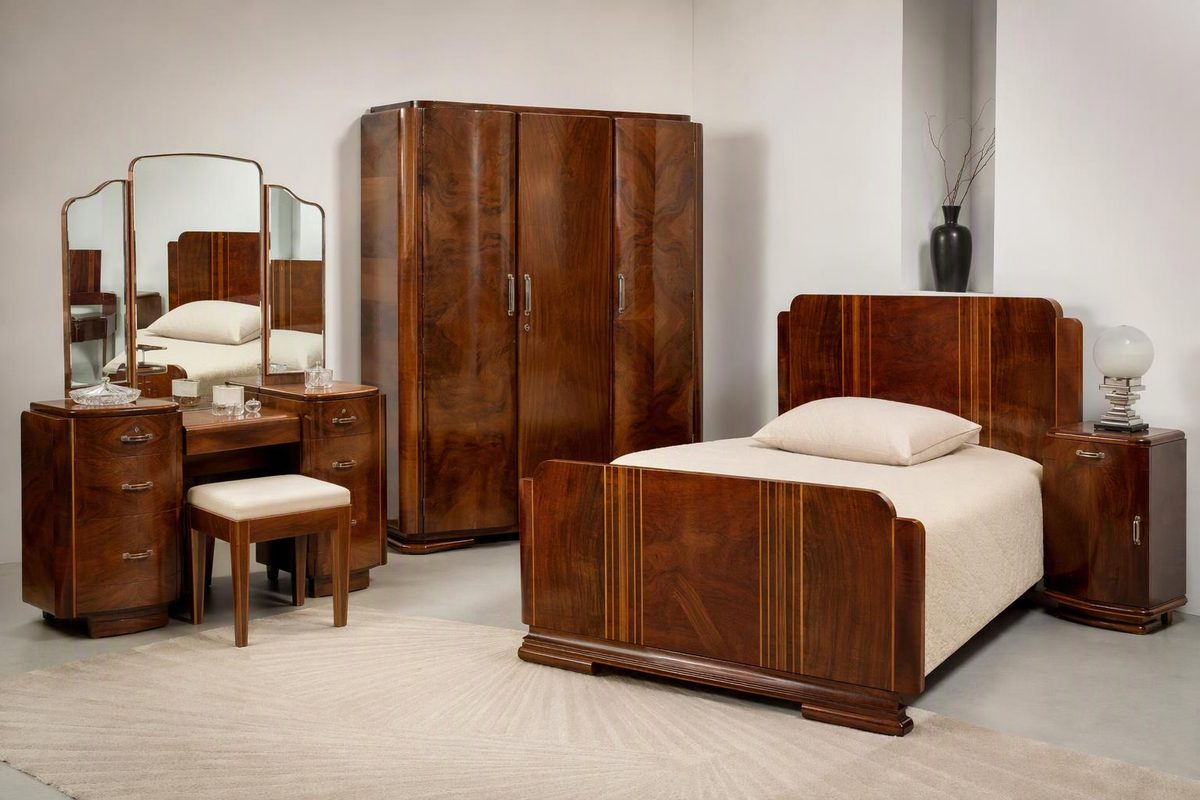
When examining a listing, look at how the whole piece is organized: the relationship between mirror and drawers, the treatment of corners, the placement of veneer and the shape of the base. A circular mirror or geometric handle is a clue to design, not proof of manufacture in the 1920s or 1930s.
Documented bedroom furniture shows how varied the possibilities are:
- Rich veneers and fine inlay. The V&A’s Ruhlmann dressing table, dated about 1919–23, has an oak carcass veneered with padouk and purpleheart, ivory-and-ebony inlay, and silvered bronze fittings. Its circular mirror pivots above the top. Veneer is part of this luxury construction, not evidence that a piece is cheap or inauthentic. V&A object record
- Sculptural, asymmetrical storage. Bonhams catalogued a Betty Joel sycamore dressing table with a circular mirror, graduated shelves on one side, hinged drawers on the other and a swept plinth. Crucially, its reported reverse label names the makers, the Token Works location and June 1937. Bonhams catalogue
- Industrial materials. Brooklyn Museum’s vanity designed by Norman Bel Geddes and manufactured by Simmons in Chicago dates to 1929–32. Its materials include enameled steel, chrome-plated metal, brass and wood. A period bedroom piece need not be veneered timber. Brooklyn Museum record
The familiar “waterfall” label describes furniture with rounded drops at horizontal edges; it identifies a design feature, not a particular manufacturer. This overview of waterfall furniture places the style in the 1930s and 1940s. Do not turn “waterfall” into an automatic 1930 date or a designer attribution.
Nor does a round mirror establish a pre-war date. The V&A’s Basildon New Period Furniture dressing table has a round mirror and six drawers but was made in 1946–50, using aluminium-clad chipboard. It belongs to a documented post-war bedroom suite. V&A object record
What evidence should a seller supply?
Ask for clear photographs of the back, underside, drawer interiors, labels and any stamped or handwritten numbers. For a dressing table, include the mirror’s reverse and its attachment points; for a bed, include the rails and their connections to both ends.
Read the evidence in this order:
- A documented model match. Compare proportions, dimensions, drawer layout, base construction and hardware with a museum record or period catalogue—not just the general outline.
- Maker evidence in context. A label is useful when its wording and location agree with the furniture and model record. Ask whether it identifies the manufacturer, retailer or designer; those are different claims.
- Provenance tied to the object. An invoice, dated room photograph or previous catalogue entry is stronger when it identifies this piece rather than simply naming a former owner.
- Construction and alterations. Examine drawer joints, back panels, runners, screws and mounting holes together. A dovetail joint cannot, by itself, establish an Art Deco date.
Absence of a mark is not disqualifying: Brooklyn Museum records no signature, inscriptions or marks on its Simmons vanity. But an unmarked lookalike still needs a convincing model comparison or other evidence before it receives the same attribution.
Keep “by,” “attributed to” and “in the style of” separate when recording a seller’s claim. “Art Deco-style” describes appearance without establishing period manufacture. For French designer claims, consult the more detailed guide to French Art Deco furniture.
Is it an original matching suite?
Treat “matching” as a claim to investigate. Pieces from the same model range may match without having been supplied together originally. Compare each component’s:
- base profile, feet and mouldings;
- veneer species and arrangement;
- handles, escutcheons and their mounting positions;
- drawer construction, labels and model numbers.
Allow for different fading and wear: pieces placed beside a window may not retain the same colour as those kept away from light. The Institute of Conservation notes that light changes timber and pigment colours, and recommends comparing exposed surfaces with protected areas. Furniture care guidance
Look particularly closely at paired bedside cabinets. Do their construction and door arrangements agree, or have two similar cabinets been assembled into a pair? On a vanity, do the mirror brackets fit the existing holes without unexplained drilling or adapters? Replacement components do not necessarily make the entire piece later, but they change what can be described as original.
For handles, inspect the reverse of the drawer front for unused holes and altered mounting positions. The guide to Art Deco drawer pulls explains these checks in more detail.
Check condition and bedroom fit before committing
Inspect veneer edges, curved corners and surfaces around mirror supports for lifting, losses or previous repairs. Open every drawer and wardrobe door; ask about sticking, loose joints, missing keys, replaced shelves and repairs to the base. Request close-ups of mirror chips, backing deterioration and damaged fittings rather than relying on a distant room photograph.
For a bed, measure the usable interior, not just the headboard. Confirm the rail spacing, support ledges, slats or platform, and the complete assembled dimensions. A seller’s “double” or “queen” description is not a substitute for checking your actual mattress and support system. Ask whether rails have been lengthened or replaced, and whether the bed dismantles for transport. If joints or supports are loose or damaged, have their suitability for use assessed before putting the bed into service.
Measure a wardrobe’s largest dismantled component against doorways, stair turns and ceiling clearance. Also check usable hanging depth, drawer-opening clearance and whether every connector is present.
Do not make stripping or refinishing the first step. The Institute of Conservation advises minimum intervention and warns that an original finish cannot be replaced; removing it can also affect monetary value. It recommends stable conditions, protection from direct sunlight and caution around loose surface material. For damaged veneer, lacquer or structurally important joints, obtain a furniture conservator’s assessment before agreeing to treatment. Conservation guidance
The useful description is the precise one: a documented period suite, a plausibly period piece with unresolved maker attribution, a restored original with identified replacements, or later Deco-style furniture. Decide which evidence supports the description before deciding whether the furniture suits your room.