
Art Deco Kitchen Furniture: Identify Period Pieces
Identify Art Deco kitchen cabinets, tables and chairs through style, maker records and construction—and distinguish period furniture from later revivals.
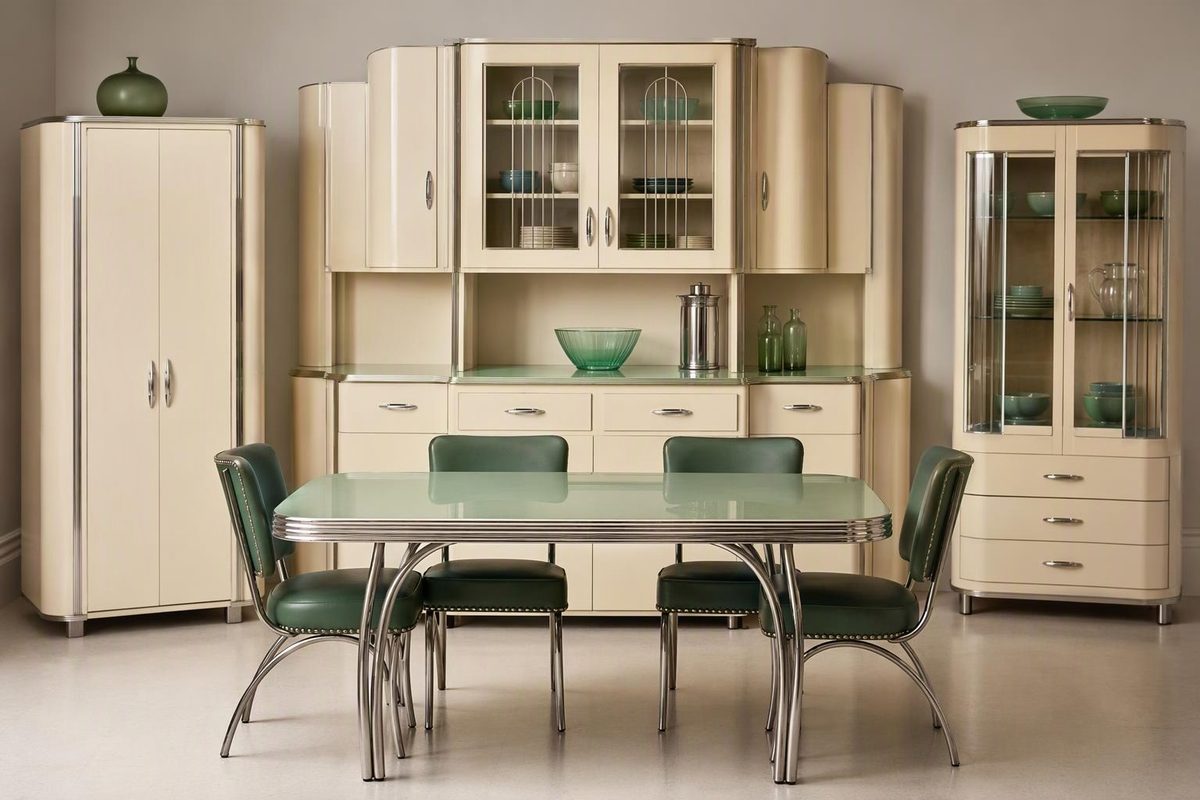
A cream-and-green kitchen cabinet at The Henry Ford has storage for baking supplies and a white porcelain-enamel work surface. The museum dates it to 1915–1930 and describes it as a “Hoosier” style cabinet: a compact workstation intended to make food preparation more orderly. It is useful evidence of an early twentieth-century kitchen—but its date does not, by itself, make it Art Deco. (The Henry Ford)
That distinction matters when buying Art Deco kitchen furniture. Establish three things separately: what the piece was designed to do, whether its design belongs to Art Deco, and when this particular example was manufactured. An old kitchen cupboard can be stylistically traditional; a convincing Deco-style table can be new.
What makes kitchen furniture Art Deco?
Art Deco was internationally prominent in the 1920s and 1930s, ranging from expensive decorative furnishings to affordable manufactured goods. Its vocabulary included geometric stylization and, particularly in American streamlined design, clean lines and strong curves. (SFO Museum)
For a kitchen cabinet, table or chair, look for a coherent combination rather than one decorative detail:
- Geometric organization: stepped profiles, angular panels or repeated bands that shape the whole piece.
- Streamlined form: rounded corners and strong horizontal lines, rather than curves added to an otherwise unrelated design.
- Deliberate surface contrast: reflective metal against painted or wooden surfaces, or patterned veneer used as part of the composition.
- Consistent detailing: feet, door panels, handles and chair backs that share the same design language.
These are comparison cues, not exclusive Art Deco traits. Simple geometry and metal frames also occur in other modern furniture; compare the complete design with documented examples.
Materials help establish context, not age. The V&A describes the rich wood veneers of luxury 1920s furniture and the growing importance of chromed steel, aluminium, coloured glass and plastics in the 1930s. Neither veneer nor shiny metal is an authentication test. (V&A)
A plain cupboard with replacement geometric handles may have acquired a Deco accent without becoming an Art Deco cabinet. Examine the furniture before judging its hardware.
Separate the furniture types
Freestanding kitchen cabinets and dressers
A cabinet combining storage with a preparation surface belongs to the history of kitchen workstations. Flour bins, jar racks and pull-out surfaces can help identify its function, but do not establish its style or maker.
“Hoosier” also needs careful reading. Coppes Commons distinguishes the broad cabinet category from products of the Hoosier Manufacturing Company. Its history museum suggests that accessories were likely purchased from wholesalers supplying several manufacturers, so a familiar flour bin is not sufficient maker evidence. (Coppes Commons)
For British comparisons, the Science Museum Group records an Easiwork kitchen cabinet, made circa 1925–1930, complete with jars, canisters, an icing set, mixer and scales. The entry also gives registered design number 676340, dated 1920. This illustrates a crucial distinction: the date attached to a registered design need not be the manufacture date of the surviving cabinet. (Science Museum Group)
Use these examples to compare function and documentation—not as proof that every similar cabinet is Deco.
Kitchen tables and chairs
For a breakfast set, assess the table and every chair separately. Compare frame profiles, feet, attachment methods and labels before accepting “matching set.” Similar upholstery can disguise chairs from different sources; replacement upholstery can also make a genuine set look unlike its catalogue photograph.
Do not equate a chrome-and-laminate dinette with the 1930s. In a 2016 interview published by Retro Renovation, Acme Chrome’s owner described postwar dinette designs from 1949–1959 that the company reintroduced in the mid-1990s using newer technology and materials. Thus, closely related silhouettes can belong to substantially different manufacturing periods. (Retro Renovation)
For wooden sets, the checks in our guide to Art Deco dining room chairs also apply to kitchen seating.
Fitted cabinets
Built-in cabinetry requires evidence from the room as well as the object. Seek dated plans, installation photographs, invoices or manufacturer catalogues.
Interwar does not automatically mean Deco. Grete Schütte-Lihotzky’s Frankfurt Kitchen, designed in 1926–1927, integrated storage, appliances and work surfaces in a compact, ergonomic scheme for public housing. MoMA presents it as a landmark of modern kitchen design. Its date alone is no reason to classify an unidentified fitted kitchen as Art Deco. (MoMA)
What to ask for before buying
Request photographs of the front, sides, back, underside, cabinet interiors and all marks. For a dresser or workstation, ask for separate views of the upper and lower sections.
Then work through four checks:
- Maker and model. Transcribe labels, stamps and handwritten numbers exactly. Coppes documents front metal tags, rear paper labels and handwritten model or finish information on its cabinets. Compare a combination of details with a dated catalogue; the museum warns that model changes and the use of existing parts make exact dating difficult. (Coppes Commons)
- Alterations. Ask whether handles, tops, glazing, feet, paint or upholstery have been replaced. Extra mounting holes warrant investigation. Our cabinet-pull identification guide explains how hardware evidence fits into the larger assessment.
- Condition. Look for loose joints, damaged veneer, corrosion, chipped work surfaces and poorly operating doors or drawers. Obtain an inspection or repair estimate for problems that photographs cannot resolve.
- Fit. Record overall dimensions, usable work-surface height, chair seat height and clearance beneath the table. Check the delivery route as carefully as the intended position.
Do not strip an unidentified finish simply to reveal the wood beneath. The Canadian Conservation Institute emphasizes that original furniture finishes have historical, aesthetic and financial value. Preserve labels and surface evidence before making restoration decisions. (Canadian Conservation Institute)
Choosing furniture for a kitchen today
For a Deco-inspired kitchen, select a few related forms rather than requiring every item to carry a sunburst or chevron. A compact table with rounded corners, seating with repeated geometric lines and restrained contrasting hardware can establish the direction without pretending to reconstruct a documented period room.
Keep the description precise. Period Art Deco requires support for both style and manufacture date. Later reproduction or reissue describes a newer example of an earlier design, with a reissue indicating renewed production rather than necessarily a copy by another maker. Art Deco-style describes appearance without establishing age; Art Deco-inspired suits a newer design that borrows the visual vocabulary rather than reproducing a specific historical model.
A new piece may be the better choice for daily use. The important distinction is not whether it looks attractive beside an old cabinet, but whether its age, materials and alterations are represented accurately.