
Sontag Building Demolition: What the Los Angeles Plan Would Remove
What the Mirabel proposal would remove from Los Angeles’s 1936 Sontag Building, why its Streamline Moderne design matters, and its preservation status.
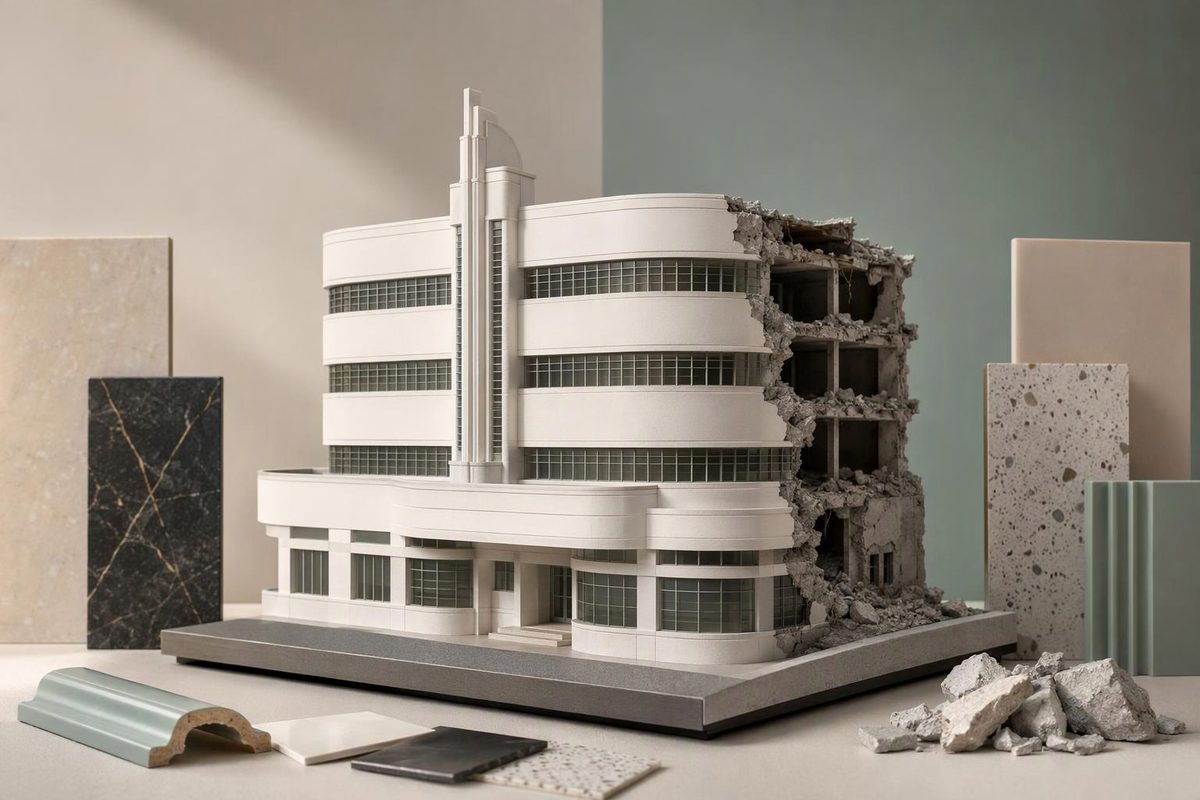
The Mirabel redevelopment proposal for Los Angeles’s Sontag Drug Building at 5401 Wilshire Boulevard calls for retaining its east and south façades while removing the rest of the historic structure. That is the distinction at the heart of the dispute: keeping the building’s recognizable street frontage is not the same as keeping the building itself. The City’s August 2023 initial study describes demolition behind those walls to construct subterranean levels, followed by their incorporation into a new one-story building. City Planning’s initial study
The latest dated update on the Art Deco Society of Los Angeles’s campaign page is August 2026. It announces release of the final environmental impact report and an August 27 hearing, while maintaining the Society’s opposition to demolition. That update describes a redevelopment and preservation dispute—not an announcement that demolition has been completed. ADSLA campaign update
What makes the Sontag Building significant?
Completed in 1936 and designed by Norstrom & Anderson, the building stands at the northwest corner of Wilshire Boulevard and Cloverdale Avenue. It was built as the Miracle Mile branch of Sontag Original Cut-Rate Drug Stores. The project’s 2024 cultural-resources analysis describes it as a flagship location, with an advertised fountain grill seating 100 people and a temperature-controlled interior. Draft EIR, cultural resources, pp. IV.A-17–18
Its precise architectural label is Streamline Moderne. The identification clues are concentrated in its low, horizontal composition: smooth plaster surfaces, rounded corners, continuous projecting bands and fluted details. A square spire and stepped panel rise above the parapet near the corner. These features give a small commercial building an emphatic presence without relying on skyscraper height. Draft EIR, pp. IV.A-15–16
The same cultural-resources analysis notes that the exterior remains substantially intact despite replacement storefronts and doors and the loss of some canopy moldings. The interior is much more altered; it should not be imagined as an untouched 1930s drugstore. ADSLA nevertheless reports surviving features, particularly a curved Streamline staircase with porthole openings. Its 2024 update says character-defining interior features remain, including the staircase. Draft EIR, pp. IV.A-19–20; ADSLA building description and update
What would Mirabel remove—and why?
The City’s August 2023 initial study describes a 42-story mixed-use tower, up to 348 homes, and three subterranean parking levels on the wider site. Those are figures from that project description, not a statement of final approval. The proposed retention concerns the Sontag Building’s south façade facing Wilshire and east façade facing Cloverdale; the remainder would be demolished to allow construction below it. Mirabel initial study
The Los Angeles Conservancy’s October 7, 2024 comment letter supports additional housing and density but challenges the relationship between parking and demolition. It asks for a reduced-parking alternative and argues that less subterranean excavation could allow the Sontag Building to remain whole. This is the Conservancy’s proposed alternative, not an adopted redesign or an independently established engineering solution. Conservancy comment letter
ADSLA likewise requested consideration of a tunneling alternative that would avoid demolition and reconstruction. Both organizations frame the issue as how to integrate historic architecture into new development, rather than simply whether new housing should be built. ADSLA’s 2024 update
Historic recognition is not the same as local landmark designation
The Miracle Mile Historic District was formally determined eligible for the National Register in 1983, with the Sontag Building identified as a contributor. The 2024 Draft EIR records those district contributors as listed in the California Register. Draft EIR, pp. IV.A-23–24
A separate application sought Los Angeles Historic-Cultural Monument designation for Sontag. The Cultural Heritage Commission agreed to consider it in February 2021, but the application was terminated. The Draft EIR states that this occurred because the application was received after the redevelopment project’s deemed-complete date, citing Government Code Section 65913.10(a). It also makes clear that the site is outside the separate Miracle Mile Historic Preservation Overlay Zone. Draft EIR, pp. IV.A-24–25
For anyone following the case, the official identifier is ENV-2019-3937-EIR, under the Mirabel Transit Priority Project. The City Planning project page is the reference point for environmental documents. When reading subsequent decisions, the important question is not merely whether they call Sontag “preserved,” but exactly which original walls, roof, interior features and structural fabric they retain.