
Tariffs on Antiques From Europe: 2026 Cost Guide
A $10,000 French antique can draw about $3,000 in U.S. duties in 2026. See why Chapter 97’s exemption does not restore 2024 treatment.
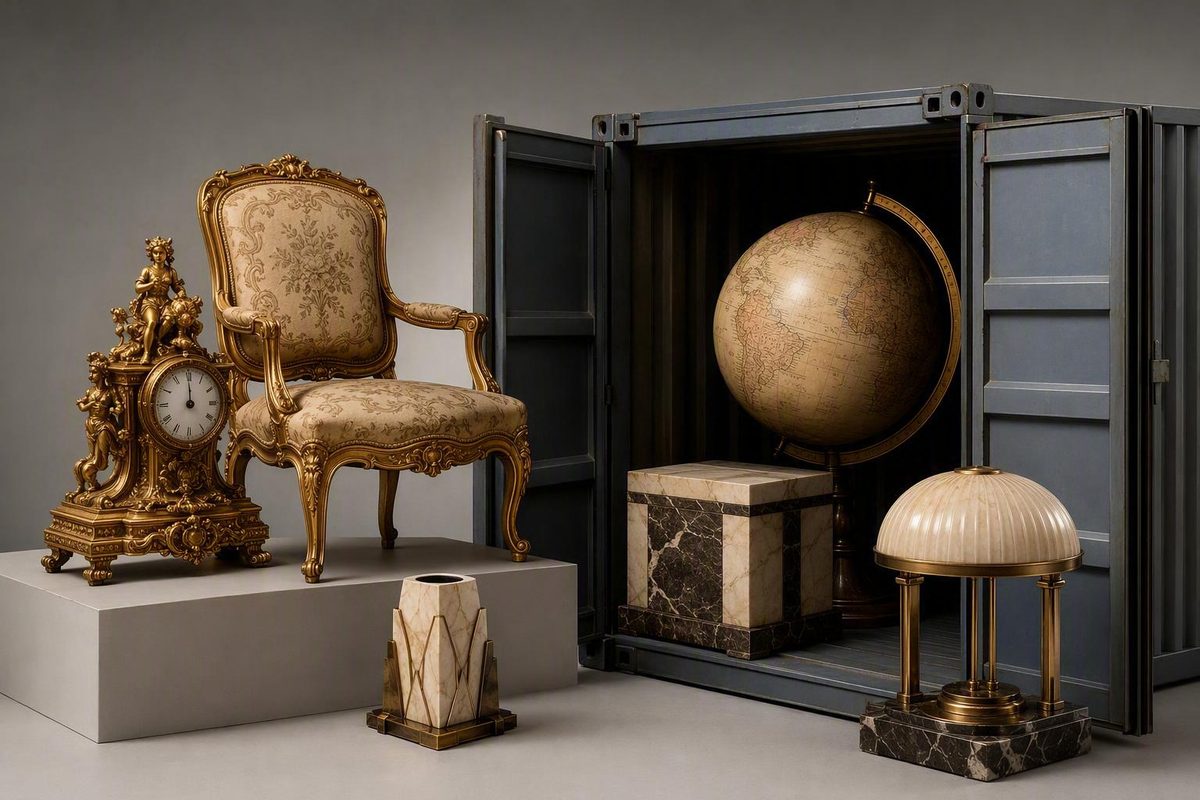
A documented 1925 French cabinet bought for $10,000 can incur roughly $3,000 in U.S. duties in 2026, lifting its cost to about $13,000 before freight, brokerage, insurance, and delivery. A comparable 1930s cabinet faces approximately the same country-tariff layer. The 100-year threshold still affects classification and value, but it no longer provides the broad border-cost advantage collectors associate with duty-free antiques.
That estimate rests on 2025 tariff reporting that places the current stack at approximately 30% for EU-origin antiques and 20% for UK-origin antiques. Exact treatment still depends on the entry date, country of origin, supported age, HTS classification, and governing tariff notices. The supplied materials do not include the operative Federal Register schedule, so a customs professional should verify the rate and exclusions before shipment.
The July 2026 Chapter 97 exemption does not reverse this result. It excludes qualifying Chapter 97 goods from the new Section 301 layer announced on July 23, according to Everglory Logistics’ account of the measure. It does not remove the IEEPA-based tariffs already reported as applying to antiques under heading 9706.
Enter your purchase price, origin, age band, and object type; the calculator shows whether 2024 or 2026 treatment wins.
European Antique Duty Comparison
This estimator compares the reported 2026 tariff stack with pre-2025 treatment. It calculates only rates supported by the article; missing product duties remain marked —.
Rate Evidence by Origin and Category
The highlighted row follows your selections. For later goods, the ordinary furniture, glassware, ceramic, or jewelry duty is additional where applicable but is not supplied by the reviewed sources.
| Origin | Category | Pre-1926 Today | 1926+ Today |
|---|---|---|---|
| EU | Furniture | ~30% | ≥~30% + ordinary rate — |
| EU | Glass / ceramic | ~30% if 9706 | ≥~30% + ordinary rate — |
| EU | Jewelry | —; Chapter 71 may apply | — |
| UK | Furniture | ~20% | ≥~20% + ordinary rate — |
| UK | Glass / ceramic | ~20% if 9706 | ≥~20% + ordinary rate — |
| UK | Jewelry | —; Chapter 71 may apply | — |
| Other | Furniture | — | — |
| Other | Glass / ceramic | — | — |
| Other | Jewelry | — | — |
The calculator excludes freight, packing, insurance, brokerage, processing, examination, storage, and delivery. It is a planning estimate, not a customs determination.
Sources: CBP antiques guidance; Cultural Property News on the reported 2025 IEEPA tariff stack; USTR’s July 23, 2026 announcement; Everglory Logistics on the reported Chapter 97 exclusion. Rates marked ~ are approximate; unknown rates are —.
The Traditional Duty-Free Rule Is Only Partly Wrong
The received wisdom has a sound legal foundation. An object more than 100 years old may qualify as an antique under HTS heading 9706, provided its age is supported and that heading correctly describes it. CBP’s antiques and artwork guidance identifies the age test and the ordinary duty-free treatment historically associated with qualifying antiques.
That rule explains why collectors have long treated a documented 1925 commode differently from a 1932 example. In 2024, a qualifying 9706 antique could have a 0% ordinary customs-duty rate, while the younger cabinet would be classified according to its function and materials.
The mistake is treating that ordinary 0% rate as the entire 2026 tariff calculation. Separate trade programs can add duties even when the normal HTS rate is zero. Cultural Property News’ analysis of the 2025 changes reported an approximately 10% base layer plus country schedules, producing a total near 30% for EU-origin antiques and 20% for UK-origin antiques.
The old rule therefore remains relevant to classification, documentation, and any ordinary product duty avoided by using 9706. It does not restore the 2024 total duty bill.
A $10,000 French Cabinet Shows the Change
Assume a cabinet was made in France in 1925, costs $10,000, enters the United States in 2026, and has adequate evidence supporting classification under 9706.
| Cost Element | 2024 | 2026 Estimate |
|---|---|---|
| Purchase price | $10,000 | $10,000 |
| Estimated duty | $0 | ~$3,000 |
| Subtotal before logistics | $10,000 | ~$13,000 |
The 2026 estimate applies the reported approximate 30% EU tariff stack to the entered value. It excludes packing, freight, insurance, brokerage, customs processing, examination, storage, and final delivery because the supplied sources provide no reliable figures for those charges.
Now replace the 1925 cabinet with a French cabinet made in 1932. It no longer qualifies for 9706 and would ordinarily be classified as furniture according to its materials and construction. The current EU tariff layer remains approximately 30%, while the ordinary product-specific rate must be checked under the applicable furniture provision.
The sources do not supply that ordinary furniture rate, so an exact duty total for the 1932 cabinet cannot responsibly be stated. The defensible comparison is that it faces at least the same approximate $3,000 country-tariff layer, plus any ordinary duty its product classification carries. The older cabinet may still save that ordinary product duty, but it does not escape the much larger tariff stack merely by crossing the 100-year line.
That is why paying a higher price solely because a dealer says an object will “ship duty-free as an antique” is no longer justified. Pay a dating premium for period authenticity, rarity, maker, provenance, condition, or historical importance—not for an assumed 30-percentage-point customs saving.
The July 2026 Exemption Does Not Restore 2024 Treatment
On July 23, 2026, USTR announced a Section 301 action covering products from 60 trading partners, effective July 24. Its release states that certain non-exempt EU products would face rates of 10% or 12.5%, net of the most-favored-nation rate, while certain UK products would face 10%. USTR directs importers to the governing notice for product-level coverage.
Everglory reports that qualifying goods in Chapter 97—including covered art, antiques, and collectors’ pieces—were excluded from that new action. The distinction is temporal and program-specific: Chapter 97 received protection from the July 2026 Section 301 layer, not a repeal of every tariff imposed since 2025.
The exemption also does not place an object into Chapter 97. A seller cannot turn a 1932 cabinet into a 9706 antique by describing it as “period Art Deco,” nor can a functional lamp automatically be entered as fine art. Classification still follows the object’s supported age and objective characteristics.
The public USTR release does not identify heading 9706 in its text, and the operative schedule was not included in the reviewed materials. Treat the reported Chapter 97 exclusion as requiring verification against the current HTSUS and Federal Register instructions.
Fine Art Now Has a Different Tariff Position
The 2025 reporting draws a consequential distinction between original fine art and functional antiques. Original paintings, drawings, sculptures, hand-pulled prints, and lithographs under headings 9701–9705 reportedly retained protection through the informational-materials carve-out. Functional antiques under 9706 did not receive the same treatment from the earlier tariff stack.
The result is an inverted version of the old assumption: an eligible original painting may enter without the tariff applied to a century-old commode.
That does not make every decorative object fine art. A bronze figure incorporated into a lamp remains a classification question. So does a porcelain vase converted into lighting, a carved architectural panel, or a clock assembled from a period case and later movement. The claimed provision must describe the merchandise as imported.
Old jewelry can present a separate problem because CBP notes that pearls and precious or semiprecious stones may require classification in Chapter 71 rather than 9706. The available sources do not provide a universal rate for antique jewelry, so neither the article nor calculator assigns one.
Proof of Age Still Matters, but for a Narrower Reason
In 2026, heading 9706 generally requires the object to be more than 100 years old on its actual import date. The current provision should be checked directly in the HTSUS search for heading 9706.
A securely documented 1925 object may pass the age screen when imported in 2026. A catalog description of “circa 1925” is less certain because the implied range may include a later year. A 1930s object remains authentic period Art Deco but is ordinarily too young for 9706.
Useful age evidence includes maker or workshop records, period catalogs, dated labels, serial numbers, inscriptions, construction evidence, historical photographs, provenance records, and a reasoned expert or auction-house statement. No single document guarantees acceptance.
The age evidence can still save money by preventing classification under the object’s modern functional category and its ordinary product duty. What it generally does not do, under the reported 2026 stack, is remove the approximate 30% EU or 20% UK tariff burden.
Origin needs equally careful support. A cabinet bought in Paris is not necessarily French. A British clock sold by a French dealer remains British-origin if it was manufactured in Britain, while an Italian lamp sold in London does not become UK-origin because of the seller or departure port.
The De Minimis Shortcut Has Also Closed
Low-value purchases no longer avoid the issue merely because they fit under the former $800 threshold. The $800 de minimis exemption was eliminated on August 29, 2025, according to KC Auction Company’s importer guidance.
That change reaches the small objects often bought casually at European markets and auctions: glass, desk accessories, ceramics, small lighting, and costume or precious-material jewelry. They now require customs handling and tariff analysis rather than automatic treatment as low-value parcels.
For antiques imported for resale, CBP separately states that a combined shipment value above $2,500 requires formal entry. A zero ordinary duty rate never eliminated that filing requirement, and the current additional tariffs make accurate valuation and classification more consequential.
Build the Customs File Before Dispatch
The commercial invoice should identify the object precisely, including maker or workshop if known, manufacture date or period, dimensions, principal materials, asserted country of manufacture, purchase price, quantity, and proposed HTS provision. “Antique décor” or “art object” does not provide enough information to support classification.
Retain photographs of the complete object, marks, labels, signatures, joinery, hardware, backs, undersides, repairs, replacement components, and later conversions. A clock with a replacement movement or a mixed-age pair may require a different analysis from an intact object of one documented period.
Send the invoice, dating evidence, origin support, photographs, provenance, and restoration history to the customs broker before the object leaves the seller. Ask for the proposed HTS code, ordinary duty, additional tariff programs, claimed exclusion, entry type, and written estimate of brokerage and clearance charges.
This work is most valuable before dispatch, when the seller can still clarify an attribution, photograph a mark, amend an incomplete invoice, or pause shipment.
Tariff Treatment Does Not Decide Admissibility
A favorable Chapter 97 classification does not override restrictions involving cultural property, protected wildlife materials, sanctions, stolen property, or unlawful export. An ivory-inlaid cabinet, for example, may pass the age test while still requiring separate specialist review of its materials and admissibility.
CBP warns that stolen, smuggled, or undeclared cultural property can be seized and forfeited and that violations may carry civil or criminal consequences. If the object’s materials, ownership history, origin, or export status are uncertain, pause shipment and obtain appropriate customs, cultural-property, or regulated-material advice.
The practical 2026 comparison is therefore narrower than the familiar antique rule suggests. A documented pre-1926 EU antique may avoid an ordinary furniture, glassware, or other product duty, but it can still carry roughly 30% in reported additional tariffs. A UK antique can carry roughly 20%. The younger object beside it faces a similar country layer, with its ordinary product rate added where applicable.
The dating premium remains meaningful in the collection. It is no longer a reliable way to make a European purchase duty-free at the border.