
Art Deco Green Glass Vase: Style vs Period
Green color does not establish age, manufacturer, uranium content, or Art Deco origin. Evidence for each claim must come from more than color alone.
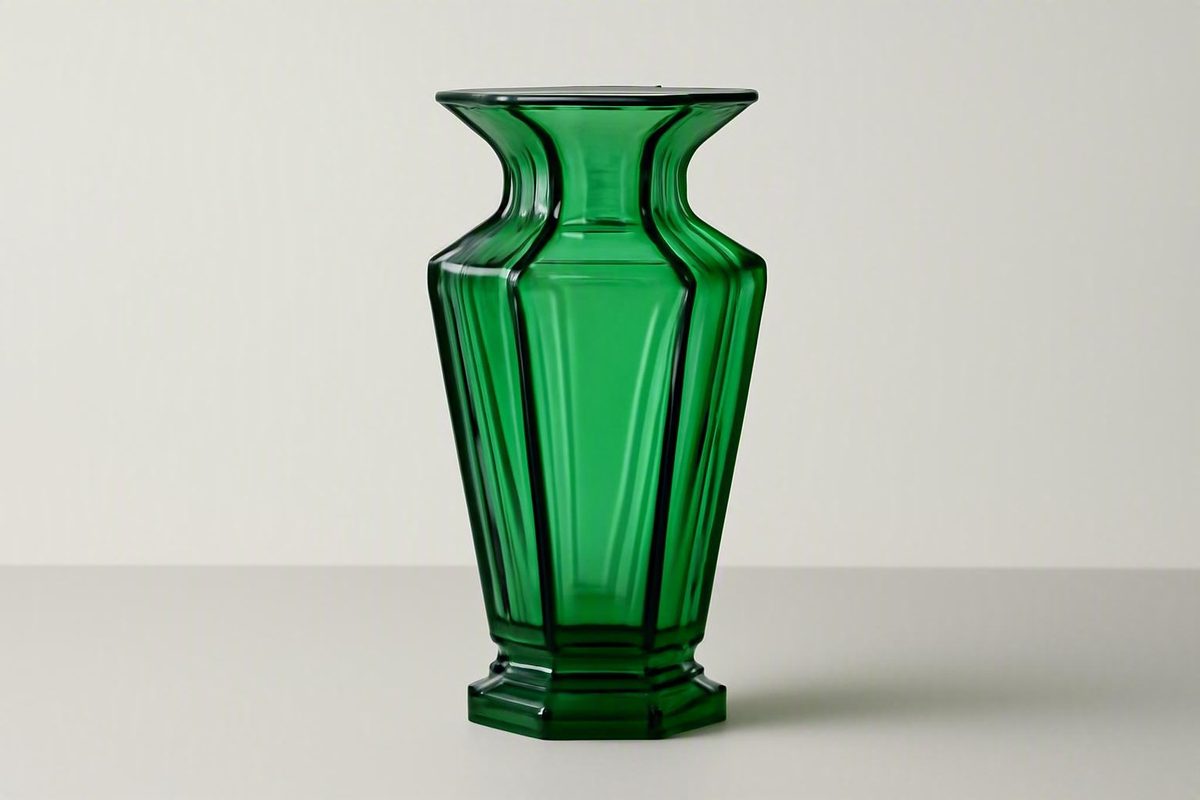
An “Art Deco green glass vase” may be a documented period object, a later revival, or a new decorative product borrowing the style. Those categories can look remarkably similar in marketplace searches, yet they differ in historical significance, attribution confidence, and the evidence needed to justify a purchase.
The safest buying strategy is to separate style from period. Examine the complete silhouette, construction, rim, interior, base, marks, labels, condition, and provenance before assigning a maker or date. Color and a persuasive listing title may provide useful search terms, but neither authenticates a vase.
This is therefore a buyer’s identification checklist rather than a substitute for a factory catalogue, museum record, technical glass analysis, or specialist appraisal.
What “Art Deco green glass vase” can—and cannot—mean
The phrase can describe at least three kinds of object:
- A documented period vase: made during the historical Art Deco era, with its date supported by factory documentation, a securely identified pattern, a documented mark, an original label with credible history, provenance, or a well-established comparison.
- A later vintage or revival vase: made after the principal Art Deco period but deliberately reusing geometric, streamlined, stepped, fan-shaped, or similarly associated features.
- A contemporary Art Deco-inspired vase: a modern decorative product whose design refers to Art Deco without claiming historical production.
“Art Deco-inspired” is therefore a statement about appearance, not dating evidence. It tells you what the designer or seller wants the object to evoke. It does not establish that the vase was produced in the 1920s, 1930s, or any other historical period.
One retail example was described as emerald-green glass with Art Deco-inspired etched curves. The captured listing gave a price of $58, dimensions of 8 by 3.5 by 8 inches, and a sold-out notice, but supplied no maker, production date, country of origin, condition report, or provenance. The simultaneous sold-out notice and purchase control also shows why availability should be confirmed directly. Review the retailer’s $58 Art Deco-inspired vase listing.
Its seller describes a sculptural form, soft curves, a contrasting rim, and “subtle art deco references.” The extracted price formatting is ambiguous, while the page presents inconsistent availability messages, so neither should be treated as reliable buying information without confirmation. Review the seller’s description of the Madam Stoltz vase.
For practical evaluation, classify each candidate according to the strongest conclusion the evidence supports:
- Documented maker and pattern: evidence specifically identifies both the manufacturer and the pattern or model, ideally through factory records, a pattern number, or a securely documented comparison.
- Probable attribution: several independent clues support a maker or origin, but decisive pattern documentation or secure provenance is absent.
- Period attribution without a known maker: construction, contextual evidence, and documented comparisons support period production, but the factory remains unidentified.
- Stylistic attribution only: the vase looks compatible with Art Deco or Streamline Moderne, but its date and origin remain unresolved.
- Documented modern revival or inspired design: the manufacturer or retailer identifies it as a later design referring to Art Deco.
Provenance may separately support a production period or ownership history without identifying a particular pattern. “Probably period, maker unknown” can therefore be more accurate and useful than a confident but unsupported factory name.
Green color does not establish age, manufacturer, uranium content, or Art Deco origin. Green glass has appeared in different periods, production settings, and visual forms. Record color as one attribute, then investigate the rest of the object.
The historical and visual boundaries of Art Deco
Art Deco emerged in Paris in the 1910s and flourished internationally most strongly during the 1920s and early 1930s, although broad accounts place its activity within a longer span extending toward mid-century. It became associated with geometry, bright color, fine craftsmanship, luxury, and technological modernity. During the 1930s, Streamline Moderne developed a sleeker language emphasizing curved forms and smooth, polished surfaces. The historical overview of Art Deco provides this broad chronology.
That history creates a visual framework, but it cannot authenticate an individual vase. Geometry was not exclusive to Art Deco, and curved forms were not exclusive to Streamline Moderne. Both angular and rounded designs continued to appear in later glass production.
When assessing a candidate, begin with the complete silhouette:
- Is the body strongly symmetrical or intentionally asymmetrical?
- Does the profile rise in steps, taper like a tower, flare like a fan, or use repeated geometric planes?
- Are the shoulders, neck, opening, and foot integrated into a coherent design?
- Does the vase emphasize vertical monumentality, low horizontal movement, or smooth aerodynamic curvature?
- Does the decoration reinforce the form, or does it appear visually independent?
- Are ribs, facets, cut lines, etched curves, or frosted areas organized around the vessel’s proportions?
These are tendencies, not compulsory features or dating tests.
Art Deco was not a single homogeneous formula. A vase does not need zigzags, chevrons, sunbursts, or a skyscraper profile to merit investigation.
Look for a relationship between form and ornament. On a coherent design, vertical ribs may heighten a tall profile, cut facets may articulate a heavy wall, or frosted relief may follow the curvature of a molded body. A solitary geometric motif on an otherwise generic vase may justify “Art Deco-inspired,” but it is weak evidence for period production.
Proportion also matters. Record how the width relates to the height, how large the opening is relative to the body, and whether the base appears visually and structurally appropriate to the mass above it. These observations may help locate comparable patterns, but they cannot independently assign a date or maker.
The result of stylistic inspection should be phrased conservatively. “The silhouette is compatible with interwar Art Deco glass” is a defensible preliminary observation. “This is a 1930s Czech vase” requires separate evidence about date and origin.
For a separate visual introduction to the style, readers may also consult this overview of Art Deco design elements by decade. It should be used as background rather than as authentication evidence for a specific vase.
Read the glass separately from the color
A green vase should not be treated as a single material category. Listings and collector descriptions may use expressions such as transparent emerald, opaque jade green, frosted, uranium green, pressed, cased, or cut-to-clear. These terms may refer to different aspects of an object, including perceived color, opacity, claimed composition, surface appearance, layered structure, decoration, or manufacturing method.
As limited working vocabulary for reading listings:
- Emerald green ordinarily describes perceived color.
- Jade green or jadeite-like generally refers to an opaque or semi-opaque appearance in the supplied examples, not a maker or date.
- Uranium green makes a claim about composition rather than color alone.
- Frosted refers to a matte or diffused surface appearance.
- Pressed glass is presented as a manufacturing description.
- Cased glass describes an object represented as having distinct glass layers.
- Cut-to-clear describes decoration represented as cutting through a colored layer to expose clear glass beneath.
These are practical descriptions, not a complete technical classification standard. A vase may also combine several attributes: a seller might describe one object as emerald-green cased glass with cut-to-clear decoration and another as opaque jade-green pressed glass with frosted relief. The terms should not be substituted for one another.
The supplied identification gallery illustrates the range by separately listing uranium-green, jade-green, ordinary transparent green, and frosted pressed-glass objects. It also presents a Czech uranium-green pressed-glass “rocket” vase as an Art Deco example. The excerpt does not provide a maker, pattern number, dimensions, mark, or precise dating evidence for that green vase, so it is best treated as a recognizable type or research lead rather than a securely attributed factory pattern. Compare the green-glass categories in the identification gallery.
A marketplace example attributed by its seller to Val Saint Lambert is described as clear glass cased in emerald green and cut back to clear in an Art Deco decorative style. That wording is useful for seeing how layered construction and cut decoration may be represented in a listing. It does not independently verify the maker or date. The same result categorizes the object as Czech without explaining how that classification relates to the Val Saint Lambert attribution, so the inconsistency should remain unresolved in your notes. See the broader marketplace results containing the seller-attributed example.
Construction vocabulary can narrow a search, but photographs may not establish the manufacturing method.
Record what can be observed before deciding what it means. If photographs are unclear, write “two vertical lines are visible on opposite sides” rather than “pressed in a two-part mold.” Write “the green surface appears cut through to clear glass” rather than declaring cased construction when no layer boundary is adequately shown.
The same discipline applies to uranium claims. A vivid green or yellow-green appearance is not proof of composition. A seller’s use of “uranium,” “Vaseline,” or “Depression glass” is a claim requiring evidence. Do not turn color, apparent fluorescence in an uncontrolled photograph, or marketplace categorization into a definitive material identification.
A step-by-step inspection of the vase
Whether examining a vase in person or remotely, follow the same order. A fixed sequence reduces the risk that an attractive color, label, signature, or seller attribution will dominate the assessment.
1. Full profile
View the vase upright from the front, back, and both sides. Study its proportions, symmetry, shoulders, neck, opening, foot, and overall balance. If inspecting remotely, ask for well-lit views taken at eye level rather than relying on one dramatic photograph.
Record the height, maximum width, opening diameter, base diameter, and weight. Measurements make comparisons with catalogued or documented objects more precise and may expose differences between a candidate and a purported pattern.
2. Rim and opening
Inspect the entire circumference of the rim. Record whether it appears rounded, flat, beveled, ground, polished, uneven, or altered. Look for chips, bruises, rough areas, changes in thickness, and evidence of later polishing.
A hand-finished edge may contribute to a broader construction assessment, but it does not prove age.
3. Interior
Examine the inner walls and bottom under adequate light. The interior may reveal residue, cloudiness, scratches, mineral deposits, trapped debris, repairs, or marks that are difficult to see from outside.
General identification guidance recommends checking both the interior and base for maker information and then comparing any suspected maker with the period in which it operated and the kinds of objects it produced. See the 1stDibs guidance on researching interior and base markings.
4. Side walls and possible seams
Study the walls in normal, reflected, and transmitted light where possible. Record visible lines, variations in wall thickness, repeated mold-like features, bubbles, inclusions, distortions, and asymmetry.
Bubbles, wear, hand-finishing, or slight irregularity may support further research, but none independently proves antiquity. Treat these features as observations rather than verdicts.
5. Decoration
Determine whether the decoration appears molded, cut, engraved, etched, frosted, painted, enameled, gilded, or applied. Record its depth, consistency, placement, and relationship to the silhouette.
Pay close attention to intersections. Does the decoration continue over a suspected seam? Does a cut appear to expose a differently colored layer? Does frosting stop abruptly at a border? Such questions can direct research, but indistinct photographs rarely justify a conclusive manufacturing diagnosis.
6. Base and pontil area
Photograph the complete underside straight on and then at an angle under raking light. Record the shape and finish of the base, the distribution of wear, any raised or recessed areas, and the appearance of the central pontil region.
Do not force a vague feature into a date. Compare the base with securely documented examples of the proposed maker or pattern.
7. Marks and labels
Search the base, interior, edges, side walls, and complete decorated surface. Identification evidence may be:
- Wheel engraved
- Acid etched
- Molded in relief
- Painted or enameled
- Inked
- Stamped
- Scratched or inscribed
- Printed on a paper or foil label
Photograph each mark straight on and under angled light. Include one image showing its position on the entire vase, not just an isolated close-up.
Preserve original paper labels rather than removing them. They may contribute provenance information or identify a manufacturer, retailer, importer, country of origin, or pattern reference. They still require comparison with reliable examples because a label’s wording and placement can be misunderstood. M.S. Rau’s identification overview discusses marks and the provenance value of paper labels.
8. Visible condition
Request explicit disclosure of:
- Rim and base chips
- Hairline or structural cracks
- Internal bruises
- Repairs or adhesive
- Ground-down or polished damage
- Cloudiness or staining
- Surface scratches and abrasion
- Interior residue
- Missing or damaged labels
- Wear to enamel, paint, gilding, or frosting
Ask the seller to photograph every disclosed flaw with a scale reference and to show its position on the complete object.
A concise remote-photo request should cover the full profile from four sides, top opening and complete rim, interior, side walls, base and pontil area, every visible seam or line, every mark and label, and all damage. Request dimensions and weight as well. If the seller cannot supply basic documentation, reflect that information gap in both your confidence and your willingness to buy.
How to interpret marks, signatures, and country names
A mark is evidence, but its meaning depends on wording, shape, placement, application method, and documented use over time. Do not identify a manufacturer merely because a familiar name or country appears on the base.
Compare a candidate mark with dated reference examples. Look beyond spelling:
- Is the text straight, curved, boxed, or arched?
- Are the letters joined, separated, serifed, or block-shaped?
- Is the mark molded, wheel engraved, acid stamped, painted, or scratched?
- Where is it placed relative to the pontil or base edge?
- Does the method of application fit the suspected factory and period?
- Are documented variants associated with different dates?
According to the cited Eastern European marks guide, many pieces made from 1918 to 1938 carried a “Czechoslovakia” mark, but that generic wording rarely identifies a specific manufacturer. The same source describes Barolac as a Joseph Inwald line of frosted and sometimes opalescent glass made circa 1920–1938, with reported marks including molded cursive “Barolac” and molded block-letter “Czechoslovakia.” Review the guide’s discussion of Czechoslovakia and Barolac marks.
A country name can therefore provide context without resolving the factory. It may support an investigation into between-the-wars production, but it does not automatically prove the object’s age, Art Deco style, manufacturer, or authenticity. A molded country name alone does not turn an unidentified frosted vase into Barolac.
Some factory associations are explicitly probabilistic. The same marks guide reports Robert and Deborah Truitt’s estimate that a distinctive arched acid-stamped “Czechoslovakia” mark is associated with Kralik in roughly 60–70% of examined cases, rather than presenting the mark as a universal guarantee. It also reports that original permanent Loetz marks containing “Loetz” or “Lötz” were wheel engraved and characterizes diamond-tip or electric-pen inscriptions using the name as almost certainly forged. Fire-polished rims and ground pontils are described as supporting Loetz clues, not conclusive tests. See the guide’s cautions concerning Kralik and Loetz marks.
An authentic vase may be unmarked. A permanent mark may never have been applied, a paper label may have been lost, or a faint mark may have become difficult to read through wear or polishing. Conversely, the presence of a name does not guarantee authenticity. Marks can be forged, copied, removed, replaced, or misinterpreted.
Use the following hierarchy:
- Matching factory or pattern documentation supported by secure provenance
- A correctly formed and applied mark supported by documented comparisons
- Construction, dimensions, form, and decoration matching known work
- A generic country mark or incomplete label
- An unsupported seller title or general visual resemblance
No single clue settles an attribution. Strong conclusions arise when several independent forms of evidence agree and no important contradiction remains unexplained.
How to research a possible maker without over-attributing
Begin with the vase, not a hoped-for manufacturer. Create an object record containing:
- Material description
- Complete profile
- Height, width, opening, and base measurements
- Weight
- Color and opacity
- Surface and decoration
- Rim and base finish
- Possible seams and pontil features
- Exact marks and labels
- Visible condition and repairs
- Known ownership history
Transcribe every mark exactly, including punctuation and country names. Compare letterforms, orientation, placement, and application method. A correct manufacturer’s name in the wrong script or technique may be evidence against an attribution rather than for it.
Research when the proposed factory operated and whether documented works share the candidate’s construction, dimensions, form, and decoration. A company known to have produced green glass is not necessarily responsible for every green vase. A manufacturer active during the Art Deco period may also have produced objects in other styles before or after it.
Whenever possible, prioritize:
- Factory catalogues and pattern books
- Pattern or model numbers
- Original manufacturer labels
- Museum collection records
- Recognized specialist reference books
- Archival advertisements or retailer catalogues
- Securely documented comparable objects
- Published auction records with adequate descriptions and photographs
Reverse-image search can generate leads, especially when a silhouette is distinctive, but it cannot authenticate an object. Search results frequently repeat the same seller attribution across dealers, resale platforms, social media, and image aggregators. Repetition is not independent corroboration.
Keep three questions separate:
- What country or region might the vase come from?
- Which factory might have made it?
- Can it be matched to a particular pattern or model?
A country mark may inform the first question while leaving the other two unresolved. A well-supported factory attribution may still fall short of a pattern identification. A pattern match is strongest when dimensions, construction, decoration, and documented variants align—not merely the outline.
Names such as Loetz, Kralik, Inwald or Barolac, Lalique, Daum, and Val Saint Lambert can serve as research directions when relevant evidence appears. They are not a checklist of likely manufacturers for every Art Deco green glass vase. Avoid “looks like” attribution based only on color, a polished base, bubbles, a generic mark, or a loosely similar silhouette.
If the evidence does not support a name, reduce the claim. Suitable descriptions may include:
- “Unidentified period glass”
- “Possibly interwar Central European glass”
- “Art Deco-style green glass vase”
- “Later vintage Art Deco revival”
- “Contemporary Art Deco-inspired vase”
- “Maker and date unverified”
That is not a failure of identification. It is an accurate statement of the available evidence. If a disputed maker, age, provenance, or expensive purchase makes the uncertainty consequential, consult an independent appraiser or a specialist with relevant glass expertise.
A disciplined marketplace buying workflow
Marketplace filters are useful for finding leads. Begin with green color, glass material, Art Deco style or the relevant period, vase type, shape, condition, and location. Treat the resulting category as an unverified candidate list rather than an authenticated catalogue.
One captured eBay sample demonstrates the breadth of such results. Its filters selected green, glass, and Art Deco, yet it included art, flower, and bud vases across numerous shapes, conditions, brands, and unbranded listings. The page displayed 184 results, while several filter and buying-format counts showed 189; the discrepancy was unexplained and illustrates why marketplace totals are temporary and imperfect. Examine the mixed eBay results and conflicting counts.
“Unbranded” does not mean inauthentic. An authentic object may be unmarked or may have lost a paper label. The reverse is equally important: a named seller attribution does not make a vase authentic. “Daum,” “Lalique,” “Loetz,” or another prestigious name in a title remains a claim until the evidence is examined.
Use exclusion terms and manual checks to remove predictable false positives, including:
- Ceramic and pottery
- Copper and enamel
- Pitchers and decanters
- Candleholders and bowls
- Art Nouveau
- Mid-century modern
- Modern décor
- Green objects that are not glass
- Glass objects that are not vases
Adjacent-category searches require particular care. Etsy’s Depression-glass results include advertisements and a mixture of purported Depression-era, uranium, Vaseline, vintage, modern, opalescent, hobnail, and carnival glass. The captured results also include objects in other colors and materials, including ceramic vases and pitchers. Etsy states that advertised visibility can be influenced partly by what sellers pay per click, so placement and search inclusion do not validate a listing title. Review the mixed Etsy search results and advertising disclosure.
A Depression-glass result is not automatically an Art Deco vase, just as an Art Deco-style vase is not automatically Depression glass.
Always open the individual listing and verify:
- Whether the material is actually glass
- Exact dimensions and weight
- Condition and repair disclosures
- Marks, signatures, and labels
- Evidence for the stated country of origin
- Any stated provenance
- Return terms
- Whether the photographs show the actual object
- The basis for every maker, period, and material claim
Before buying, send a written request for base and rim photographs, dimensions, weight, marks and labels, condition details, repair disclosure, and available provenance. Ask what evidence supports any named maker, production date, pattern, or uranium-glass claim. “The previous owner said so” should be recorded as oral provenance, not converted into documentation.
Save the listing description and photographs before purchase. Marketplace pages can be edited or removed, and inventory messages may conflict. “Sold out,” “unavailable,” “backordered,” “add to cart,” shipping, and stock notices can change or appear together. Confirm availability, delivery terms, and the return policy directly when they affect the decision.
Price is not proof: how to approach value responsibly
Authentication, desirability, and valuation are separate questions.
A high price does not authenticate a maker or production date. A plausible period attribution does not establish market value.
Active asking prices are offers. The same applies to sale badges, seller-stated discounts, sponsored placements, and luxury-marketplace prices. They show what a seller is requesting, not what a buyer ultimately paid.
The contrast between the $58 contemporary Art Deco-inspired retail vase and a marketplace example described as a 1930s green Daum vase with a $1,700 asking price demonstrates the range of objects and claims appearing under related searches. It does not establish a valuation range: the objects differ in claimed maker, age, construction, documentation, and sales context, while the Daum description and price remain marketplace claims rather than a verified realized result. See the seller-described $1,700 Daum example.
A meaningful comparable should match the candidate as closely as possible in:
- Maker or level of attribution
- Pattern, model, or closely related form
- Dimensions and weight
- Color, opacity, and glass construction
- Decoration and finish
- Condition and restoration
- Labels, marks, and provenance
- Sale venue and sale date
Published completed-auction results are more useful than active listings when discussing value, provided the result is adequately described and the object is genuinely comparable. Deco Library states that when it mentions values, it uses published auction results rather than asking prices; it also says that it does not sell antiques or accept paid gallery placement. Read Deco Library’s stated approach to collecting-market values.
The available evidence does not contain an adequate set of verified realized sales for closely matched Art Deco green glass vases. A precise value range, rarity claim, appreciation forecast, or investment conclusion would therefore be unjustified.
For an inexpensive modern decorative vase, uncertainty may simply form part of the buying decision. For a consequential purchase, named-maker attribution, or object represented as rare, obtain specialist advice or an independent appraisal before relying on the seller’s price.
Frequently asked questions
How can I tell whether an Art Deco green glass vase is genuinely from the period?
No single feature proves it. First determine whether the form is stylistically compatible with Art Deco or Streamline Moderne. Then examine the construction, rim, interior, side walls, decoration, base, pontil area, marks, labels, dimensions, condition, and provenance.
Compare those observations with securely dated catalogues, pattern records, museum objects, and documented examples. A period-compatible silhouette is only the beginning. Stronger evidence includes a matching factory pattern, an appropriate documented mark, an original label with credible history, or provenance supporting the proposed date.
Treat bubbles, asymmetry, wear, polished edges, and pontil features as supporting observations rather than age tests. If the evidence supports period production but not a manufacturer, “unidentified period glass” is more defensible than a speculative name.
Does a “Czechoslovakia” mark identify the maker of a glass vase?
Usually not. A “Czechoslovakia” mark may provide country and dating context, particularly when investigating between-the-wars glass, but generic wording rarely identifies a specific manufacturer.
The exact shape and application method still matter. Molded block letters, an arched acid stamp, and other variants may have different reported associations, but those associations must be compared with dated examples and the rest of the vase. A country mark does not by itself prove Art Deco style, factory, age, or authenticity.
Can an authentic Art Deco glass vase be unsigned?
Yes. Some authentic glass was unmarked, while other objects carried paper labels that were subsequently lost. Marks can also become faint or difficult to read through wear, damage, or polishing.
Evaluate an unsigned vase through construction, profile, dimensions, decoration, documented comparisons, and provenance. A signed vase requires similar scrutiny because marks can be forged, copied, replaced, or misinterpreted.
Does green color or a seller’s uranium-glass label prove the glass contains uranium?
No. Ordinary green, jade-green, emerald, frosted, uranium, and Vaseline glass are not interchangeable categories. Green appearance alone cannot establish composition.
Treat “uranium glass” in a listing as a claim requiring evidence. Photographs of apparent fluorescence may provide a research lead, but uncontrolled lighting and image processing prevent them from serving as definitive proof. Do not infer uranium content from color, period, or marketplace category.
How much is an Art Deco green glass vase worth?
There is no responsible single range based on the available evidence. Value depends on attribution strength, maker, pattern, dimensions, construction, color, condition, restoration, provenance, and the date and venue of sale.
Use published completed-auction results for closely comparable objects rather than active asking prices. Do not combine a modern inspired vase, an unidentified period candidate, and a seller-attributed luxury example into one range. If no closely matched realized sales exist, state that the value remains uncertain and consult a qualified independent appraiser when the financial consequences justify it.
The practical decision rule is simple: classify the vase only as confidently as the evidence allows. Style may justify “Art Deco-inspired.” Compatible construction and documented period comparisons may support a period attribution. A named maker requires stronger mark, pattern, catalogue, or provenance evidence. Before buying, obtain complete photographs, dimensions, condition and repair disclosures, and the basis for every seller claim. Treat asking prices as offers rather than evidence of value, and seek specialist review whenever attribution or cost makes uncertainty consequential.