
Art Deco Platinum Jewelry Melt Value: Calculate Before Selling
Calculate platinum content, account for stones and refining deductions, and compare an Art Deco jewel’s scrap payout with its net intact-sale proceeds.
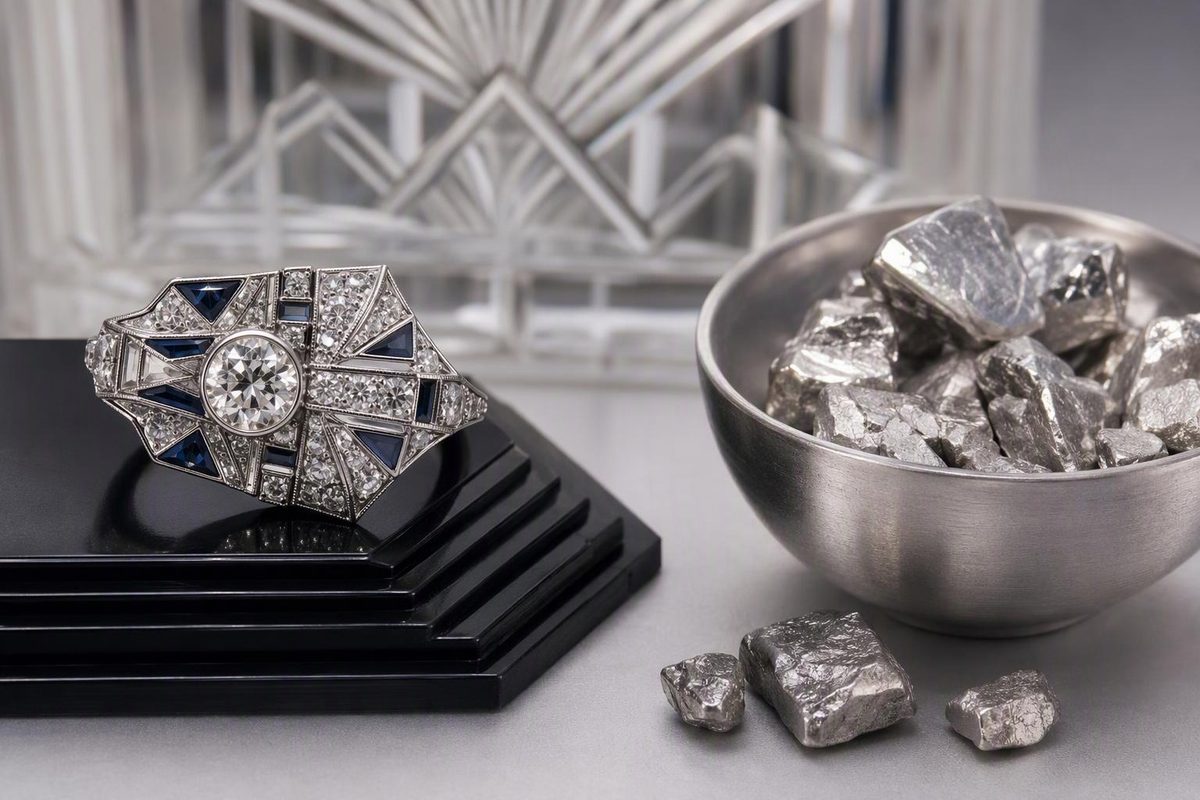
A 20-gram Art Deco diamond bracelet does not contain 20 grams of pure platinum. Its weight includes the stones, and its setting is an alloy. Even after those adjustments, the calculated metal value is not necessarily the cheque a scrap buyer will write.
Keep three figures separate: theoretical platinum melt value, net scrap payout, and net proceeds from selling the jewel intact. The first is arithmetic; the other two require actual terms and an assessment of the object.
Establish the platinum weight and purity
Photograph the jewel, every mark, and any repairs before authorising stone removal or destructive testing. If its period attribution is uncertain, use our Art Deco jewelry identification guide before treating the setting as scrap.
For the calculation, you need the weight of the platinum-alloy portion, excluding gemstones and other materials—not simply the whole jewel’s scale weight.
Diamond weight can be converted from carats to grams: one metric carat equals 0.2 grams, according to GIA. Thus, a 20-gram jewel containing exactly 2 carats of diamonds would have 19.6 grams remaining, assuming there are no other non-platinum components. Mounted-stone estimates introduce uncertainty; ask a jeweler to provide a weight range rather than removing stones merely to obtain a preliminary scrap figure.
Read the mark with its metal designation:
| Mark | Platinum fraction to use, if verified |
|---|---|
| 950Pt or 950Plat | 0.95 |
| 900Pt or 900Plat | 0.90 |
| 850Pt or 850Plat | 0.85 |
The current US FTC jewelry guides recognise these parts-per-thousand markings. They also permit an unqualified “Platinum” description for material containing at least 950 parts per thousand platinum. Those current US rules are not a dating key or a guarantee of an old jewel’s composition.
IRIDPLAT needs particular care. In a 2006 Ganoksin practitioner discussion, Jurgen J. Maerz described the traditional US 900-platinum/100-iridium alloy and its IRIDPLAT stamp, while noting that the alloy was still being produced. Treat the stamp as an alloy clue—not proof of Art Deco age. A plain PLAT mark, worn stamp, or unmarked white setting should prompt verification rather than an automatic 90% or 95% assumption.
Ask the evaluator to check whether clasps, replacement parts, or gold-backed sections need separate treatment. Do not apply one platinum percentage to an entire mixed-metal jewel.
Calculate the theoretical melt value
Use a platinum spot bid in the same currency as the offer, with its date and time recorded. A forecast or an earlier market spike is not today’s settlement price.
Platinum-only melt value = net alloy weight in grams × platinum fraction × (spot price per troy ounce ÷ 31.1035)
The conversion uses approximately 31.1035 grams per troy ounce, not the ordinary ounce used by many household scales; see NIST’s conversion table.
For a dated example, Kitco’s platinum chart displayed a US-dollar spot bid of $1,433 per troy ounce at 22:54 New York time on November 1, 2026—approximately $46.07 per gram of pure platinum.
Using that quote, a hypothetical 20 grams of net platinum alloy, already excluding stones and other components, gives:
| Verified purity | Pure platinum content | Theoretical platinum value |
|---|---|---|
| 900 | 18.0 g | $829.30 |
| 950 | 19.0 g | $875.37 |
These are calculated metal values, not auction results or buyer offers. Replace the spot quote when comparing current bids.
The formula values platinum only. Iridium and other alloy constituents are not additional platinum ounces. Ask explicitly whether any other precious metals will be assayed and paid for; do not add their theoretical values unless the buyer’s settlement terms support that payment.
Turn melt value into a realistic scrap payout
There is no universal payout percentage. Published US refiner terms illustrate why the headline rate is insufficient:
- Midwest Refineries lists payment at 90% of pure platinum content, with platinum pricing $25 per ounce below the settlement-day bid. It says orders under 3 troy ounces are bought using average melt-weight loss and purity, rather than an individual melt-and-assay determination.
- Mid-States Recycling & Refining lists 97% accountability for lots below 10 troy ounces of fine platinum, but also a $150 minimum melt/assay fee and a $15-per-ounce refining charge on accountable fine metal. Its schedule gives a four-week settlement period.
These published terms, as of November 2, 2026, are examples, not endorsements or binding quotes. A high payable percentage with a minimum lot fee can be less attractive for one ring than a lower percentage with smaller deductions.
Request a written estimate showing the accepted alloy weight, purity assumption, payable percentage, pricing date, all deductions, and treatment of stones. Include shipping, insurance, and payment-method costs in your comparison where applicable. Confirm whether you can decline before melting. If gemstones are returned rather than purchased, their possible later sale proceeds remain separate—and uncertain.
Compare what you would actually receive
Before dismantling a potentially period jewel, obtain an intact-sale assessment from an estate-jewelry specialist. Ask what evidence supports the date and maker attribution, how condition affects saleability, and which recent sold lots, rather than asking prices, are genuinely comparable. Maker, provenance, and condition are among the criteria Sotheby’s identifies for its estimates.
Compare a firm dealer purchase offer directly with net scrap proceeds. For consignment or auction, subtract seller charges and other agreed costs from the expected selling price. At auction, use the expected hammer price as the starting point: the buyer’s premium is a fee added to it. Do not treat a premium-inclusive published result or an insurance replacement appraisal as your likely take-home amount.
A simple hypothetical comparison:
- Net scrap offer: $700.
- Intact sale: $1,000, less an assumed 20% seller commission and $50 in other costs.
- Net intact proceeds: $750.
Under those assumptions, the intact sale breaks even with scrap at $937.50: ($700 + $50) ÷ 0.80. These are comparison inputs, not market valuations or standard commission rates.
If a conservative intact-sale estimate comfortably exceeds the written scrap offer after costs, keep the jewel together. If the figures are close, weigh sale uncertainty and waiting time against the irreversible loss of the setting. A broken clasp alone is a reason to seek a repair assessment—not a sufficient reason to melt an Art Deco jewel.