
Floating Vanities in Art Deco Bathrooms: Style vs. Period
Choose floating vanities for an Art Deco-inspired bathroom, distinguish style from age, and check installation needs before altering a historic interior.
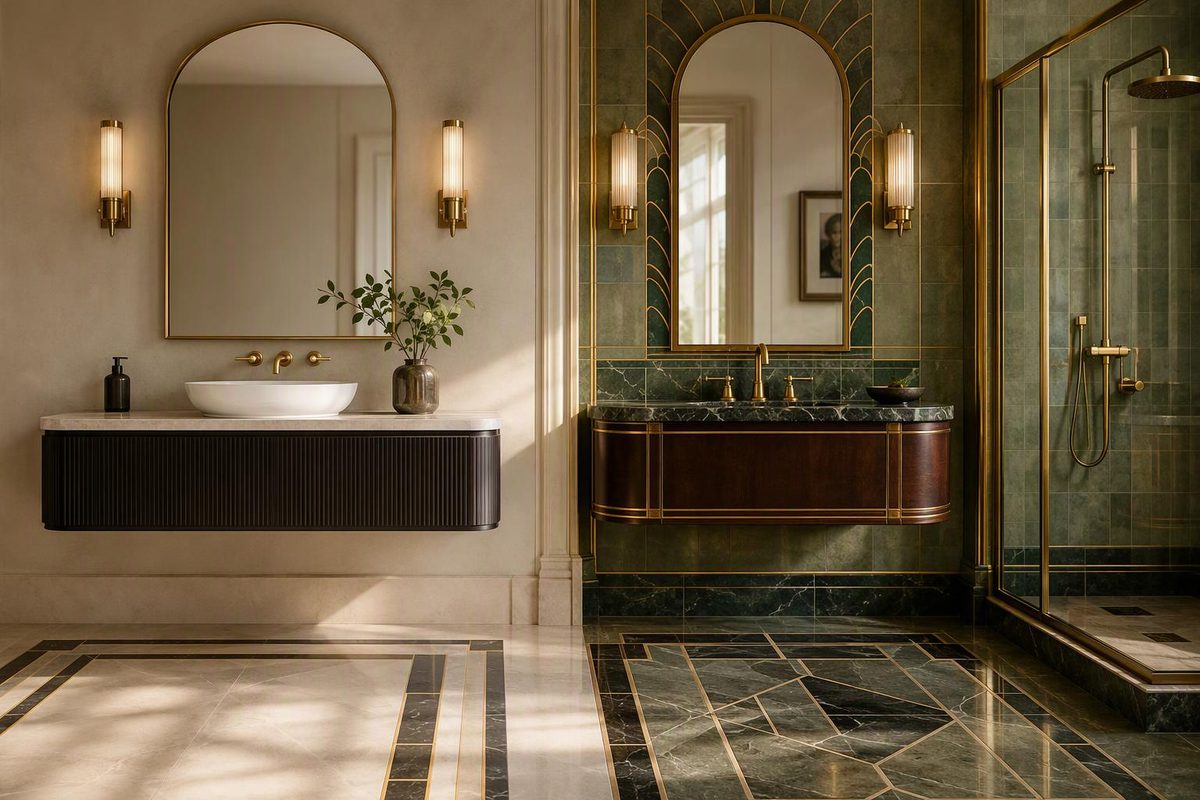
A wall-hung cabinet with dark wood, a pale countertop and sharply geometric pulls can look convincingly Deco. But the gap beneath it tells you how it is supported—not when it was made.
Floating vanities can work in an Art Deco-inspired bathroom, but wall mounting alone establishes neither style nor age. For a new interior, the task is to choose a coherent design and verify its installation requirements. For a historic bathroom or a supposedly antique cabinet, the task begins with evidence.
What “floating” actually describes
A floating bathroom vanity is a wall-mounted cabinet beneath a basin or vanity top, without floor-standing legs. Kohler distinguishes this configuration from freestanding vanities and notes that it requires a strong wall to support the weight. A wall-mounted basin without a cabinet is a different fixture; a dressing-table vanity need not contain a basin at all. Kohler’s vanity guide explains the mounting distinction.
The practical attractions are an exposed floor and easier access for cleaning underneath. The visual effect can make a small bathroom feel larger, though it does not reduce the cabinet’s actual projection into the room. The trade-off is a more demanding installation, and storage must be compared model by model rather than assumed from overall width. Kohler’s buying guide discusses under-cabinet cleaning, measurements and storage configurations.
Which details make it read as Deco?
Art Deco is not simply minimalism with metallic handles. The V&A traces its geometric vocabulary through earlier linear design and avant-garde movements, while the Metropolitan Museum describes a much broader decorative range that includes figures, animals, plants and abstract geometry. Rich materials and ornament matter alongside form. V&A: An introduction to Art Deco; The Met: French Art Deco.
For a modern interpretation, consider these combinations rather than treating them as a historical specification:
- Furniture-led: a clearly expressed wood grain, restrained countertop and geometric metal pulls. Let the cabinet front carry the pattern instead of adding competing motifs everywhere.
- Geometric: plain fronts paired with a stepped mirror outline or a carefully placed chevron border. One strong motif is easier to read than several unrelated ones.
- Decorative: a glossy dark finish, contrasting stone-look top and coordinated metalwork. Choose finishes for their relationship to the room, not because “black and gold” supposedly proves Deco identity.
These are design choices, not authentication tests. Fluting, rounded corners, glossy finishes and brass-colored hardware are not exclusive to Art Deco. For a closer look at the vocabulary, see our guide to Art Deco geometric patterns.
A documented period object shows how broad the category can be. Armand-Albert Rateau’s Dressing Table, circa 1925, in the Metropolitan Museum is made of bronze, basalt and mirror glass. The museum records that he first conceived the model for the duchess of Alba’s bathroom in Madrid in 1921 and later included a version in the 1925 Paris Exposition. Its inspiration came from antiquity, not merely angular geometry. It is a useful comparison for period bathroom furniture—not evidence that a contemporary floating sink cabinet is a reproduction of it. The Met’s object record.
Before buying or commissioning one
Check the whole assembly, not just the photographed cabinet:
- Wall support: obtain the exact model’s installation instructions before ordering. Have the installer confirm the wall construction and required support for the cabinet, countertop and basin together; do not assume the existing finish can carry the load.
- Plumbing and storage: compare the supply and drain positions with the cabinet’s internal layout. Ask for drawings showing usable drawers, pipe space and access for maintenance.
- Height and clearance: plan the countertop and basin together, especially with a raised vessel sink. Check bathroom-door swings and full drawer extension.
- Exposed surfaces: inspect the floor and wall previously hidden by a freestanding vanity. A floating replacement may reveal missing flooring or unfinished surfaces.
- Materials: request the actual cabinet, veneer and countertop specifications. “Walnut finish” or “marble effect” is not the same claim as walnut veneer or natural marble.
Kohler’s measurement guidance specifically addresses plumbing location, door and drawer clearance, variable mounting heights and flooring exposed by a switch to wall mounting. Its installation advice recommends considering a professional installer for wall-hung models and consulting product-specific instructions.
If the room—or the cabinet—is historic
Before opening a wall or removing fittings, identify and photograph what survives. The US National Park Service’s preservation guidance calls for assessing significant interior features and finishes, and photographing them thoroughly before rehabilitation; tile floors, hardware and visible plumbing fixtures can contribute to a building’s character. This is preservation guidance, not a statement of the rules governing every property. Preservation Brief 18.
For a cabinet advertised as “original Art Deco,” request maker marks, catalogue comparisons, dated photographs and provenance. Also ask whether it was originally wall-mounted, whether legs were removed, and when any basin opening was cut. A period cabinet converted into a floating bathroom vanity should be described as an altered period object, not an untouched original bathroom fitting. Replacement cabinet pulls deserve their own check.
A newly made floating vanity can be a thoughtful Deco-inspired addition. The honest distinction is between a design that borrows the style, a documented period object, and a historic object altered for present-day use.