
Art Deco Cabinet Pulls: How to Identify and Date Them
Identify Art Deco cabinet pulls by form, finish, mounting evidence and furniture context—and spot reproductions or later replacement hardware.
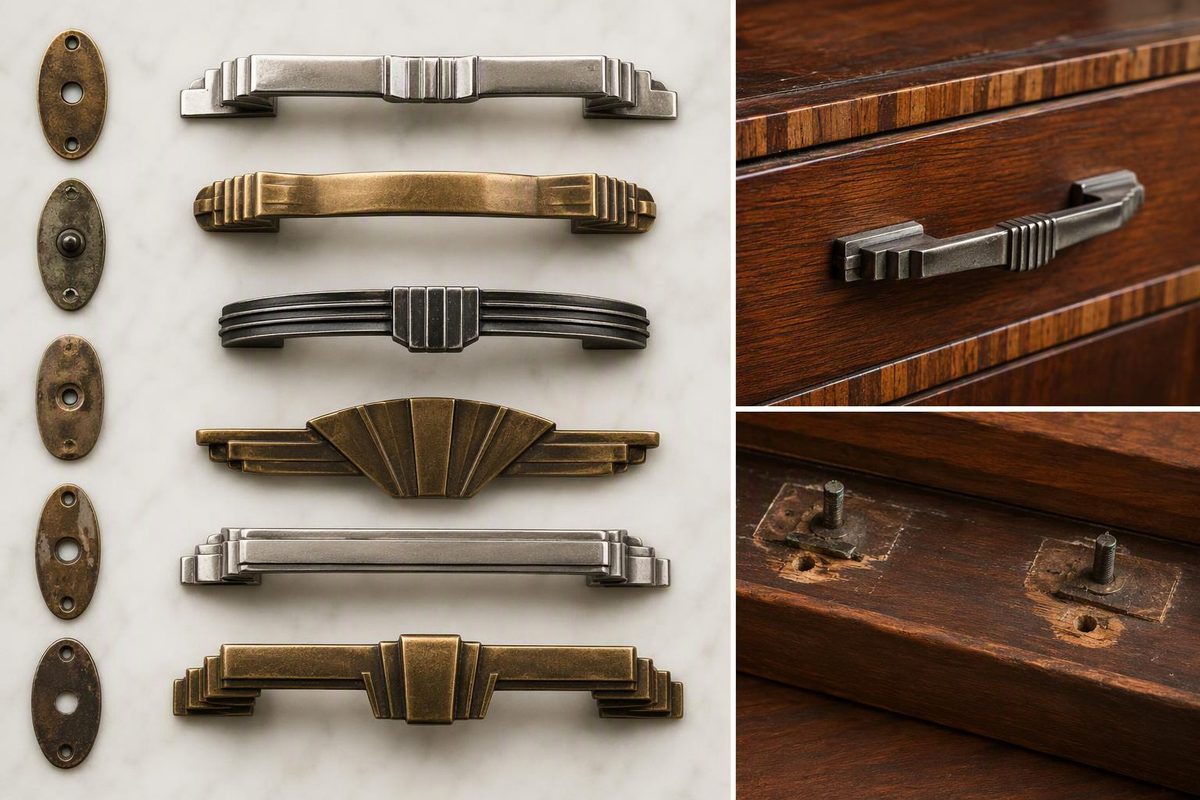
A small handle can carry a large attribution. A stepped chrome pull may make an ordinary dresser look “1930s,” while a faceted brass knob can push a new cabinet toward “Deco style.” Neither establishes when the furniture—or even the hardware—was made.
Émile-Jacques Ruhlmann’s documented furniture shows why one stock image of an “Art Deco pull” is inadequate. His circa-1925 Fuseaux cabinet combines Macassar ebony and ivory with silvered bronze, while the related État cabinet, designed in 1922 and manufactured in 1925–26, uses silvered brass among a much broader palette of woods and marquetry materials (The Met, Fuseaux cabinet; The Met, État cabinet). These are overall object records, not proof that every fitting is made from the listed metal, but they demonstrate how varied documented interwar cabinet materials could be.
The useful question is therefore not “Does this pull look Deco?” but “Does its design, material and installation make sense on this particular cabinet?”
Record the form before naming the style
When screening a pull advertised as Art Deco, first describe what is actually present:
- Geometric knob: round, square, octagonal or faceted, sometimes built in stepped layers.
- Bar or bridge pull: a straight or gently arched grip fixed at two points, with separate or integrated mounting blocks.
- Drop or pendant pull: a hinged element hanging from a backplate. The format long predates Art Deco, so its presence cannot date a cabinet.
- Recessed or flush grip: hardware kept close to the cabinet surface.
- Escutcheon: a keyhole plate that may be plain or incorporated into the cabinet’s composition.
- Carved or molded grip: wood, light-colored material or plastic shaped to coordinate with the façade.
Symmetry, repeated arcs, parallel grooves, radiating lines, chevrons and stepped profiles can support a Deco-style description. Those motifs belong to the wider vocabulary explained in the decade-by-decade Art Deco style guide, but none is exclusive to interwar production. Later manufacturers and present-day reproductions use them too.
Nor was period hardware always abstract. Ruhlmann’s 1929 Meuble à fards has an octagonal keyhole in a gilt-bronze figurative plate chiseled by sculptor Alfred Janniot. MuMa Le Havre describes the plate as a bas-relief integrated into the furniture—a documented example of high-style Deco combining geometry with modeled figures (MuMa Le Havre).
Material and finish can narrow the question
Museum records for interwar cabinets include silvered bronze, silvered brass and gilt bronze, not only the bright chromium finish now strongly associated with Machine Age design. Furniture could also coordinate its fittings with wood or light-colored decorative materials. Yet an object record’s medium line does not necessarily assign a material to each pull, hinge or lock plate; inspect detailed cataloguing and photographs before making that leap.
Examine an inconspicuous worn edge under magnification rather than filing or scratching it. Yellow metal beneath a white surface is consistent with plating over a copper alloy such as brass, but that observation identifies neither the exact plating nor its date. Darkening in recesses may be compatible with age, but old hardware can be polished and new hardware can be given an artificial patina.
Treat seller terms as claims to verify:
- “Chrome” may describe appearance rather than an identified finish.
- “Bakelite” is often applied loosely to dark or colored plastic.
- “Bronze” may mean a bronze-colored finish rather than the alloy.
- “Original Art Deco hardware” makes a claim about age and installation, not merely style.
Do not use a hot pin, solvent or abrasive test on a mounted pull. Such tests can permanently mark plastic, lacquer, plating or the cabinet itself.
Read the mounting evidence
The back of a drawer front is often more informative than the polished face. Remove hardware only if it comes away without force, and keep every washer and nut with its original position.
Check for:
- Unused or plugged holes. A second hole pattern is good evidence that another fitting was once installed, although it does not reveal when the change occurred.
- A mismatched shadow. Protected finish or a compressed outline extending beyond the present backplate suggests that a differently shaped fitting occupied the spot.
- Fresh-looking disturbance. Pale wood, sharp-edged holes or recent breakout can point to a newer installation, but restoration may also explain them.
- Inconsistency within a set. Pulls expected to match should be compared for dimensions, casting details, fasteners and wear. One conspicuously different fitting deserves closer study.
- Altered spacing. Measure the center-to-center distance between two fixing points. Enlarged holes, angled screws or improvised washers can indicate that a pull was adapted to an existing drawer.
- Poor compositional fit. A pull that collides with molding, obscures inlay or interrupts matched veneer may be a replacement, though only a documented design or earlier photograph can settle the point.
Screw type alone is not a reliable date. Old hardware can acquire new screws during repair, and old screws can be reused with replacement pulls. Treat fasteners as part of the installation history, not as a one-step authenticity test.
Date the cabinet and the pulls separately
A period pull can be salvaged and fitted to later furniture; a period cabinet can receive replacement hardware. Record two conclusions:
- Furniture: documented period, plausibly interwar, later revival or unresolved.
- Hardware: documented or apparently original to the installation, old replacement, modern reproduction or unresolved.
The strongest period attribution combines compatible design with mounting evidence, construction and materials, plus documentation or a close comparison to a catalogued example. Ruhlmann’s État cabinet is instructive because The Met commissioned it in 1925 and dates its manufacture to 1925–26. Its details belong to a documented object, rather than merely to a seller’s impression of the style (The Met).
Maker labels, stamps, invoices, early interior photographs and period catalog illustrations outweigh resemblance to an online listing. A patent number or maker’s name can become a useful lead, but copy every character exactly and confirm that the resulting record describes the same form.
Buying loose Art Deco cabinet pulls
For a restoration, begin with the cabinet rather than the advertised style. Record:
- fixing type and center-to-center spacing;
- pull width, projection and backplate footprint;
- clearance for fingers and adjacent drawers;
- reported base material and finish;
- finish color and sheen;
- quantity required;
- condition of threads, hinge points and mounting posts.
Ask for photographs of the front, back, side profile and fasteners. A listing showing only the decorative face cannot establish construction, mounting compatibility or age. Also distinguish old stock—hardware represented as unused but made earlier—from salvaged, recast, reproduction and merely Art Deco-style pieces. Each description requires its own evidence.
For a valuable cabinet, avoid drilling new holes until the existing pattern and any protected outlines have been recorded. The aim is not to force every cabinet into a bright geometric stereotype. It is to preserve the evidence that may show whether its pulls have always belonged there.