
How to Assess an Art Deco Wall Sconce
Assess style, construction, marks, condition, restoration and provenance, then classify it as Art Deco-style, plausibly vintage or documented period.
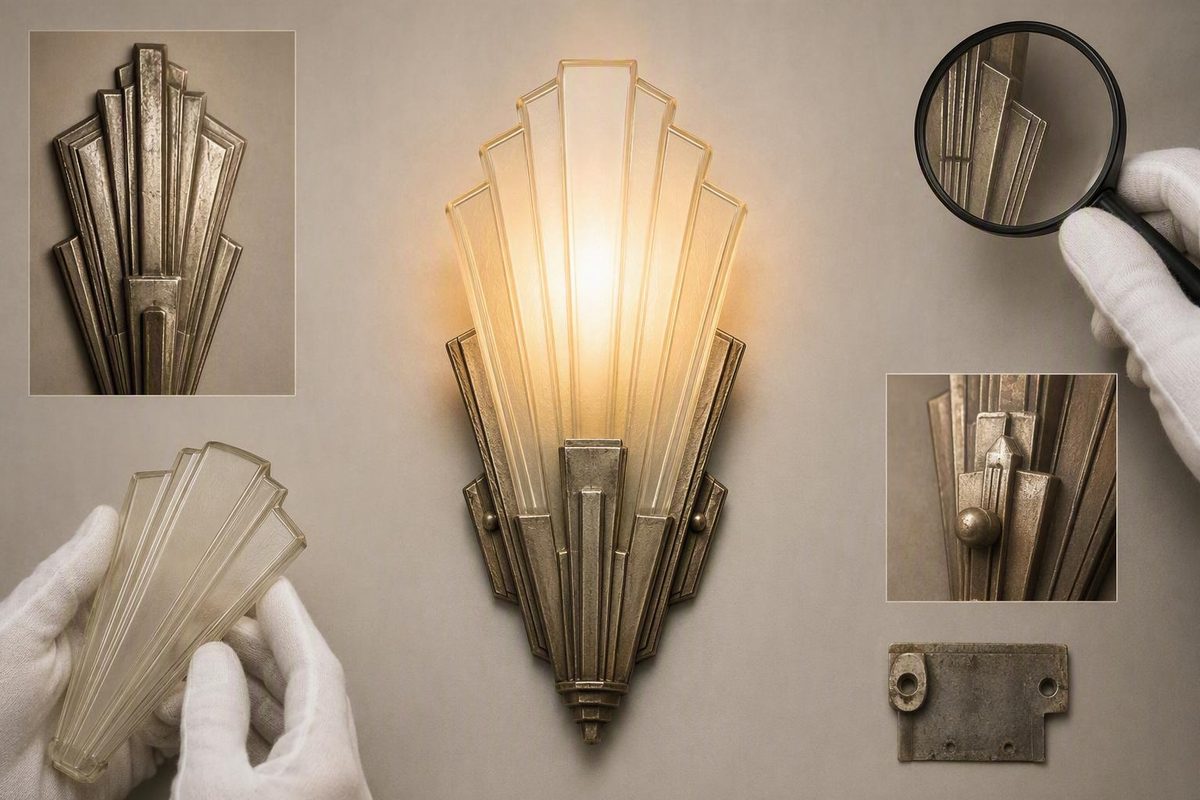
No product name, retail category, motif, finish, or silhouette can establish when an Art Deco wall sconce was made. Treat style, construction, marks, condition, restoration, and provenance as separate evidence.
This guide is a listing-review and documentation method, not an authentication test. It uses three working classifications:
- Art Deco-style: The appearance uses recognizable Deco visual language, but the date is unknown.
- Plausibly vintage: Multiple construction details appear compatible with older manufacture, with no decisive contradiction, but records do not support a period attribution.
- Documented period: A mark, design, or individual fixture is supported by dated records, reliable provenance, or a secure comparison with an authoritative documented example.
“Plausibly vintage” is deliberately cautious. It requires more than an old-looking finish or shade and does not mean “probably period Art Deco.”
Start with the label: Art Deco appearance is not proof of age
Retailers use “Art Deco” broadly. One category may contain geometric, Streamline-inspired, minimalist, transitional, and contemporary fixtures. Category placement explains how a seller markets the sconce—not its date, maker, or authenticity. Brass-colored metal, frosted glass, sunbursts, and stepped outlines can all appear on old and new lighting.
Modern products show why the distinction matters. The Studio Endo DECO SCONCE is described by its maker as inspired by bold Art Deco geometry, but its specifications include a dimmable LED array, selectable 2700K or 5000K color temperature, powder-coated finishes, and hardwired installation. “Contemporary Art Deco-inspired sconce” is therefore accurate: the stylistic reference and modern technology are both disclosed.
Use the same discipline with an unidentified fixture. Describe what can be seen first, then make only the age claim that the supporting records permit.
The visual vocabulary of an Art Deco-style sconce
Begin with the overall composition. Features commonly associated with Art Deco-style lighting include:
- Bilateral symmetry
- Stepped or ziggurat profiles
- Geometric fans and sunbursts
- Chevrons and zigzags
- Elongated vertical lines
- Tiered, skyscraper-like shades
- Repeated angular borders or panels
Commercial descriptions also use slip shade or slipper shade for shades fitted into sconces and, in groups, chandeliers. Because the available salvage-market evidence does not establish a standardized historical definition or precise chronology, record the observable fitting arrangement rather than relying on the name. “Wedding-cake” and “skyscraper” likewise describe tiered profiles; they are not dating tests. An architectural-salvage overview of these forms notes both their association with Deco lighting and the presence of later reproductions.
Chrome, nickel, brass, bronze, frosted glass, opalescent glass, and pressed or molded glass recur in descriptions of Art Deco lighting. Geometric fans, sunbursts, chevrons, stepped forms, symmetry, and elongated lines appear just as regularly. These features support a stylistic description, but modern manufacturers can reproduce the same combinations, as this commercial overview of Art Deco lighting illustrates.
Distinguish angular Deco styling from Streamline influence when possible. A sharply stepped, symmetrical fixture with chevrons or radiating ornament differs from one dominated by rounded corners, sweeping curves, and horizontal emphasis. The latter may be better described as Streamline-influenced, although sellers frequently group both under Art Deco. Deco Library’s broader design-elements article provides additional motif context; for a sconce, visual classification remains only the first stage.
Use an evidence table, not a single authenticity test
No screw, patch of patina, glass bubble, finish, or motif authenticates a sconce by itself. Record supporting and contrary evidence without forcing either into a predetermined conclusion.
| Evidence observed | What it may suggest | What it cannot prove | Next check |
|---|---|---|---|
| Geometric, fan-shaped, or stepped design | Art Deco stylistic compatibility | Date or maker | Compare the full profile with documented examples |
| Chrome or brass-colored metal | A finish used in Deco and later revivals | Composition, age, or originality | Inspect worn edges, reverse surfaces, seams, and plating |
| Slotted or Phillips-head screws | Original assembly or later repair may be present | Slotted means period; Phillips means reproduction | Check consistency and ask about restoration |
| Patina | Aging, use, storage, or an applied finish | Age or authenticity | Compare exposed and protected surfaces |
| Bubbles or irregularities in glass | A manufacturing feature worth recording | Period manufacture | Inspect seams, edges, fitting dimensions, and marks |
| Old-looking wiring | An electrical component that may predate later work | Age of the decorative fixture | Record it without using it as a dating verdict |
| Maker mark | A possible route to maker, model, or origin | Genuine mark or original components | Transcribe and compare it with reliable records |
| Period documentation | Potential support for a date or attribution | That a similar loose fixture is the same model | Match dimensions, materials, fittings, and details |
New screws, sockets, wires, or mounting parts may indicate repair or rewiring rather than modern manufacture of the whole fixture. Conversely, old-looking parts can be reused. Patina, weight, glass irregularities, and period-looking hardware remain observations until corroborated.
Reserve documented period for evidence that survives close comparison. Useful support may include a dated manufacturer catalogue, patent, advertisement, factory record, provenance document, or securely identified museum example. A mark becomes meaningful when its exact wording, form, and location connect it to such evidence.
Inspect the sconce in a fixed order
A consistent sequence makes listings easier to compare and keeps an attractive shade from distracting you from missing evidence.
- Overall profile: Photograph the fixture straight on and from both sides. Record symmetry, stepped forms, orientation, dimensions, and wall projection.
- Backplate, front and reverse: Look for seams, holes, wear, finish differences, repairs, and replacement mounting parts.
- Canopy interior: Record labels, stamps, unfinished metal, repairs, and wiring changes.
- Shade and fitting: Note the glass profile, seams, chips, fitter dimensions, retaining method, and how securely the shade sits.
- Sockets and switches: Photograph materials, shapes, markings, damage, and their relationship to the surrounding structure.
- Fasteners: Record screw-head types, mismatches, tool marks, and replacements without treating them as a date test.
- Wiring: Note visible insulation, splices, brittleness, and disclosed rewiring. Leave testing or assessment of questionable wiring to a qualified electrician.
- Metal finish: Describe color, plating loss, corrosion, pitting, polishing, paint, and possible refinishing.
- Marks: Check the base or backplate, canopy interior, sockets, shade fittings, and glass.
- Restoration history: Ask what was cleaned, rewired, replated, refinished, repaired, or replaced—and when.
Copy every name, logo, model number, label, stamp, or signature exactly rather than expanding initials or guessing at a maker.
A magnet can help distinguish some materials: attraction may indicate iron or steel beneath a brass-looking surface, while no attraction may be consistent with a nonferrous metal. Neither result dates or authenticates the sconce.
Saveable listing-review checklist
- [ ] Overall front, side, top, and bottom views
- [ ] Backplate front, reverse, and canopy interior
- [ ] Sockets, switches, shade fittings, and fasteners
- [ ] Wiring, insulation, and visible splices
- [ ] Glass edges, seams, chips, and fitter dimensions
- [ ] Exact photographs of every label, stamp, number, logo, or signature
- [ ] Dimensions and wall projection
- [ ] Known provenance and restoration invoices
- [ ] Disclosure of replaced components
- [ ] Pre-restoration photographs, if available
Separate condition and electrical safety from authenticity
Condition affects whether a sconce can be conserved and safely installed; it does not determine when the decorative fixture was made. Check for chipped or cracked glass, corrosion, pitting, flaking finishes, brittle insulation, frayed wiring, damaged sockets, loose shade fittings, and distorted mounting parts.
Old wiring is a safety concern, not reliable evidence of age. Professional rewiring may introduce modern wire, sockets, screws, or mounting components into an older decorative shell. Do not energize or install a questionable hardwired sconce until a qualified electrician has assessed the fixture and intended installation.
Keep care conservative. Dust metal with a soft cloth and document the surface before intervention. Mild soap and lukewarm water may be suitable for sound, removable, undecorated glass known to tolerate washing. Do not immerse or wash glass with paint, applied decoration, labels, repairs, cracks, loose material, or unstable surfaces. Seek appropriate conservation advice when its condition or decoration is uncertain.
Avoid harsh chemicals, abrasives, aggressive polishing, replating, stripping, or refinishing before assessment. Such work may remove an earlier surface, alter wear patterns, or destroy evidence useful for identification. Photograph the fixture before and after treatment, retain invoices, and record every component repaired or replaced.
Classify the fixture with a defensible description
The final description should reflect the strongest evidence present, not the most attractive possibility.
Example 1: contemporary Art Deco-inspired
A newly made hardwired fixture has an integrated LED array, selectable color temperature, powder-coated finishes, and geometry explicitly described by its maker as Art Deco-inspired.
Classification: Contemporary Art Deco-inspired wall sconce. Why: Both the stylistic reference and modern specifications are documented.
Example 2: Art Deco-style or plausibly vintage
An unsigned sconce has a stepped molded-glass shade and compatible-looking metalwork, but no catalogue match or provenance. Its construction shows several internally consistent older-looking features, while the seller discloses later wiring and screws.
Classification: Art Deco-style wall sconce; possibly or plausibly vintage, date and maker unconfirmed. Disclosure: Identify the observations supporting that cautious description and list every known replacement. If the evidence consists only of style and surface appearance, use Art Deco-style; date unknown instead.
Example 3: documented period
A mark or distinctive design can be securely matched to a dated catalogue, patent, advertisement, manufacturer record, provenance document, or authoritative museum example. Dimensions, materials, fittings, and design details agree, while discrepancies and replacements are disclosed.
Classification: Documented period only to the extent supported by the match. A similar outline or partially legible name is insufficient.
A practical listing formula is:
Object type; stylistic description; stated or documented date; materials; marks; dimensions; condition; replacements; rewiring status; provenance; basis for attribution.
For example:
Wall sconce; Art Deco-style stepped geometric design; date unknown; chrome-colored metal and molded frosted glass; unsigned; dimensions stated; minor edge chips and plating loss; socket and wiring replaced; no known provenance; attribution based on visual style only.
A convincing Deco silhouette begins the identification process; it does not complete it. Precise wording is more useful than confidence unsupported by records.