
Art Deco Cocktail Shaker: How to Identify and Date One
Use marks, materials, components and museum comparisons to distinguish a period Art Deco cocktail shaker from a later Deco-style piece.
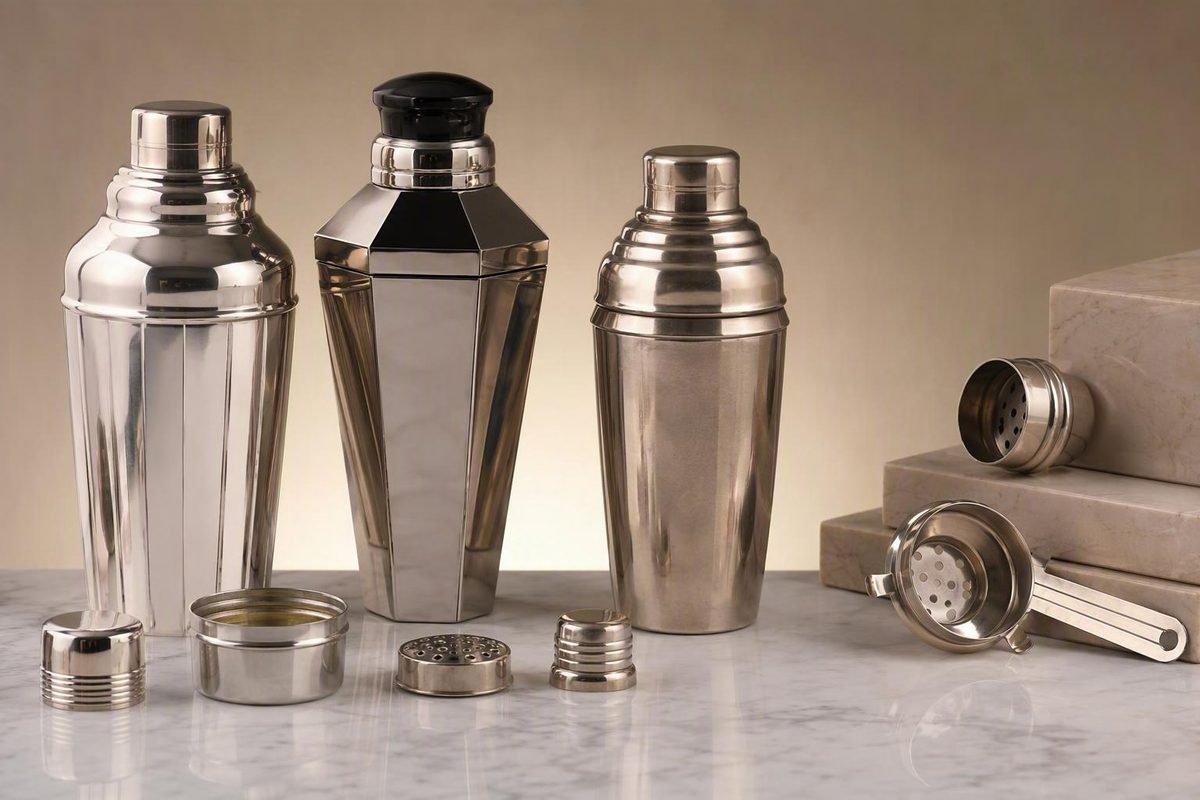
A stepped lid, gleaming chrome and a skyscraper silhouette can make a cocktail shaker look convincingly Art Deco. They cannot, by themselves, establish when it was made. The useful question is not simply “Does this look Deco?” but “Do its marks, materials, construction and documented model history agree?”
Museum examples show why that distinction matters. The V&A’s circa-1930 Mappin & Webb shaker combines an inverted-cone body, cylindrical neck and stepped lid in electroplated nickel silver. The museum explicitly describes its chrome finish and stepped decoration as having “overtones of American Art Deco”—yet records the object itself as unmarked (V&A). Style helps identify a direction; it does not supply a date or maker.
What period examples actually look like
There was no single Art Deco shaker material or shape. Documented interwar examples include:
- Stepped electroplate: the V&A shaker above has restrained linear bands, a stepped top and an internal strainer.
- Chrome, brass and early plastic: William Archibald Welden’s 1938 “Empire” shaker for Revere is chrome-plated brass with Bakelite (Metropolitan Museum of Art).
- Architectural chrome: Norman Bel Geddes’s “Manhattan” ensemble turns a tall cylindrical shaker, stemmed cups and stepped tray into an allusion to the New York skyline (Metropolitan Museum of Art).
- Spun aluminum: the Brooklyn Museum dates a Russel Wright/Century Metalcraft shaker to 1928–40 and records aluminum, cork, a separate lid and strainer (Brooklyn Museum).
These references make two points. First, chrome is common but not compulsory. Second, geometry ranges from spare cylinders to conspicuously architectural compositions. Assess the whole object rather than treating one stepped ring or black knob as a certificate of age. For the broader vocabulary, compare the forms with Art Deco’s defining elements.
A practical identification sequence
1. Account for every component
Lay out the body, cap, strainer and any cups or tray. A three-piece shaker usually needs all three shaker components to work as designed; a complete ensemble may include matching cups and a fitted tray.
Check whether the parts share the same finish, wear pattern, proportions and manufacturing quality. A bright cap on a worn body may be a replacement, although appearance alone cannot prove that. Ask the seller to photograph the pieces separated, including the inside of the cap and strainer.
Completeness matters especially with named designs. The Met records the “Manhattan” as a shaker, six cups and tray, all in chrome-plated brass. Its architectural effect depends on arranging those elements together. A lone shaker can still be authentic, but it is not a complete ensemble.
2. Read the underside before reading the seller’s title
Photograph every word, symbol and number in raking light. Search the exact combination rather than a generic phrase such as “vintage Deco shaker.” A model attribution becomes much stronger when the mark, dimensions, material and shape all match a museum or period-catalogue record.
For example, the Brooklyn Museum’s “Manhattan” shaker is stamped “Revere / ROME / N.Y.” on its underside. The museum separates the design date, 1934–35, from the manufacture date, circa 1939–41 (Brooklyn Museum). That distinction is important: a patent or design year is not automatically the production year of every surviving example.
An absent mark is not an automatic rejection—the V&A’s circa-1930 example is catalogued as unmarked—but it removes one useful route to attribution. In that case, provenance, exact dimensions and a close model match must do more of the work.
3. Distinguish solid silver from silver plate
Do not let “silver cocktail shaker” blur material and color. On British work, a hallmark is a set of component marks showing independent testing, legal fineness, the assay office and the responsible sponsor (Goldsmiths’ Company Assay Office). Read the entire group; the sponsor’s mark identifies the party responsible for submitting the article, not necessarily the person who physically made it.
EPNS means electroplated nickel silver, not sterling. The Silver Society explains that electroplate is a thin silver layer deposited on base metal and that EPNS letters were sometimes placed in shields to resemble a hallmark (Silver Society). Chrome plate, silver plate, solid silver and aluminum are materially different even when a polished listing photograph makes them look similar.
Look for plate loss at the rim, seams and projecting edges. Exposed yellow metal may be consistent with brass beneath worn plating; it is condition evidence, not by itself proof of a particular maker or decade.
4. Match the object, not just the name
Once a possible maker or model emerges, compare:
- overall height and maximum width;
- body profile and base construction;
- number and order of lid sections;
- strainer-hole pattern;
- finial, handle or knob material;
- wording, typography and placement of marks;
- documented production dates.
This prevents a genuine manufacturer’s name from doing too much work. Revere, for instance, made more than one notable modern shaker. Welden’s asymmetrical 1938 “Empire” uses chrome-plated brass and Bakelite, while Bel Geddes’s “Manhattan” is a narrow architectural cylinder. A Revere stamp supports the manufacturer; it does not identify the model on its own.
5. Separate period, later and merely styled
Use the narrowest description the evidence permits:
- Documented period Art Deco: marks or provenance and a model-specific comparison support interwar manufacture.
- Plausibly period: form, material and construction fit documented examples, but the maker or date remains unresolved.
- Later Deco revival: evidence gives a later production date even though the design borrows Deco geometry.
- Art Deco style: a visual description only; age and maker are unproven.
This wording is more informative than forcing every streamlined metal shaker into the 1920s. In the United States, important designs continued into the late 1930s and early 1940s: the Brooklyn Museum dates manufacture of its “Manhattan” shaker to circa 1939–41. Meanwhile, the New Orleans Museum of Art records Chase’s “Gaiety” as a 1933 design made after Prohibition’s repeal, illustrating that “Prohibition-era style” and manufacture during Prohibition are not interchangeable claims (NOMA).
Condition and usability are separate questions
For collecting, inspect dents, split seams, corrosion, plate loss, distorted rims, missing strainers and seized lids. Ask whether polishing has softened marks or removed plating. For a glass-bodied shaker, request close photographs around the rim and metal fittings.
Do not assume an authentic period shaker remains suitable for drinks. Vintage-barware specialists quoted by Tales of the Cocktail warn that large ice can knock an old shaker out of round, thin examples require care, and many vintage shakers leak; they also recommend keeping vintage barware out of commercial dishwashers and drying it completely (Tales of the Cocktail Foundation). Unknown corrosion, interior coatings or repairs warrant specialist assessment before food use. Collectibility and food safety are different judgments.
What to request before buying
A useful listing or condition report should provide:
- clear photographs of the underside and every mark;
- the shaker disassembled, including the strainer;
- exact height, width and capacity;
- interior, rim and seam close-ups;
- disclosure of dents, leaks, repairs and replating;
- provenance or the source for any named attribution;
- confirmation of which cups, tray or accessories are included.
Then compare those facts with a museum record or period source for the exact model. A Deco silhouette can begin the identification, but agreement among the mark, material, dimensions, components and documented date is what turns a seller’s adjective into a defensible attribution.