
Art Deco Drawer Pulls: How to Identify Period Hardware
Identify Art Deco drawer pulls by form, material, mounting evidence and furniture context—and spot replacements, revivals and misleading listings.
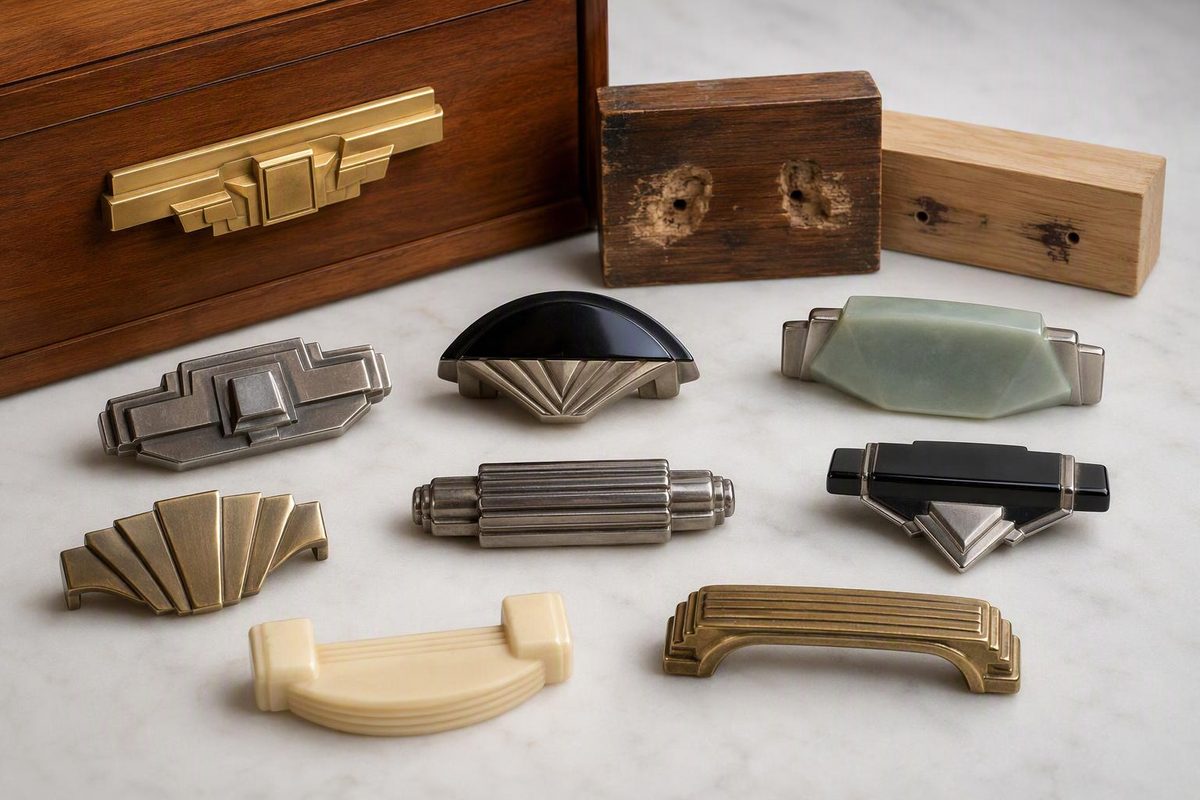
A stepped brass handle can look convincingly “Deco” and still have been fitted last year. Drawer pulls are removable parts, reproduced in large numbers and often replaced during refinishing. Their outline is useful evidence; it is not a date stamp.
The sound question is therefore not simply Is this an Art Deco pull? It is: Does its design, material, manufacture and mounting support the claimed date—and does it belong on this piece of furniture?
What period Art Deco pulls look like
Art Deco hardware does not have one standard shape. The movement joined luxury craft to industrial production, developing from European work of the 1920s into mass-market American design in the 1930s. The Wolfsonian describes that range as extending from handcrafted objects to streamlined household products (The Wolfsonian–FIU). Furniture hardware follows the same broad arc.
Common forms include:
- geometric backplates with rectangles, diamonds, chevrons, fans or stepped profiles;
- compact knobs or tabs that preserve a drawer front’s strong geometry;
- horizontal bar pulls, sometimes sharply angular and sometimes rounded for a Streamline Moderne effect;
- contrasting inserts set into metal mounts;
- stylized floral, sunburst or machine-age motifs reduced to crisp, symmetrical shapes.
Yet none is exclusive to the interwar period. Stepped plates and sunbursts remain staples of reproduction hardware, while an authentic 1920s pull may be remarkably restrained.
Material should agree with the furniture
High-style 1920s furniture could treat a handle as part of an integrated decorative scheme rather than as an off-the-shelf fitting. A Heal’s dressing table made in London in 1926–27 combines ebony and shagreen veneers with carved ivory handles and matching ivory stringing. The V&A records the design as probably by J. F. Johnson and notes its Parisian influence (V&A). Its companion bedside cabinet repeats the same ebony, shagreen and ivory vocabulary (V&A).
That example supplies a useful test: original hardware usually participates in the furniture’s design. Its scale, color, geometry and quality should make sense beside the veneer, inlay and proportions.
Period possibilities include brass, bronze, nickel- or chrome-plated metal, wood and early plastics, as well as luxury materials on bespoke furniture. Material alone proves little. Documented Art Deco furniture also used combinations such as Macassar ebony, maple veneer and brass on a circa-1938 secretary, and burl walnut, holly and plywood on a 1931–35 Donald Deskey bedroom suite (The Wolfsonian–FIU).
Treat broad listing terms cautiously. “Bakelite,” “chrome” and “brass” are often visual guesses. A seller should distinguish solid metal from plating and an identified plastic from an amber, marbled or black plastic of unknown composition. Avoid destructive or improvised chemical tests, especially while a pull remains attached to valuable furniture.
Inspect the back before the front
The strongest evidence is often hidden inside the drawer. Remove a pull only when this can be done safely, using a correctly fitting tool and supporting the fitting so it cannot spin against the finish.
Check these points:
- Hole pattern. Where the pull uses through-posts, do they pass cleanly through the drawer front? Extra holes, plugged holes or an elongated opening suggest earlier hardware or later adaptation.
- Impression and finish shadow. A long-fitted backplate may leave a protected area or a precise outline in the finish. A shadow that does not match the present plate indicates that the hardware or its position has changed, although refinishing can erase such evidence.
- Fasteners. Nuts, screws, washers and posts should work together and fit the thickness of the drawer front. Bright new fasteners do not necessarily make the visible pull new—old hardware is frequently remounted—but they prevent a confident claim that the assembly is untouched.
- Wear. Genuine use may soften exposed edges and produce contact wear where fingers repeatedly grip. Uniform artificial darkening in recesses is not equivalent to use. Conversely, carefully kept old furniture can retain crisp hardware.
- Consistency. Compare every pull. Matching fronts with different posts, castings or backplates may indicate replacements assembled to complete a set.
No single sign settles the issue. Tarnish can be manufactured, old screws can be reused, and authentic pulls can be moved from one piece to another.
Read construction, not just patina
Turn an unattached pull over. The back can reveal casting seams, stamped or pressed construction, finishing marks, plating loss and evidence that threaded posts were brazed, cast or mechanically fixed in place. Those details can help group a set and expose obvious substitutions.
But “handmade” is not a requirement. Art Deco encompassed both cabinetmaking and factory production. Likewise, a rough back is not automatically old, and a clean machine-made fitting is not automatically new. The relevant comparison is a documented fitting from the same manufacturer, furniture line or period—not a generalized idea that antiques must look irregular.
Marks deserve exact transcription. Record every letter, number and symbol before polishing anything. A patent number, registered-design number or maker’s name may be searchable, but it dates the protected design or identifies a business; it does not by itself establish when this particular example was manufactured.
Date the whole object
A drawer pull cannot authenticate a chest. Start with the furniture’s label or stamp, construction, veneer, drawer joints, secondary woods and provenance, then ask whether the hardware agrees. The same caution used for other Art Deco identification questions applies here: one fashionable motif cannot carry the attribution.
For a loose set, confidence should be lower because the original context has been lost. Useful evidence includes:
- a period manufacturer’s catalog showing the exact model and dimensions;
- a design registration or patent whose drawings match all significant details;
- period photographs of a named furniture line;
- a museum-catalogued comparison;
- documented provenance from the original furniture.
A merely similar online listing is weak evidence, and an asking price is not proof of either age or value.
A practical classification
After inspection, use language proportionate to the evidence:
- Art Deco-style drawer pulls: the geometry evokes Deco, but age is unknown or evidently modern.
- Plausibly period pulls: material, construction and wear are consistent with the 1920s or 1930s, but no model-specific documentation establishes the date.
- Period pulls, probably original to the furniture: the fittings are consistent with the piece and mounting evidence supports long-term installation, with no contradictory holes or shadows.
- Documented original hardware: maker records, provenance or a precise published comparison ties the pull to that furniture model.
That final category is much narrower than online marketplaces imply. For buyers, the most revealing requested photographs are the full furniture front, pull front and back, both mounting posts, the inside of the drawer and any marks. Those views cannot guarantee authenticity, but they can quickly separate a stylistic label from a defensible attribution.