
Choosing an Art Deco Ceiling Light Requires Four Checks
Identify Deco vocabulary and match format to room constraints. Then distinguish among period, restored, reproduced and inspired pieces and verify specifications.
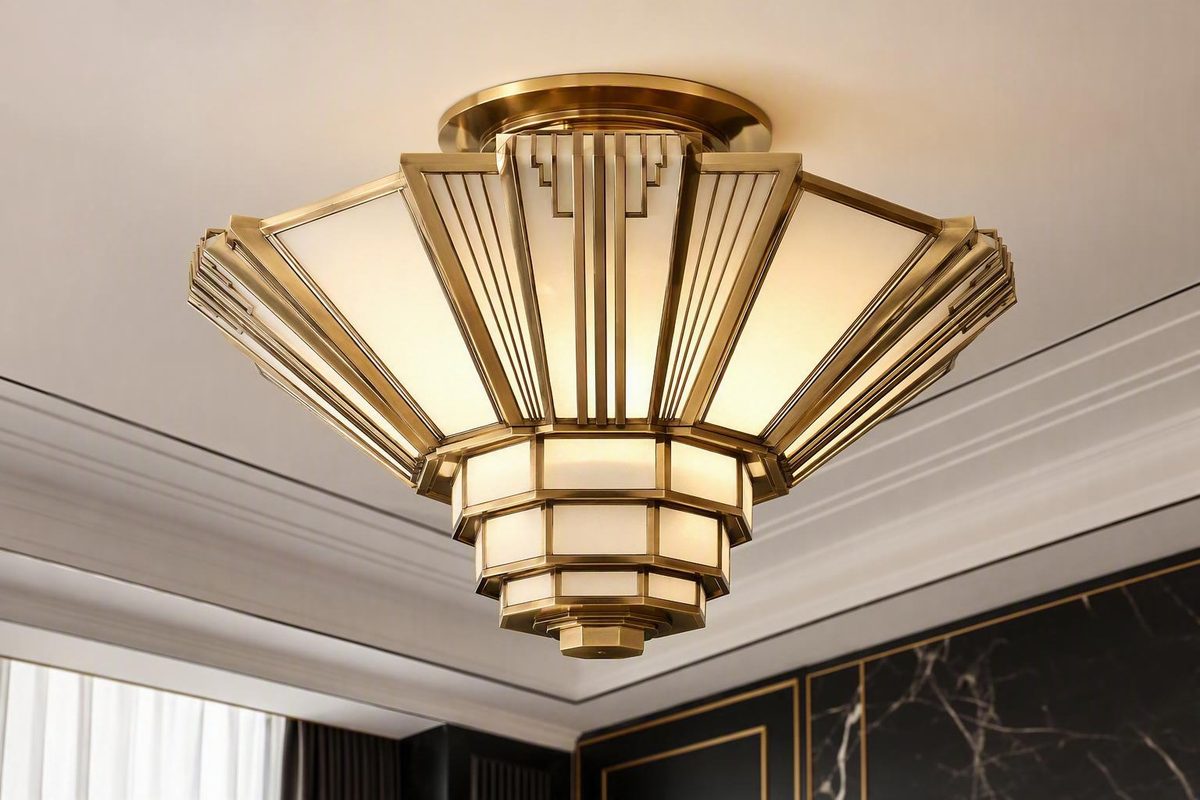
An Art Deco ceiling light must do more than look geometric. It has to suit the room’s vertical space, deliver the intended kind of light, work with the available mounting conditions, and arrive with enough documentation to establish what it is.
“Art Deco” may describe a documented period fixture, a vintage light altered or restored later, a reproduction of an older design, or a contemporary fixture that borrows Deco motifs. Retail collections may also place transitional, Neoclassical, schoolhouse, modern, and mid-century designs under the same style heading.
This guide is therefore a style-assessment and pre-purchase checklist, not a substitute for product specifications, local electrical requirements, or professional inspection. The supplied retailer material does not provide complete product-level evidence for dimensions, output, certification, environmental ratings, structural support, warranties, lead times, or replacement parts across every fixture discussed. Those details must be obtained for the exact model before purchase or installation.
A defensible choice combines four things: recognizable Deco vocabulary, the right fixture format, verified technical information, and an accurate account of age and condition.
What Makes a Ceiling Light Recognizably Art Deco?
Art Deco developed in Paris during the 1910s and gained international prominence in the 1920s. Its name is connected to the 1925 Exposition Internationale des Arts Décoratifs et Industriels Modernes, and the style flourished principally during the 1920s and early 1930s. These dates provide context rather than a simple authentication rule: not every geometric light from the era is Art Deco, and not every Deco-looking fixture dates from it.
For an overview of the movement’s motifs and evolution into 1930s streamlining, see Deco Library’s guide to Art Deco’s defining elements. A broader historical reference describes the style as emerging in Paris in the 1910s and flourishing internationally during the 1920s and early 1930s (Art Deco historical overview).
The most recognizable Art Deco lighting organizes ornament through balance and repetition. Common features include:
- Strong bilateral or radial symmetry
- Repeated straight lines
- Stepped or ziggurat profiles
- Chevrons and zigzags
- Fans and stylized fountains
- Sunbursts and radiating ribs
- Globes, hemispheres, and domes
- Layered architectural silhouettes
- Stylized rather than naturalistic decoration
A central lamp, canopy, globe, or bowl creates a natural origin point for a sunburst, while repeated arms can form a balanced fan or star. No single feature proves age, however. A sunburst can appear on a period original, a faithful reproduction, a later revival, or a generic contemporary fixture.
Materials provide another stylistic clue. Frosted, opalescent, patterned, colored, layered, or pressed glass commonly appears with chrome, nickel, brass, or bronze. Glass may be formed into stepped shades, geometric bowls, fluted panels, globes, or tiered structures. Reflective metal can reinforce the style’s machine-age associations, while bronze and brass connect a fixture to its warmer, more decorative side.
Not all Deco is sharply angular. Streamline Moderne, associated with the style’s later development, favors smooth curves, rounded corners, horizontal emphasis, and polished surfaces that suggest speed or aerodynamic movement. A sleek chrome dome with curved bands may therefore belong to the broader Deco vocabulary even without chevrons or stepped ornament.
Art Nouveau offers a useful contrast. It generally favors organic curves, nature-derived motifs, whiplash lines, flowers, tendrils, insects, and compositions that may be deliberately asymmetrical. Art Deco also uses plants and animals, but typically translates them into balanced, repeated, or geometric patterns. A flower rendered as a symmetrical fan is more consistent with Deco than a stem that appears to grow freely around a fitting.
Retail labels often blur these distinctions. A collection may mix Deco with modern globes, schoolhouse shades, transitional fittings, Neoclassical ornament, or mid-century silhouettes. Such hybrids may work well in a Deco-influenced interior, but a collection label is not a historical classification.
Use this four-part sequence for an initial visual reading:
- Overall profile: Is the fixture stepped, angular, domed, tiered, streamlined, or architectural?
- Symmetry: Is it balanced around a center line or central point?
- Motif: Does it use chevrons, fans, sunbursts, zigzags, globes, or disciplined repetition?
- Materials: Are glass and metal treated in a way consistent with the broader Deco palette?
This process can establish stylistic compatibility. It cannot establish when, where, or by whom the light was made.
Flush, Semi-Flush, Pendant, or Chandelier?
Fixture format determines how much physical and visual space an Art Deco ceiling light occupies. Choosing a suitable format before becoming attached to a particular shade or finish prevents many impractical shortlists.
A flush mount sits close to the ceiling, usually with the body or canopy meeting it directly. It is the logical starting point when vertical space is tightly constrained.
A semi-flush mount hangs from a short stem, neck, or fitting. The resulting gap gives the shade some visual separation from the ceiling without creating the longer suspension of a pendant. It can work where a modest drop is acceptable and the fixture’s side profile deserves to be visible.
A pendant hangs farther into the room from a cord, chain, rod, or stem. Pendants range from compact single-shade fittings to large multi-light compositions. Suitability depends on the exact installed drop, fixture width, mounting location, and activity below.
A chandelier is generally a larger suspended composition with multiple lamps, arms, shades, tiers, or decorative elements. Some Deco chandeliers are vertically elongated; others spread horizontally through bowls, globes, or repeated geometric arms. Their weight, width, and installed drop require product-level verification.
Bowl lights and inverted domes complicate retailer terminology. A glass or alabaster bowl might be classified as a pendant, semi-flush fitting, or chandelier depending on its suspension and scale. Remains, for example, separates its Deco inventory into categories including chandeliers, pendants, flush mounts, semi-flush mounts, lanterns, and inverted-dome chandeliers, illustrating the breadth of the category (Remains Art Deco collection).
Use a qualitative rather than universal ceiling-height framework:
- Begin with flush mounts where vertical space is tightly constrained.
- Consider semi-flush mounts where the room can accept a modest drop.
- Consider pendants only where their documented suspension and width suit the mounting position and circulation.
- Consider chandeliers where the complete installed size, weight, and composition can be accommodated.
No style-based formula can determine whether a fixture fits. Labels such as “hall light,” “bedroom chandelier,” or “low-ceiling fixture” are only starting points. House of Antique Hardware described its Middlebury Square flush mount as an option for a low ceiling, but the captured listing was sold out; it is an illustration of the format, not a current recommendation (retailer flush and semi-flush category).
Actual fit must be assessed from:
- Maximum diameter or width
- Body height
- Minimum and maximum installed drop
- Canopy diameter and depth
- Adjustable chain, cable, or rod range
- Complete fixture weight
- Furniture beneath or near the mounting point
- Door and cabinet paths
- Normal walking and working routes
- Position of the existing electrical connection
- Documented mounting and support requirements
Before comparing products, measure the room and ceiling, identify the mounting point, and record the maximum acceptable drop. Compare those constraints with a dimensioned drawing for the exact fixture—not a staged photograph, room rendering, or collection description.
Glass, Alabaster, Crystal, and Metal: Reading the Material Palette
Decorative glass paired with polished metal is one of the most persistent Art Deco lighting combinations. Chrome and nickel create a cooler, machine-age effect; brass, bronze, gilt, and gold-colored finishes produce a warmer impression. All can fit the broad Deco palette, although none proves that a particular fixture is period-original.
Glass treatments associated with Deco and Deco-inspired lighting include:
- Frosted or acid-treated glass
- Opalescent or opaline glass
- Opaque milk glass
- Molded or pressed glass
- Ribbed and patterned glass
- Layered glass
- Mirrored glass
- Colored glass
- Clear glass
- Faceted crystal
These materials create different visual tendencies, but their names do not establish lighting performance.
Likewise, a clear shade around a low-output frosted lamp may appear less glaring than an opaline shade with a powerful lamp visible through an opening. Compare complete fixtures rather than assuming one material is always softer or brighter.
Alabaster and crystal appear prominently in some higher-priced contemporary Deco-inspired collections. Vaughan Designs, for example, presents flush, semi-flush, bowl, glass, and alabaster ceiling fixtures within a collection it explicitly describes as Art Deco-inspired (Vaughan Art Deco collection). Neither alabaster nor a premium price establishes historical accuracy.
Request photographs of the actual shade both illuminated and unlit. If visual uniformity matters, ask what degree of variation the maker accepts. If output matters, request verified product data instead of estimating brightness from a lifestyle photograph.
Metal descriptions also require interpretation. “Bronze” may identify a color or finish rather than the underlying metal. Chrome, nickel, gilt, and gold descriptions can likewise cover different substrates and finishing processes.
Do not infer wall thickness, durability, corrosion resistance, craftsmanship, or solid-metal construction from a finish name. For each shortlisted fixture, obtain:
- Exact shade and body materials, not merely color descriptions
- Identification of solid, plated, coated, lacquered, or painted components
- Shade thickness where fragility or opacity matters
- Manufacturing method where disclosed
- Expected variation in natural stone or handmade glass
- Complete installed weight
- Cleaning restrictions
- Availability and cost of replacement shades or globes
- Likelihood that replacements will visually match
- Details of any coating that affects maintenance or future refinishing
The best material is not simply the one that sounds most luxurious. It is the one whose appearance, light behavior, maintenance requirements, weight, and replacement risk suit the intended location.
Period Original, Restored Vintage, Reproduction, or Deco-Inspired?
“Art Deco ceiling light” does not, by itself, say when a fixture was manufactured. Divide listings into four explicit categories before comparing them.
1. Documented period original
A period original is supported by evidence of manufacture during the relevant historical era. That evidence may include traceable provenance, maker documentation, catalog references, period photographs, invoices, auction history, consistent construction, or a defensible specialist attribution.
Geometry, patina, or an Art Deco style tag does not make a fixture a period original.
2. Restored or rewired vintage fixture
A vintage fixture may retain its original body and shades while incorporating later work, including:
- New wiring
- Replacement sockets
- Modern mounting hardware
- Refinished or replated metal
- Replacement chains, stems, or canopies
- Reproduction shades
- Components added during conversion from an earlier fuel source
Restoration is not automatically a defect. It may preserve an otherwise unusable object or make continued use more practical. The relevant questions are what was changed, when, by whom, and whether the work has been clearly disclosed.
3. Disclosed reproduction
A reproduction is a later fixture intentionally based on a period model or historical design language. It may copy a known form closely or combine historically plausible components into a new product.
Those benefits must still be confirmed for the individual product; “reproduction” does not itself establish compliance, safety, or serviceability.
4. Contemporary Art Deco-inspired design
This is the broadest category. A new fixture may use symmetrical globes, stepped forms, fluted glass, polished metal, or a sunburst without reproducing a documented historical model. It can be an excellent aesthetic choice, but it should not be represented or understood as a period artifact.
Retail collections often mix these categories. Remains provides separate made-to-order and vintage filters, while Vaughan explicitly describes its range as Art Deco-inspired. Such distinctions are more informative than a single umbrella style label.
| Category | Likely documentation | Wiring status | Customization | Replacement parts | Potential restoration | Central authenticity question |
|---|---|---|---|---|---|---|
| Documented period original | Provenance, maker or model references, period comparisons | May be original or later | Usually limited | Often uncertain | Possible or substantial | Does the evidence support the claimed date and maker? |
| Restored or rewired vintage | Original-object evidence plus restoration records | Partly or fully replaced | Sometimes possible during restoration | Variable | May be completed or still required | Which components are original, repaired, replaced, or refinished? |
| Disclosed reproduction | Manufacturer and design-source information | Usually modern, but verify | Often available | Potentially easier to obtain | Normally limited when new | Is it accurately described as later manufacture? |
| Contemporary Deco-inspired | Current manufacturer specifications | Modern or integrated | May include finish, size, or shade options | Depends on manufacturer | Normally none when new | Is the design merely evocative or based on a documented model? |
A collection page is not evidence of age. Nor are age and price substitutes for documentation. An old fixture may be incomplete, heavily altered, or unsuitable for the proposed installation; an expensive fixture may be entirely contemporary. Neither age nor price automatically proves safety, quality, rarity, or historical importance.
How to Investigate a Purported Period Fixture
Begin by separating style evidence from age evidence.
Style evidence includes symmetry, stepped profiles, chevrons, sunbursts, globes, decorative glass, and polished metals. These characteristics may establish visual compatibility with Art Deco. They cannot date the fixture.
Age evidence comes from documented history and physical construction. Ask for:
- Provenance and ownership history
- Prior purchase invoices
- Auction records
- Maker attribution
- Model or pattern references
- Period catalog comparisons
- Photographs of documented examples
- A written account of restoration and replacement
- Any specialist assessment already completed
When inspecting a fixture—or directing a seller to photograph it—look beyond the decorative front. Examine the canopy, chain or stem, shade fittings, sockets, wiring passages, screws, casting details, glass edges, maker marks, repairs, and replaced components. Look for adapted fittings, drilled holes, mismatched hardware, or evidence of conversion from another use.
Substantial weight, aged surface color, slot-head screws, thick glass, bubbles, small chips, and manufacturing irregularities may justify further investigation. None independently proves authenticity.
Maker marks require the same caution. Names such as Lalique, Sabino, or Degue appear in commercial identification guidance, but a signature or molded name must be consistent with documented forms, materials, production methods, and provenance. A mark is one part of an attribution, not its conclusion. Collecting guidance similarly emphasizes maker attribution, provenance, condition, documented comparison, and restoration history (M.S. Rau’s collecting overview).
Replacement wiring and hardware may be appropriate for continued use, but alterations can complicate dating. Request a written restoration history that distinguishes retained, repaired, replaced, and refinished components.
For an online purchase, ask for clear photographs of:
- Front and back of the canopy
- Every label, stamp, signature, or molded mark
- Shade rims, edges, fitters, and retaining hardware
- Sockets and socket covers
- Wiring entry and exit points
- Screws, nuts, chains, rods, and fasteners
- Cracks, chips, solder, adhesive, and repaired breaks
- Areas of plating loss or refinishing
- Newly fabricated or replacement components
- The complete fixture illuminated and unlit
For an expensive, fragile, or materially significant purchase, consider an independent specialist assessment. It may identify inconsistencies and improve the evidence available, but it cannot be assumed to produce a definitive maker attribution or manufacturing date.
It states that it does not deal in antiques and that galleries do not pay for placement (Deco Library’s editorial positioning).
The Specification Checklist to Complete Before Buying
An attractive listing is not necessarily a complete one. The supplied retailer excerpts omit many details needed to assess fit, output, electrical compatibility, mounting, and long-term ownership.
This section is a document-request checklist, not electrical-code or installation guidance. The evidence available here does not establish jurisdiction-specific requirements or prove that any named fixture is suitable for a particular location. Obtain the exact manufacturer instructions and consult an appropriately qualified professional where the fixture is antique, rewired, converted, unusually heavy, or otherwise technically uncertain; commercial antique-lighting guidance also recommends close attention to condition, conversion, and professional restoration where needed (antique-lighting buyer guidance).
Scale
Record:
- Maximum diameter or width
- Body height
- Minimum and maximum installed drop
- Canopy dimensions
- Shade dimensions
- Complete weight
- Adjustable chain, cable, or rod range
- Whether adjustment is completed at the factory or on site
- Projection of arms or ornament
Use a dimensioned drawing where possible.
Light output
Request:
- Number of lamps
- Bulb base or socket type
- Maximum permitted wattage
- Actual or recommended lumen output
- Color temperature
- Color-rendering information where relevant
- Whether lamps are included
- Whether the source is replaceable or integrated
- Shade openings and direction of illumination
- Product-level photometric information, if available
Shade opacity, lamp position, openings, and enclosed construction can change how the complete fixture performs.
Controls
Verify compatibility for the exact lamp, driver, control method, and dimmer model. A retailer’s collection-wide statement about dimming, smart bulbs, or smart-home systems does not establish compatibility for every fixture.
For integrated LED products, ask whether the driver and light source are accessible or replaceable, what replacement specifications apply, and whether proprietary parts or controls are involved.
Electrical and environmental suitability
Ask the manufacturer, seller, or qualified installer to document:
- Rated voltage and frequency
- Product certification or listing relevant to the buyer’s jurisdiction
- Grounding instructions
- Explicit dry-, damp-, or wet-location rating
- Permitted lamp type and maximum wattage
- Restrictions applying to enclosed shades
- Any required adaptation for imported wiring or sockets
A collection’s general suggestion that its products suit kitchens or bathrooms does not establish approval for every model. Product-level documentation is necessary before treating a fixture as suitable for a moisture-prone location.
Mounting and structure
Obtain:
- Complete installed weight
- A list of supplied mounting hardware
- Junction-box requirements
- Documented ceiling-support requirements
- Canopy dimensions and coverage
- Installation instructions
- Assembly instructions
- Any manufacturer requirement for professional installation
For a product marketed for both wall and ceiling use, request instructions and product-level documentation for the intended orientation. A dual-purpose name or photograph is not enough.
Availability and ordering
Distinguish among:
- Exact price
- Starting or “from” price
- Sale price
- Price for the photographed configuration
- Price after selecting size, finish, shade, or suspension
Then confirm:
- Finish and shade surcharges
- Customization charges
- Lamps and accessories
- Taxes and duties
- Shipping and insurance
- Production or restoration lead time
- Return restrictions
- Restocking fees
- Cancellation terms
- Damage-reporting deadlines and procedures
After-sales support
Ask whether the seller can provide:
- Replacement shades and globes
- Matching glass from the same production
- Lamps of the required dimensions
- Replacement LED drivers or modules
- Chains, rods, and ceiling canopies
- Socket covers and retaining rings
- Proprietary mounting components
- Finish-care products
- Installation and maintenance documentation
A fixture that is straightforward to buy may be difficult to maintain. Replacement-part availability matters particularly for delicate glass, natural stone, unusual lamp bases, and integrated light sources.
What Captured Prices Reveal—and What They Do Not
The following figures come from supplied retailer-page captures. The captures do not state a common capture date, and the prices were not independently rechecked for this article. Treat them as historical examples rather than current offers. Availability, configurations, promotions, and terms may have changed.
At the more accessible end of the sample, Tudo And Co displayed its Art Deco B and D fixed lights from $134, the Myrtle fixed ceiling light at $169, and the Miller milk-glass fixed ceiling light at $235. “From” indicates a starting configuration rather than a guaranteed final cost (captured Tudo And Co collection).
Vault Light displayed the Gem Ceiling Light at a captured sale price of $149, reduced from $249. Promotional pricing and stock are especially volatile, so this figure is useful only as a dated comparison point (captured Vault Light collection).
Premium flush-mount examples captured from Remains included:
- Mini Globe Flush Mount from $920
- Piet Flush Mount from $985
- Billie Flush Mount from $1,215
Made-to-order statement examples from the same collection included the Veronique 8 Chandelier from $6,400 and the Triple Dome Chandelier with Solid Shades from $8,790 (captured Remains collection).
A “from” price may rise with the selected size, shade, finish, configuration, suspension length, or customization. It may also exclude lamps, taxes, shipping, duties, installation, and any structural or restoration work.
The fully displayed House of Antique Hardware examples in the supplied capture were marked sold out. Those listings can illustrate formats, finishes, and previously displayed prices, but they should not be treated as currently shoppable recommendations.
Taken together, the cited sample runs from roughly $134 to more than $8,000, based on the Tudo And Co and Remains captures above. This is not a normalized market range. It combines contemporary fixed lights, premium flush mounts, promotional merchandise, made-to-order products, and chandeliers of different sizes and lamp counts. It also does not isolate documented period originals as a separate market category.
Price cannot establish:
- Period authenticity
- Electrical or structural suitability
- Material quality
- Solid-metal construction
- Durability
- Brightness
- Rarity
- Collectible importance
- Quality of restoration
For comparison, calculate total acquisition cost as:
Fixture price + configuration surcharges + lamps + shipping + insurance + taxes or duties + restoration or rewiring + installation + structural work + anticipated replacement parts
Compare totals only after confirming what each price includes. A low initial price may become less competitive after delivery and missing components; a higher starting price may include customization that another seller charges separately.
A Final Shortlist Method: Style, Fit, Evidence, and Safety
Use a four-stage workflow to reduce a broad selection to a defensible shortlist.
Stage 1: Classify the fixture
Record:
- Format: flush, semi-flush, pendant, bowl, inverted dome, or chandelier
- Primary motif and overall profile
- Shade and body materials
- Finish
- Seller’s category: period, vintage, restored, reproduction, made to order, or inspired
If the seller uses only “Art Deco,” ask for a more precise description. Do not upgrade “style,” “inspired,” or “revival” into a period claim.
Stage 2: Test physical fit
Compare the verified diameter, body height, installed drop, canopy size, weight, adjustment range, and documented mounting conditions with the measured room and mounting location.
Generic labels such as “kitchen light,” “hall chandelier,” or “low-ceiling fixture” do not replace measurements.
Stage 3: Assess evidence and specifications
Pause a purchase when information central to the proposed use is missing. Depending on the fixture, that may include:
- Complete dimensions and weight
- Electrical specifications
- Product-level certification information
- Environmental rating
- Installation instructions
- Provenance
- Maker or model attribution
- Restoration history
- Identification of replacement parts
A seller who needs time to obtain documentation is different from one who refuses to disclose it.
Stage 4: Compare total cost
Keep exact, starting, and sale prices in separate columns. Add configuration, delivery, insurance, restoration, lamps, installation, and expected replacement parts.
For antiques, account for fragile shipping, nonstandard fittings, unavailable shades, and possible mounting adaptation. For contemporary integrated fixtures, consider the availability of replacement drivers, modules, and proprietary components.
Red flags include:
- Unsupported claims that a fixture is “original Art Deco”
- No photographs of the canopy, fittings, sockets, or wiring
- Missing diameter, drop, or weight
- Vague descriptions such as “brass tone” without construction details
- Collection-wide compatibility promises
- No product-level environmental rating for a moisture-prone location
- Conflicting dates or style descriptions
- Refusal to disclose restoration
- A maker mark presented as conclusive proof
- A sale price shown without the applicable configuration
Green flags include:
- A complete specification sheet
- Dimensioned technical drawings
- Accurate category labeling
- Written restoration records
- Clear maker, model, or provenance evidence
- Identification of replacement components
- Product-level certification and environmental-rating information
- Replacement-part availability
- Written return, cancellation, and damage terms
- Photographs of concealed construction as well as decorative surfaces
Antique, rewired, converted, unusually heavy, fragile, or structurally demanding fixtures warrant appropriately qualified evaluation or installation. The best Art Deco ceiling light is not necessarily the oldest, most ornate, or most expensive. It is the one whose style, dimensions, documentation, condition, and technical requirements align with the intended setting.
Frequently Asked Questions
What type of Art Deco ceiling light works best for a low ceiling?
Begin with a flush mount because it generally occupies less vertical space than a suspended pendant or chandelier. A semi-flush fixture may also work where a modest gap below the ceiling is acceptable.
Do not choose by format name alone. Verify the complete installed height, diameter, canopy dimensions, weight, and mounting instructions against the measured room. Door paths, circulation, furniture, and the exact mounting position also affect suitability.
How can I tell whether an Art Deco ceiling light is original or a reproduction?
Treat style as the first filter, not proof. Symmetry, stepped glass, chevrons, sunbursts, globes, and polished metal may make a fixture look Art Deco, but they cannot establish its age.
Request provenance, maker or model references, prior invoices, restoration records, and documented comparisons. Examine the canopy, shade fitter, sockets, wiring passages, screws, castings, glass edges, marks, repairs, and replacement components. Patina, old-style screws, thick glass, bubbles, chips, or a maker mark are clues for further investigation—not conclusions.
For a significant purchase, consider an independent specialist assessment, while recognizing that inspection may not produce a definitive date or attribution.
Are brass and chrome both authentic Art Deco finishes?
Both are historically established within the broad Art Deco material palette. Brass and bronze create a warmer effect, while chrome and polished nickel emphasize the cooler, machine-age side of the style. Streamlined designs often make strong use of smooth reflective metal.
Neither finish authenticates an individual fixture. Confirm whether the relevant components are solid, plated, coated, lacquered, or painted, and obtain appropriate care instructions.
Can an Art Deco ceiling light be installed in a bathroom or kitchen?
The style label cannot answer that question. A retailer may suggest kitchens or bathrooms at collection level, but that does not establish that every fixture has the appropriate product-level documentation for the proposed location.
Obtain the exact model’s environmental rating, electrical documentation, and installation instructions. For a moisture-prone or otherwise technically uncertain location, ask an appropriately qualified professional to assess the product and proposed installation under the requirements applicable where it will be used.
Do antique Art Deco ceiling lights need to be rewired?
Some may; others may already have been rewired. Age alone does not establish the condition of the wiring, sockets, insulation, grounding provisions, or mounting components.
Request a written restoration history and have the actual fixture evaluated where appropriate. Replacement wiring can be a practical alteration, but it may coexist with older sockets or hardware and may complicate historical assessment. A description such as “working” does not by itself establish readiness for installation.
The compact decision rule is simple: identify the Deco vocabulary, choose the fixture format according to verified physical constraints, label the piece accurately as period, restored, reproduced, made to order, or inspired, and require complete technical and provenance documentation before buying. A well-documented light that fits the room and can be installed appropriately is a stronger choice than an attractive but underspecified listing.