
Art Deco Lady Floor Lamp: Design Date vs Casting Date
Identify an Art Deco lady floor lamp through model, scale, marks and casting date, with documented Clarté examples and a published auction result.
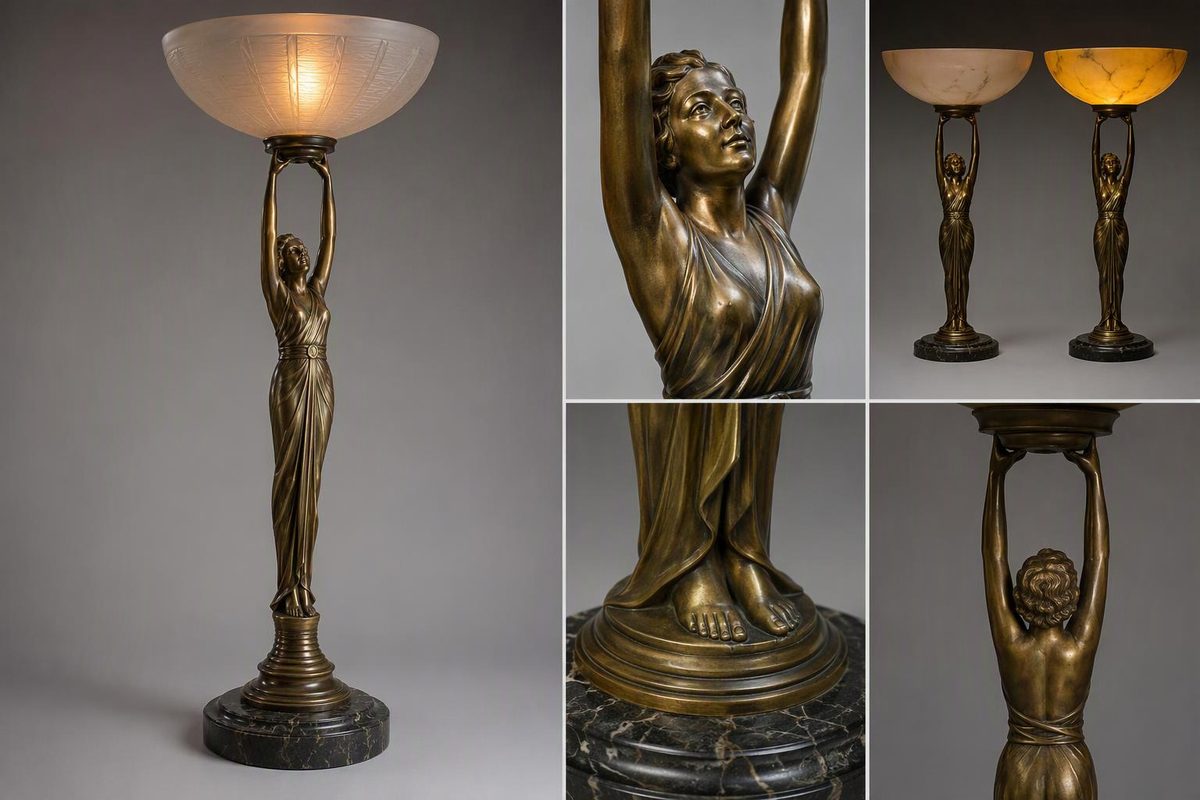
Max Le Verrier’s Clarté captures the appeal of the Art Deco lady floor lamp: a standing nude holds a luminous globe in outstretched arms, making the figure part of the lighting design rather than decoration on a conventional stem. Maison Max Le Verrier dates the design to 1928, describing its bobbed hair and restrained outline as expressions of the era. Yet a lamp matching that design need not have been made in the 1920s or 1930s. Maison’s model history establishes the design’s origin—not the casting date of an individual example.
For a buyer, the useful distinction is between a period lamp, a later casting of a period design, and an unrelated Deco-style figure lamp. Using Clarté as a documented example, identify the model and scale first; then investigate when the particular lamp was made.
Start with the figure—and measure the whole lamp
“Lady lamp” describes a subject, not a maker or model. For a proposed Clarté, compare the pose, hairstyle, proportions and globe arrangement with documented examples. Bonhams describes a life-sized example with an arched back, extended arms supporting a frosted spherical shade, and a domed base. Those details provide a more precise comparison than “woman holding a ball.” Bonhams, lot 80, 26 November 2013
Scale is especially important. Maison’s history distinguishes human-sized Clarté from a smaller 85 cm version, Lumina at 68 cm, and Lueur at 38 cm. These are the maker’s stated sizes, not universal measurements for every lamp sold under those names. Maison Max Le Verrier
Ask for three measurements:
- Figure height, excluding any added pedestal.
- Overall height, including the shade and base.
- Maximum width and depth, including projecting arms and globe.
A smaller figure mounted on a tall stand is not the same object as a life-sized casting. Nor does a close-up photograph establish that a lamp is floor-sized. For comparison, Bonhams recorded the 2013 example as 166 cm high; dealer Deconamic lists a bronze height of 156 cm and a height including its custom wooden base of 186 cm. Confirm what each measurement includes before comparing lamps. Bonhams; Deconamic
A signature does not establish a period casting
The Bonhams life-sized lamp carried a cast “M.Le Verrier” signature and “Le Verrier Paris” foundry stamp, but the auction house dated it post-1945. Its saleroom notice also clarified that it was cast bronze and stamped “Bronze.” This is a documented example of a signed, foundry-marked lamp that was not catalogued as interwar production. Bonhams catalogue and amendment
The distinction remains relevant to present-day listings. Deconamic explicitly describes its signed, foundry-marked, life-sized Clarté as a “posthumous contemporary cast” of the 1928 design. That disclosure is more useful than a title simply calling the object “Art Deco.” Deconamic listing
Request clear photographs of every signature and stamp, plus invoices, earlier photographs or ownership records that identify the actual lamp. A model match supports the design attribution; a dated record must also be tied to the object in front of you. An old photograph may establish that the lamp existed by a certain date without establishing its exact casting date. Without stronger evidence, keep its manufacturing date unresolved.
Treat material as a separate question. Bonhams catalogued another Clarté, 81.7 cm high and unsigned, as green-patinated metal of the mid-to-late twentieth century. That description does not specify the alloy, and the green finish is not evidence of interwar age. Bonhams, lot 232, 11 August 2020
Examine the figure as a working lamp
A female-figure lamp needs inspection where sculpture and lighting meet. Ask for close-ups of the hands and wrists, the globe support, the feet-to-base connection, and any visible cable entry or socket mounting.
Look for cracks, repaired joints, missing fingers, altered supports and mismatched finishes. Ask whether the figure was made as a lamp or subsequently adapted from a sculpture, and what evidence supports the answer. Do not dismantle a heavy casting yourself to investigate it.
Record the shade and pedestal separately from the figure. The contemporary Deconamic example includes a crackled-glass shade and custom wooden base; neither feature, by itself, establishes a period assembly. Deconamic’s component description
For replacement-glass questions, consult the shade identification and fit guide. General electrical and stability checks are covered in the torchiere buying guide. Have the electrics assessed by a qualified professional before use; an attribution is not an electrical safety assessment.
Use like-for-like auction comparisons
Bonhams published a result of £35,000 including buyer’s premium for the 166 cm, post-1945 Clarté on 26 November 2013. That is a historical result for a specified life-sized lamp—not a current price guide for every “Art Deco lady lamp.” Published auction result
Before using any comparison, match model, scale, material, casting date, shade, base and condition. The decisive seller question is: “What dates this particular casting, rather than the design it reproduces?”