
Lincoln Tunnel Art Deco Bricks: Price and Buying Guide
Compare the two reclaimed Lincoln Tunnel brick types, calculate project quantities at $2.25 each, and learn what to verify before ordering.
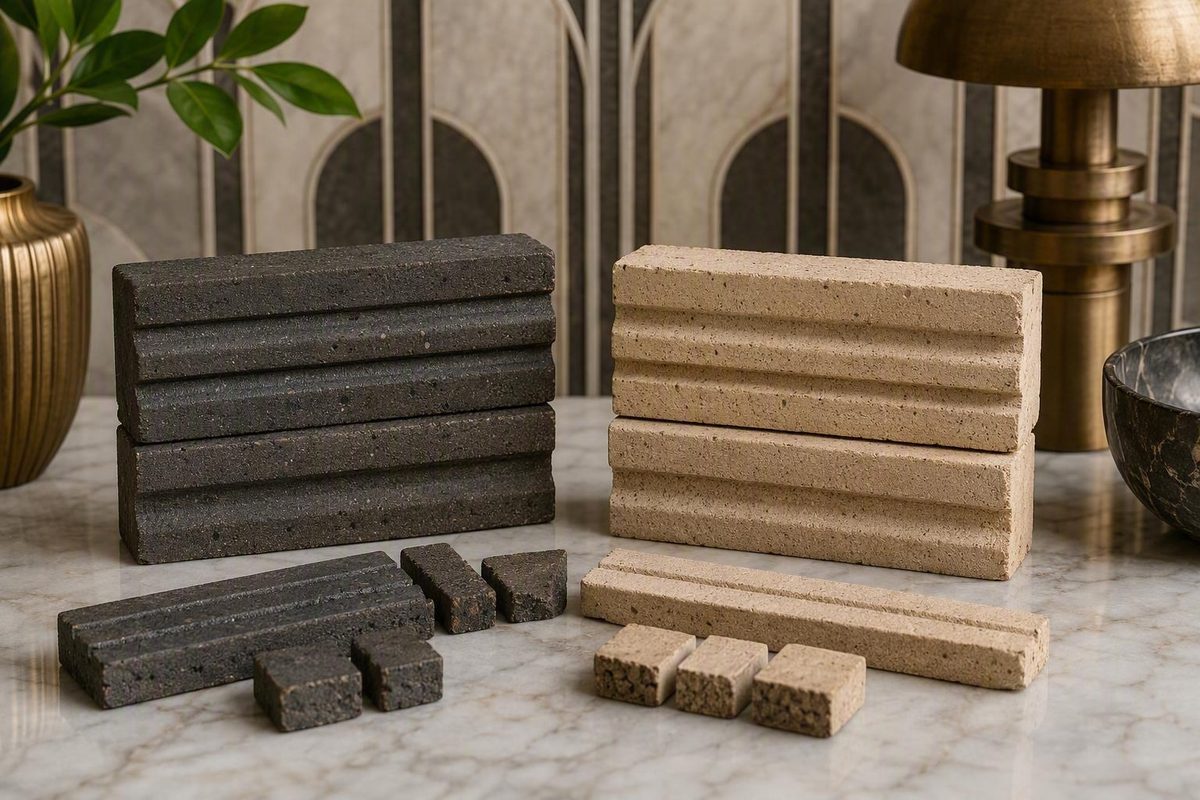
Lincoln Tunnel Art Deco bricks are listed through Orbit at $2.25 each, subject to availability. The documented choices are buff Type C brick from the retaining walls’ exterior face and red common brick from their interior layers. Neither listing identifies a special brick that carries the recessed vertical banding: that effect belonged to the walls’ masonry arrangement, not a separately listed ornamental unit.
Choose a brick, project shape and dimensions; the calculator returns the quantity, material cost, waste allowance and recessed-band allocation.
Estimate material from the documented dimensions and $2.25 unit price. Mortar joints, delivery and other charges are not included.
Order 9 Type C bricks for an estimated material cost of $20.25.
1 × 1 ft feature wall, running bond, calculated from the 7⅞ × 2.25 in. exposed face. Mortar joints are excluded.
| Product | Documented Size | Original Position | Wall Face Used | Flat Face Used |
|---|---|---|---|---|
| Type C buff | 7⅞ × 3¾ × 2.25 in. | Exterior face | 7⅞ × 2.25 in. | 7⅞ × 3¾ in. |
| Red common | Average 8 × 3.5 × 2.25 in. | Interior layers | 8 × 2.25 in. | 8 × 3.5 in. |
Source: Port Authority reuse account and Orbit Lincoln Tunnel product listings. Unit price: $2.25 per brick; quantity subject to availability. Estimates exclude mortar joints, taxes, pallets, handling, loading and delivery.
Buy the Bricks Through Orbit
The Port Authority placed the salvaged bricks on the reuse market in July 2026 as the original approach walls were dismantled for ramps associated with the $10 billion Midtown Bus Terminal project. Orbit, a third-party marketplace for reclaimed construction materials, carries the documented listings.
Check Orbit’s current Lincoln Tunnel listings before planning a purchase. Inventory was described as subject to availability, so the existence of a dated listing does not confirm that either brick type—or the quantity needed for a project—remains available.
The practical ordering sequence is:
- Select Type C buff exterior face brick or red interior common brick.
- Confirm the exact product and available quantity.
- Request a complete written quote rather than multiplying the quantity by $2.25 alone.
- Confirm the fulfillment date and whether delivery or buyer collection is available.
- Ask what invoice, project description or other provenance documentation accompanies the order.
Purchasing questions should be directed to Orbit at hello@orbitexchange.co. Deco Library does not sell or authenticate the bricks.
The material came from retaining walls outside the Manhattan approach to the New Jersey-bound north tube and along Dyer Avenue—not from inside a tunnel tube. The Port Authority describes the source and salvage program.
Type C Is the Visible Exterior Brick
Orbit documented two products at the same unit price, but they have different positions in the original wall and different visual character.
| Brick Type | Original Position | Approximate Size | Documented Price |
|---|---|---|---|
| Type C buff face brick | Exterior face | 7⅞ × 3¾ × 2.25 in. | $2.25 each |
| Red common brick | Interior layers | 8 × 3.5 × 2.25 in. average | $2.25 each |
The Type C brick is the direct choice for a buyer seeking material from the retaining walls’ visible Art Deco exterior. Orbit describes it as buff-colored face brick in good condition, with quantity subject to availability. The Type C listing records its dimensions and origin.
The red common brick came from the walls’ interior layers. Its historical interest depends principally on documented Lincoln Tunnel provenance; viewed alone, it may resemble ordinary reclaimed red masonry. Orbit’s red-brick listing documents the interior source.
The equal listed price does not make the products interchangeable. Their color, dimensions, surfaces and relationship to the original exterior differ. Check the product title on the quote if exterior face brick is essential to the collecting or design concept.
Recessed Bands Were Part of the Wall Composition
The retaining walls’ Art Deco treatment included vertical recessed brick bands, concave brick ridges, concrete coping, stylized piers and abutments, and lighting towers. Those elements created changes in plane, shadow lines and a strong vertical rhythm across the approach.
Orbit does not document a third category called a patterned-band brick, nor do its two product descriptions promise that every loose unit has a molded motif, inscription, unusual profile or maker’s mark. The recessed banding describes how masonry was positioned within the architectural composition.
A loose Type C brick may therefore look like a buff face brick rather than a miniature Art Deco ornament. A red common brick may carry no visible clue to its origin. That does not negate the represented provenance, but it makes transaction records especially important.
For a feature wall that refers to the original vertical bands, the calculator treats “band bricks” as a design allocation from the total order. The required percentage is not supplied by the historic listings because it depends on the new design. Enter the share specified by the designer; do not assume that those bricks are a separate product.
The Walls Date From 1937 to 1945
The retaining walls were built between 1937 and 1945. Their architectural team was led by Aymar Embury II, whose work treated the tunnel approach as a coordinated ensemble rather than a collection of individually ornamented bricks.
This creates two distinct kinds of historical interest. Architectural provenance concerns an object’s documented origin in the historic structure. Individual decoration concerns a visible feature on the object itself. The available listings establish the represented source and product type, but they do not state that each brick is individually decorative.
Type C has the closest relationship to the visible wall surface. The red common brick formed part of the construction behind that surface. A listing photograph can illustrate the product category, but visual similarity alone is not transaction-specific proof of origin.
If provenance is central to the purchase, ask whether the paperwork will identify:
- The Lincoln Tunnel retaining-wall project
- Type C exterior face brick or red interior common brick
- The purchased quantity
- The transaction date
- Any available batch or inventory reference
Do not assume that a certificate is included. Retain the invoice, listing details, correspondence, packaging labels and photographs together, particularly when the brick has no distinctive identifying mark.
The $2.25 Price Excludes Unconfirmed Charges
Both products were documented at $2.25 per brick. Contemporary coverage also reported that unit price through Orbit. 6sqft reported the sale and Lincoln Tunnel provenance.
| Quantity | Material-Only Cost |
|---|---|
| 1 brick | $2.25 |
| 10 bricks | $22.50 |
| 100 bricks | $225.00 |
| 500 bricks | $1,125.00 |
These examples exclude any taxes, deposits, pallets, packaging, handling, loading, delivery, freight or other charges. The available evidence does not establish which additional charges apply, whether there is an order minimum or whether the documented price will remain unchanged.
Before paying, obtain answers for the exact brick type and quantity:
- Is the requested quantity currently available and reservable?
- Is there a minimum or maximum order?
- Does the live unit price remain $2.25?
- Are taxes, pallets, packaging, handling or loading added?
- What does local delivery cost, and does it include unloading?
- Is buyer collection permitted, and is an appointment required?
- What payment or deposit confirms the order?
“Local delivery available” does not mean delivery is free. Likewise, a listing location is not confirmation of walk-in access or buyer pickup.
Inspection Is Available at the Listed Nanuet Location
Both listings identify 15 Fisher Avenue, Nanuet, New York 10954 as the material location and state that in-person review and local delivery are available. They showed an availability date of August 14, 2026, while the listing narrative described delivery as expected in late summer 2026.
Those fields do not establish immediate fulfillment or an unrestricted collection procedure. Ask Orbit for the expected date applicable to the specific product and order quantity.
An in-person review is most useful when choosing a display brick or ordering enough material for a visually consistent installation. Examine the available stock, or request current photographs, for color variation, chips, cracks, edge loss, staining, weathering, residual mortar and dimensional variation.
Orbit’s “good” quality classification is a broad marketplace description. It does not promise that every brick is cosmetically identical, fully cleaned or free from wear. Ask whether individual selection is possible if appearance matters.
Project Estimates Need a User-Selected Waste Allowance
The calculator uses the listed brick dimensions and the $2.25 unit price. It estimates wall quantities from the brick’s long face, hearth quantities from its flat face, and a single-course garden edge from the selected along-run dimension.
It does not add a mortar joint because the supplied product information gives no joint width. Bond choice does not change the theoretical face area; cuts, breakage, condition and installation details are represented by the waste percentage entered by the user. The source material provides no standard waste figure for these salvaged bricks.
For a one-off display piece, the arithmetic may be only $2.25 before fulfillment charges. For a wall, hearth or garden edge, dimensions should be checked against the actual delivered batch before finalizing the layout. The listed measurements are approximate, and the red common-brick dimensions are expressly described as an average.
A recessed-band allocation in the calculator is not an additional order. It divides the estimated total between bricks intended for the bands and those intended for the surrounding field. The design determines that share.
Installation Suitability Is Not Established by the Listings
The product information documents provenance, approximate dimensions, marketplace condition and availability. It does not establish suitability for structural work, paving, a fireplace, a hearth or another regulated application.
Historical provenance is not technical approval. Before purchasing for a permanent installation, obtain the appropriate professional assessment and code review. That review may need to address the bricks’ condition, heat exposure, weather exposure, structural role, substrate and installation method.
Nonstructural concepts include a loose commemorative object, desk piece, bookend or interpretive exhibit. A larger feature wall or landscape installation requires a separate suitability decision based on the actual material and setting.
Salvage Preserves Material, Not the Complete Design
The affected wall sections are being dismantled for ramps associated with the new Midtown Bus Terminal. The Port Authority identifies Chief Bricks as the party recovering the masonry, cleaning it and removing mortar before resale. Some recovered bricks are being retained for future repairs to walls that remain; other material can enter the reuse market through Orbit.
The deconstruction and reuse pilot involves the Port Authority, Orbit and Chief Bricks through the Transit Tech Lab. It is intended to test demand for reclaimed material and evaluate possible financial and embodied-carbon savings compared with conventional demolition.
The published project information does not provide completed figures for carbon savings, waste diversion, resale revenue or overall financial performance. Those benefits remain goals under evaluation rather than quantified outcomes in the supplied evidence.
A reused brick preserves a material fragment of the historic approach, but not the original relationship among its recessed bands, ridges, coping, piers, lighting and roadway. The strongest purchase combines the correct product choice with records that preserve where the fragment came from.