
Art Deco Couches: How to Identify a Period Sofa
Learn to identify Art Deco couches through frames, maker marks, provenance and model records, and separate period sofas from restorations and revivals.
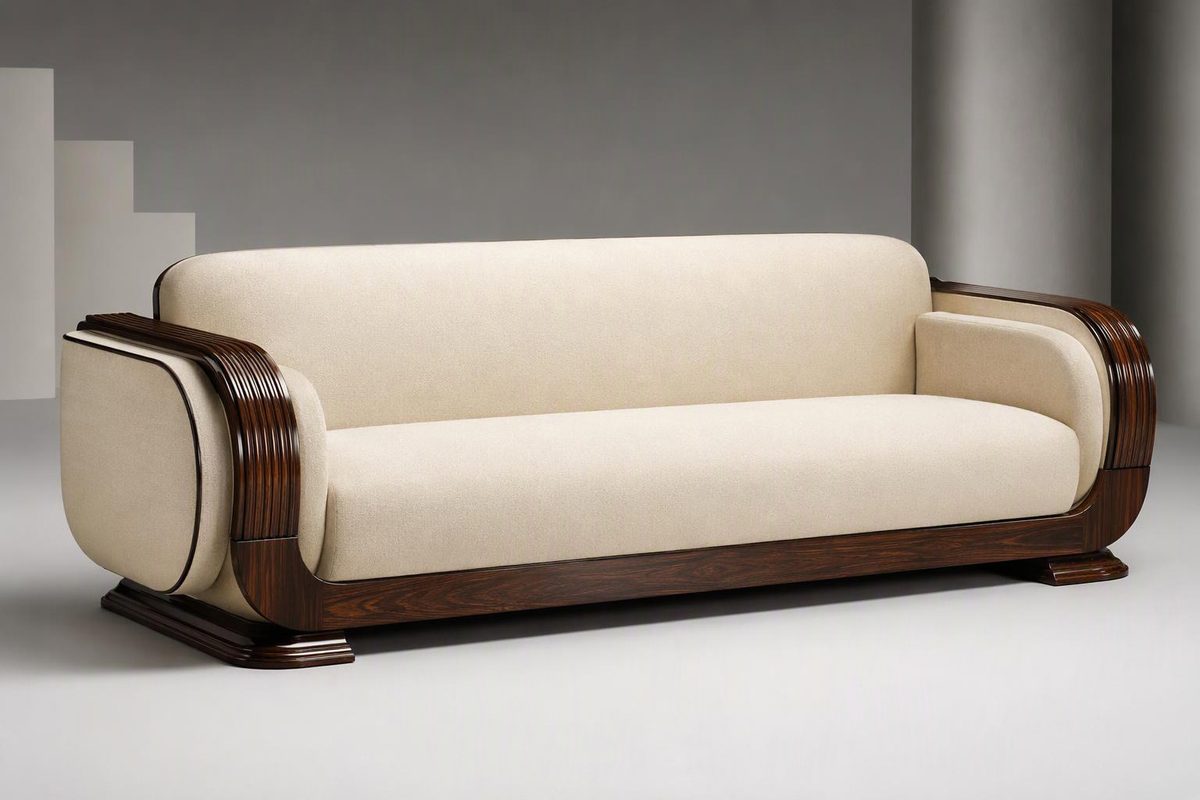
An Art Deco couch should be described as period only when its frame, construction and documentary evidence support interwar manufacture. Curved backs, channel upholstery, glossy veneer and geometric profiles can suggest the style, but none proves age; without stronger evidence, the accurate description is usually “Deco-style sofa, manufacture date unknown.”
Choose the strongest evidence available; the tool gives you a working catalogue category.
The appearance does not establish age
With stylistic resemblance alone, describe the couch as Deco-style and its manufacture date as unknown. Do not assign a period or designer attribution.
Evidence Check
Select what can be documented for this particular couch, not what it resembles.
How to use the category
Treat this as a working description, not authentication. Photographs of the underside, marks, joints and alteration evidence are still needed.
Source: Decision logic follows the evidence ladder and four catalogue categories described in the accompanying article.
What Period Art Deco Sofas Actually Looked Like
A circa-1932 Ruhlmann “Ducharne” sofa does not look much like Jean-Michel Frank’s austere iron-and-leather settee of about 1929. “Art Deco couch” describes a broad market category rather than one reliable shape.
Three documented examples show the range:
- Upholstered luxury: A circa-1920 sofa by Louis Süe and André Mare was made in mahogany with velvet upholstery. Its full silhouette and exposed wood belong to a traditionally luxurious strand of early Deco (Sotheby’s).
- Refined geometry: Ruhlmann’s circa-1932 “Ducharne” suite combined Macassar ebony, gilt bronze and fabric upholstery. Sotheby’s records it as produced by Porteneuve, with each piece branded DESSINÉ PAR RUHLMANN/EDITÉ PAR PORTENEUVE (Sotheby’s).
- Severe modernism: Jean-Michel Frank’s circa-1929 settee for collector Templeton Crocker used iron and leather. A sofa from the Deco period could be visually austere rather than ornamental (Christie’s).
Metal was not merely decorative. The Musée des Arts Décoratifs dates a group of tubular-metal furniture to 1926–31 and says the material’s flexibility, lightness and strength changed furniture forms, especially seating and the cantilever chair (MAD Paris).
In the United States, Warren McArthur’s 1934–35 “Rainbow Back” chair combined anodized aluminum and upholstery, providing a documented comparison for metal-framed seating associated with later Deco and Machine Age design (Carnegie Museum of Art).
An Art Deco couch may therefore have a compact exposed-wood frame, a fully upholstered architectural body, metal supports or a combination of these. Judge the complete object rather than one fashionable detail. For the style’s broader chronology, see what defines Art Deco design.
Use the Silhouette as a Screening Test
A couch plausibly designed in the interwar period may have:
- stepped, rectilinear or controlled curved massing;
- low or continuous arms integrated into the body;
- disciplined symmetry;
- contrasting exposed wood or metal against upholstery;
- restrained geometric carving, fluting or banding;
- polished veneer, lacquer, metal mounts or tubular supports;
- proportions and details shared with matching lounge chairs.
These are screening clues, not proof. Channel backs, scalloped profiles, fan shapes and waterfall arms have all been revived. Bonhams, for example, catalogued an unmarked mahogany and veneer sofa as “Art Deco-style” and dated it to the late 20th century, not the Art Deco period (Bonhams).
Read “Art Deco style” literally unless the seller supplies separate evidence of interwar manufacture.
Examine the Frame Before the Fabric
Upholstery is often the youngest part of an old couch. Re-covering does not make a period frame modern, but it can remove labels, original textiles and evidence of earlier construction.
Ask for clear photographs of:
- the complete front, back and both sides;
- the underside and areas beneath removable cushions;
- each leg, foot, stretcher and exposed metal junction;
- the frame beneath a loose dust cover, but only where it can be viewed without damage;
- labels, brands, stamps, inventory numbers and handwritten notations;
- old tack holes, replacement blocks, spliced rails and screws that may record repair;
- veneer loss, lifting lacquer, corrosion and cracks around load-bearing joints.
Traditional webbing, springs or horsehair can be consistent with older upholstery, but none is a standalone date test. Techniques persisted, old sofas were rebuilt, and restorers may reproduce traditional layers. Conversely, modern fabric and foam may conceal a substantially older frame.
Do not identify materials from color or shine alone. Bright metal is not necessarily chrome; dark striped veneer is not necessarily Macassar ebony; a flawless black surface may be recent lacquer over either an old or a new frame. Record what is observable, then seek documentary or specialist confirmation.
Repair evidence also needs interpretation. Fresh screws prove intervention, not the age of the surrounding wood. Extra corner blocks may be later reinforcement. Repeated tack holes can show several upholstery campaigns, but without a documented starting point they do not produce a manufacture date.
Build Attribution From Several Kinds of Evidence
The strongest identification joins several kinds of evidence, ranked roughly in this order:
- Exact model documentation. Match dimensions, arm profile, feet, back divisions and exposed frame to a period catalogue, design drawing, dated interior photograph or established reference—not merely to a similar online listing.
- A credible maker or retailer mark. Compare its wording, typeface, position and attachment method with documented examples. The branded Ruhlmann/Porteneuve suite is persuasive because its mark, model, materials, provenance and literature agree; a loose label alone would not be enough.
- Continuous provenance. An invoice, estate inventory, dated room photograph or correspondence linking the sofa to an early owner is more useful than an undated family story.
- Consistent construction and materials. The frame, mounts and alteration history should not contradict the proposed maker or production period.
- Style comparison. Use appearance to form a hypothesis, not to name a designer.
American furniture needs particular care around the transition from Deco to broader modernism. Herman Miller began selling Gilbert Rohde’s first unadorned modern bedroom suite in 1932 while continuing its historical revival lines. By the early 1940s, Rohde’s modern designs made up most of the company’s output, according to The Henry Ford (The Henry Ford). A 1930s American couch can therefore be period modern without fitting the most theatrical idea of Art Deco.
Classify the Couch Before Valuing It
A useful catalogue description places the sofa in one of four groups:
- Documented period: Interwar manufacture is supported by a model record, reliable mark, provenance or compelling combination of evidence.
- Period frame, restored: The underlying sofa is old, but fabric, filling, finish, feet or structural parts have been renewed. The description should identify what changed.
- Later authorized edition or reissue: The sofa was made after the original design under a named manufacturer or rights holder. Both the design date and this example’s manufacture date matter.
- Later Deco-style sofa: It uses Deco vocabulary without evidence of period manufacture or a documented historical model.
Seller qualifiers are not interchangeable. “Attributed to” proposes likely authorship but acknowledges uncertainty. “In the manner of” and “style of” describe resemblance and do not identify the maker. None should be shortened to an unqualified designer name.
An auction estimate, dealer asking price or result for a documented designer model should not be transferred to an anonymous look-alike. Value depends heavily on attribution, provenance, originality, restoration quality, structural condition and whether a matching suite remains together.
Before buying, request a written condition report and restoration history. Confirm that the dimensions work in the room and along the delivery route. If the frame sags, moves at its joints or has cracks near load-bearing points, have a qualified upholsterer or furniture conservator examine it.
The most accurate description may be less glamorous—“Deco-style sofa, manufacture date unknown, later upholstery, maker unidentified”—but it is more useful than an unsupported period or designer attribution.