
Art Deco Door Knobs: How to Identify and Date Them
Identify Art Deco door knobs through complete-set design, materials, construction, maker marks, catalog matches and building context.
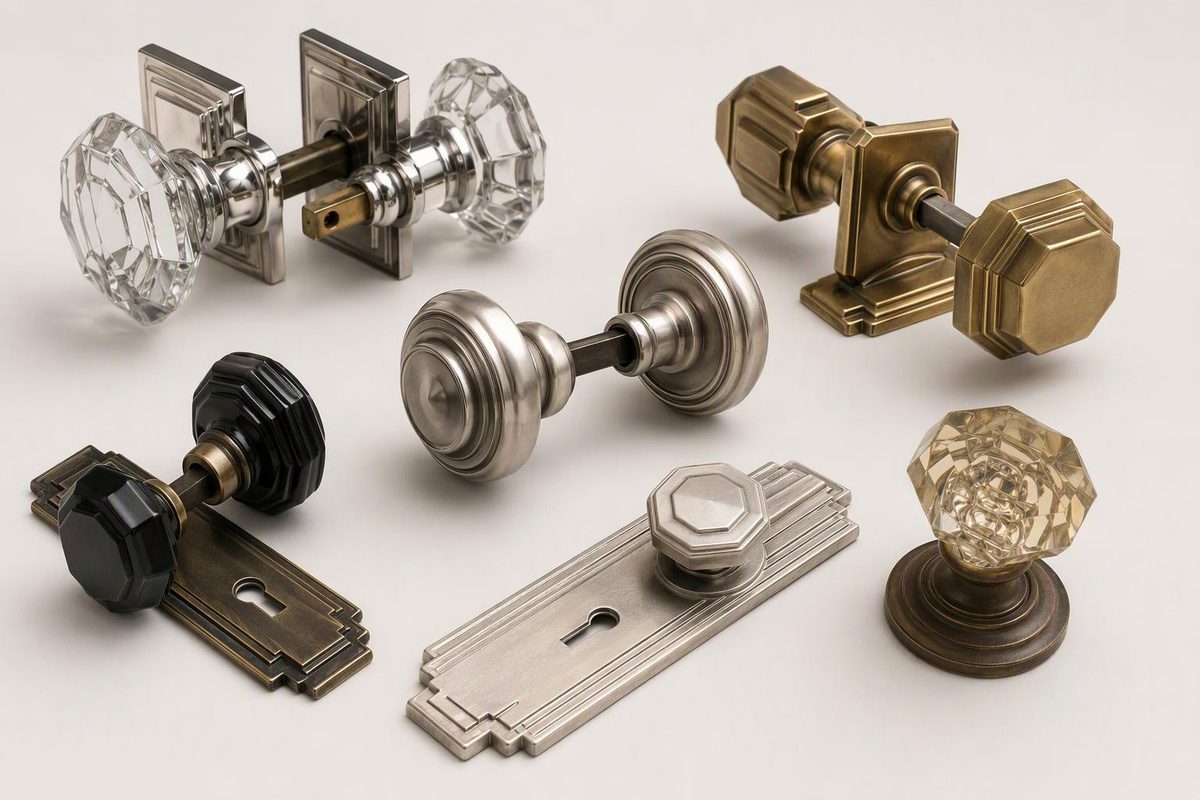
A starburst on a backplate may look unmistakably Art Deco. It is not, by itself, proof of a 1920s or 1930s door set. The knob may be earlier, the plate may be a reproduction, or both may have been assembled around an old mortise lock during a renovation.
The useful question is not simply “Does this look Deco?” It is: Do the knob, plate, spindle, lock and building context tell the same story?
What a period Art Deco set tends to look like
Art Deco door hardware translates the period’s decorative vocabulary into a working assembly. Common signals include:
- stepped or tiered backplates;
- sunbursts, fans, chevrons and fluting;
- elongated octagons and clipped corners;
- centered, symmetrical layouts;
- crisp low-relief ornament rather than deep Victorian foliage;
- streamlined horizontal lines on later 1930s designs.
Knobs may be round, oval, faceted, flattened or polygonal. Metal examples can be cast or formed from sheet metal; glass also appears with Deco-period trim. Brass, bronze and steel were available, with the visible color determined partly by the finish rather than the underlying metal.
None of these features establishes a date alone. The Metropolitan Museum of Art’s circa-1895 Guaranty Building hardware, designed by Louis Sullivan, combines geometric arcs with naturalistic foliage decades before mature Art Deco. It is a warning against calling every geometric metal knob “Deco” (The Metropolitan Museum of Art).
Conversely, period modern design was not restricted to hard-edged zigzags. The V&A holds a documented 1935 door handle designed by Gertrude Hermes and made by Henry Hope & Sons. Its spherical cast-brass knob has a recessed cross, while its backplate takes the form of a stylized rose. The museum records its original commission and 1935 exhibition history, making its date far more secure than appearance alone could (Victoria and Albert Museum).
For the wider shift from 1920s luxury geometry to 1930s streamlining, see the decade-by-decade Art Deco design guide.
Inspect the complete assembly
A complete door set normally offers more evidence than a loose knob. Record each component before taking anything apart:
- Knob: shape, pattern, material, dimensions and damage.
- Rose or backplate: outline, ornament, screw arrangement and keyhole.
- Shank and spindle: square size, threading, set screw and attachment method.
- Lock: mortise or rim case, faceplate dimensions, patent text and maker marks.
- Strike and screws: finish, wear and whether old holes correspond.
- Door: thickness, bore or mortise, paint shadows and unused screw holes.
“Matching” can mean several things. A knob and plate may share a finish but come from unrelated patterns. A pair of knobs may be old while the plate is new. A complete-looking set may contain a replacement spindle or latch.
Yale & Towne’s circa-1937 Catalog No. 29, preserved with a July 21, 1939 additions-and-corrections sheet, shows how specific complete combinations could be. It gives separate numbers for knobs, roses and escutcheons, distinguishes cast and wrought construction, and places Jackson, Kalmar, Quito, Tower and Verticon among its “Modern” designs. It also notes that some special shanks cannot be used with regular roses (Yale & Towne catalog text; ADCA catalog record). A convincing catalog match should agree in silhouette, ornament, dimensions and component numbers—not merely resemble a seller’s photograph.
Material does not establish the date
Glass
Faceted clear glass with a narrow geometric plate is often sold as Art Deco, and it may be period appropriate. But glass knobs long predate the movement. The Antique Doorknob Collectors of America lists a Corbin glass-door-knob catalog from about 1905, while Yale’s late-1930s catalog still offered clear, milk-white and cut-glass knobs (ADCA catalog archive; Yale & Towne catalog text). Glass therefore provides a broad date range, not a precise one.
Inspect the glass-to-shank junction for chips hidden by the ferrule, adhesive, a loose insert or mismatched metal. Mold seams, bubbles and minor irregularities may describe manufacture, but none independently proves Art Deco age.
Brass, bronze and steel
Do not identify the base metal from surface color alone. Plating, lacquer, oxidation and old paint can disguise it. Yale offered cast bronze or brass and wrought bronze, brass or steel knobs. One wrought knob construction placed an outer brass or bronze covering over a sheet-steel inner shell. The same catalog describes threaded, solid and proprietary “Triplex” spindles (Yale & Towne catalog text).
A magnet can help locate ferrous parts, but it is not a verdict on the whole set: a brass-covered knob may contain steel, and a steel spindle may pass through nonferrous trim. Record the result component by component.
Black knobs
Black does not automatically mean Bakelite, and “Bakelite” should not be used for every dark molded material. Yale cataloged both porcelain and “jet” knobs, without the catalog passage establishing that every black-looking knob shares one composition. Until the material is identified, describe what is visible—black, glossy, molded or ceramic-like—and keep the attribution provisional.
Construction clues are not a calendar
Traditional sets commonly use two knobs joined through the lock by a square spindle. One or both knobs may be threaded onto it and secured by a set screw. Historic systems were not fully interchangeable: Yale described several spindle and shank constructions and warned that some knobs fit only specified roses.
Compatibility is therefore evidence. A set screw that misses the spindle, a rose that binds the shank, or a knob that cannot be adjusted to the door thickness may indicate mixed parts. It does not prove that every component is new.
Likewise, a mortise lock is compatible with many older doors but does not date the decorative trim. Hardware can be reused. Preservation architect Susan Turner notes that catalogs and makers’ marks can verify manufacturing dates, while a building’s construction date should not be treated as proof that its hardware is original without documentary support (Traditional Building).
Use an evidence hierarchy
1. Exact manufacturer catalog match. Compare the full set, not just the knob face. Record the catalog year, design name, item numbers, stated material, dimensions and finish.
2. Maker or patent marks. Check the lock face and case, spindle, shank and reverse of the plate. A maker narrows the search. A patent date usually establishes only that the object cannot predate that patent; it is not necessarily its production date.
3. Documented building context. Original hardware schedules, invoices, historic photographs or an apparently unaltered group of identical sets across a building are more persuasive than “removed from a 1930s house.” Paint outlines and old screw holes can show that trim occupied a door for a long time, but not exactly when it was installed.
4. Construction and wear. These can support or challenge a proposed date, but should not overrule a contradictory catalog match.
The ADCA’s Visual Hardware Archive organizes more than 4,000 photographed knobs by shape and pattern, including radial, concentric, odd-shaped and glass categories. It is useful for finding comparison candidates; maker documentation should settle the attribution where possible (ADCA Visual Hardware Archive).
Period, assembled, reproduction or Deco-style?
Use the narrowest defensible description:
- Documented period Art Deco: a period catalog, specification, provenance or equivalent record supports both the set and its Deco-era attribution.
- Plausibly period: design, construction and context are compatible with the interwar years, but no exact model match has been found.
- Assembled from old components: older parts form a set that was not originally sold together.
- Reproduction: a later product intentionally copies a historic pattern.
- Art Deco-style: the design borrows Deco motifs, with no supported period claim.
“Antique,” “vintage” and “from a 1930 house” are not substitutes for those distinctions. The same discipline applies to Art Deco cabinet pulls, where mounting evidence and furniture context can reveal replacements.
Before buying or restoring
Ask for photographs of both knob faces, both plates, the spindle, set screws, lock face, lock case and every mark. Request exact measurements and confirm what is included: a photographed lock, strike or key may not form part of the sale. Check door thickness, spindle size, backset and plate footprint before assuming a set will fit.
Do not aggressively polish an unexamined surface. Dark recesses may be an intended finish or stable patina, and abrasive cleaning can remove plating and evidence. Turner recommends testing a cleaning method in an inconspicuous place because surfaces that look alike may require different treatment (Traditional Building).
For a historic property, retain and repair sound original material where feasible. The National Park Service defines preservation as maintaining and repairing historic materials rather than extensively replacing them (National Park Service). Historic knobs may also need an accessibility solution. NPS preservation guidance discusses add-on lever devices, selective retrofits and power-assisted opening as options that can limit the loss of significant hardware, but it does not replace current federal, state, local, accessibility or fire-code review for a particular project (NPS Preservation Brief 32).
A confident attribution comes from convergence: period design vocabulary, compatible components, a catalog match and credible building history. Without that convergence, “Art Deco-style door knob” is not evasive wording. It is the accurate one.