
How to Identify Valuable Antiques at Home
A practical home triage for antiques: preserve clues, record marks, test Art Deco claims, compare sold lots and know when to call a specialist.
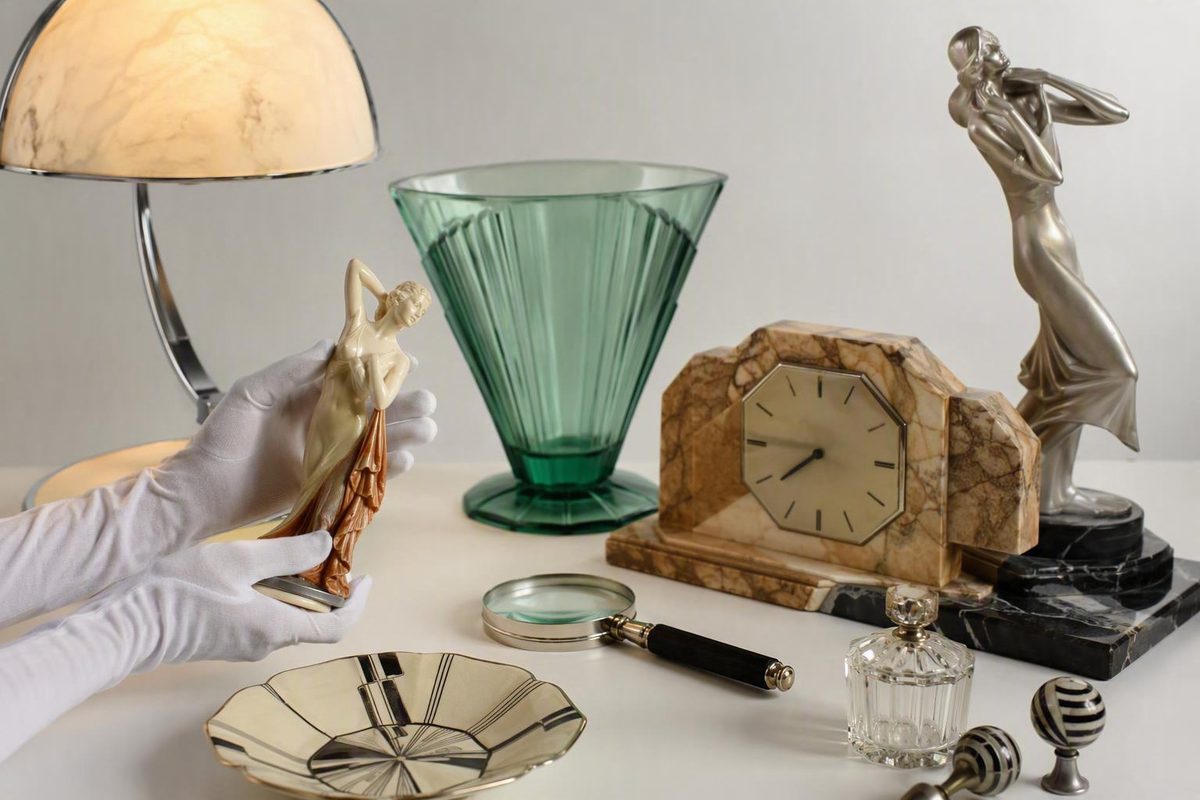
The promising object is often not the showiest one. It may be a small bracelet in a dressing-table drawer, a vase with a faint signature under its base or a cabinet whose paper label faces the wall. Before asking “What is it worth?”, preserve the evidence that can answer the more important questions: what is it, who made it, when was it made and what has happened to it?
This is a triage method, not a substitute for authentication or a formal appraisal. Its purpose is to separate ordinary household pieces from objects that deserve deeper research without cleaning away a mark, discarding a component or mistaking an Art Deco look for Art Deco age.
First, stop changing the object
Do not polish metal, strip a finish, wash an old textile, rewire a lamp, glue loose parts or run an unfamiliar electrical object. Put detached pieces, keys, shades, fitted cases and paperwork beside the object and keep them together. If treatment may be necessary, the Smithsonian American Art Museum advises using trained professionals rather than treating an object casually at home (Smithsonian American Art Museum).
Photograph the object as found before moving it more than necessary. Take:
- a full view from the front, back and sides;
- the underside, interior, drawers and backboards;
- signatures, labels, stamps, numbers and handwritten notes;
- damage, repairs, replaced parts and areas of wear;
- accessories and related documents;
- a ruler beside the object, followed by written dimensions.
These are not merely attractive listing photographs. Sotheby’s asks estimate-seekers for four to six clear views showing the whole object, front and back, condition, material or texture, and unusual marks (Sotheby’s).
Build an evidence card
Create one record per object. The Smithsonian’s suggested collection documentation includes photographs, dimensions, maker information, condition, inscriptions, ownership history, appraisal reports and references in catalogues (Smithsonian American Art Museum). A phone note is enough to begin, provided it stays attached to the correct photographs.
Record five kinds of evidence separately:
- Object: type, dimensions, weight where safe, materials and all components.
- Marks: exact lettering, capitalization, symbols and location. Transcribe rather than “correcting” an unclear name.
- Construction: joints, fasteners, casting seams, mold lines, backing, linings, clasps, wiring and tool marks.
- Condition: chips, cracks, losses, dents, fading, corrosion, repairs and replacements.
- History: who owned it, where and when it was acquired, and which receipts, photographs, letters or inventories survive.
A mark is a lead, not a verdict. Getty’s cataloguing guidance warns that inscriptions are not always accurate and that signatures or dates may have been added later (Getty). Search the exact mark alongside the object category, then compare its typography, placement and method of application with documented museum objects, maker archives or specialist catalogues. A name scratched into glass does not carry the same evidential weight as a correctly placed molded factory mark corroborated by the form and production method.
For a British precious-metal object, read the marks as a set. A full UK hallmark identifies the sponsor, metal fineness and assay office; a date letter may also indicate the hallmarking year, but it is optional (GOV.UK). A lone “925” therefore should not be expanded into a maker, country or date. For that particular trap, see what S925 does—and does not—establish.
Test an Art Deco claim in layers
“Art Deco” on a family note or online listing describes an attribution, not necessarily a period of manufacture. The label covers a large range of decorative arts and architecture made between the world wars, and the style continued commercially into the 1930s (Metropolitan Museum of Art). Later revivals reuse its geometry, stepped silhouettes, sunbursts, stylized flora and streamlined curves.
Start with style, but do not stop there. Use the decade-by-decade Art Deco reference to form a plausible date range, then ask whether the material and construction agree with it.
- Furniture: inspect the back, drawer interiors, feet and hardware. Record veneers, secondary woods, screw types and evidence of refinishing. Do not assign a famous designer from an exotic-looking veneer alone.
- Glass: note whether decoration is molded, cut, etched, enameled or applied, and record bubbles, seams, grinding and base wear. Color by itself cannot establish age or maker; period and modern Art Deco glass require documented comparisons.
- Jewelry: photograph every clasp, hinge, stone setting and repair as well as every mark. A geometric composition can be period, later revival or a recent design. The Art Deco bracelet checklist shows why form, materials, construction, repairs and marks must agree.
- Lighting: preserve shades, canopies and mounting hardware. Old-looking metalwork does not prove that the glass, wiring and fixture began life together; use the four checks for an Art Deco ceiling light.
The strongest home identification is cumulative: style fits the proposed date; materials and manufacture are plausible; the mark matches documented examples; wear is consistent; and provenance does not contradict the story. One mismatch does not automatically mean “fake,” because objects are repaired and altered, but it should narrow the claim.
Separate age, rarity and value
Age alone does not create demand. Neither does heaviness, elaborate decoration or a family story. Auction specialists consider maker, origin, provenance, date, materials, dimensions, rarity, type, condition and comparable sales together (Sotheby’s). That is a useful home checklist because it prevents one exciting feature from carrying the entire attribution.
Rank the object provisionally:
- Documented: maker and date supported by a reliable mark, records or a close documented match.
- Plausible: period, material and construction fit, but maker or exact date remains uncertain.
- Style only: appearance suggests Art Deco, but evidence of interwar manufacture is absent.
- Contradicted: construction, marks or provenance conflict with the proposed identity.
Use the narrowest description you can defend. “Geometric silver-tone bracelet, maker unknown” is more useful than “rare 1920s platinum Art Deco bracelet” when neither metal, maker nor date has been established.
Compare sold objects, not hopeful prices
Search auction archives for the same maker, model or pattern first. If no exact match exists, widen one variable at a time: closely related model, same maker and period, then similar material, size and object type. Record:
- sale house, date and lot number;
- catalogue attribution and provenance;
- dimensions, materials and condition;
- whether the lot sold, passed or was withdrawn;
- whether the displayed figure is hammer price or includes buyer’s premium;
- currency and whether one object or a group was sold.
A dealer’s asking price is not proof that a comparable buyer paid it. Even a genuine auction result needs adjustment for condition, size, attribution strength and market date. Sotheby’s distinguishes an auction estimate from a formal appraisal and notes that insurance value reflects replacement cost, while fair-market value concerns a likely sale price (Sotheby’s). Decide which question you actually need answered before requesting a number.
When to stop researching at home
Seek a category specialist, qualified appraiser or conservator when:
- a mark and construction both point to a significant maker;
- close sold examples reach a level material to your insurance, estate or sale decision;
- stones, precious metals or restricted materials require testing or legal review;
- attribution depends on opening, dismantling or cleaning the object;
- condition is unstable;
- ownership history is incomplete or raises legal or ethical questions.
Send the evidence card and photographs before transporting the object. Ask whether the specialist has expertise in that exact category, whether the opinion is an auction estimate or written appraisal, what value definition and effective date will be used, and whether the specialist has a financial interest in buying or selling it.
The useful discovery at home is not “this must be valuable.” It is a defensible description, an intact object and a clear record of what is known, what is merely plausible and what still needs expert examination.