
Art Deco Egyptian Revival Jewelry: Motifs and Dating Clues
Recognize Egyptian motifs in Art Deco jewelry, compare documented examples, and separate period settings from older components and later revivals.
A Cartier brooch catalogued by Sotheby’s as circa 1923 sets an ancient green faience bust of Sekhmet against a lapis lazuli sky dotted with diamond stars. Its fan-shaped outline, black enamel border and repeating lotus ornament turn an Egyptian relic into a modern jewel. Sotheby’s recorded its signature, Cartier Londres, its number, S.L 7353, and its appearance in the Illustrated London News on January 26, 1924. That combination—design, marks and a contemporary published record—is far more useful for dating than the Egyptian subject alone. Sotheby’s catalogue
Art Deco Egyptian Revival jewelry combines Egyptian imagery with the design language of the 1920s and 1930s. But “Egyptian Revival” names an inspiration, not a manufacturing date. A scarab can belong to an earlier revival, a period Deco setting, a later interpretation or a modern assembly containing old parts.
What changed after Tutankhamun’s discovery?
Howard Carter peered into Tutankhamun’s tomb on November 26, 1922. The discovery and subsequent excavation attracted worldwide attention. National Geographic’s account
Jewelry’s Egyptian revival was already established, however:
- Around 1870: a bracelet by French jeweler Émile-Désiré Philippe combined carved hardstone scarabs with gold djed pillars, ankhs and nefer amulets, according to Sotheby’s bracelet record.
- Around 1913: a Louis Comfort Tiffany necklace used gold, lapis lazuli, turquoise, carnelian, green hardstone and enamel, with a serpent’s head above its central amulet. Sotheby’s necklace record
- Around 1923: Cartier’s Sekhmet brooch placed an ancient fragment within a newly made jeweled composition.
The collector’s distinction is therefore not “Egyptian before or after 1922.” It is whether the whole jewel’s design and documented construction belong to the Deco period. Tutankhamun’s discovery intensified the fashion; it did not originate every scarab necklace. Christie’s historical account
Recognize the motif—and the surrounding design
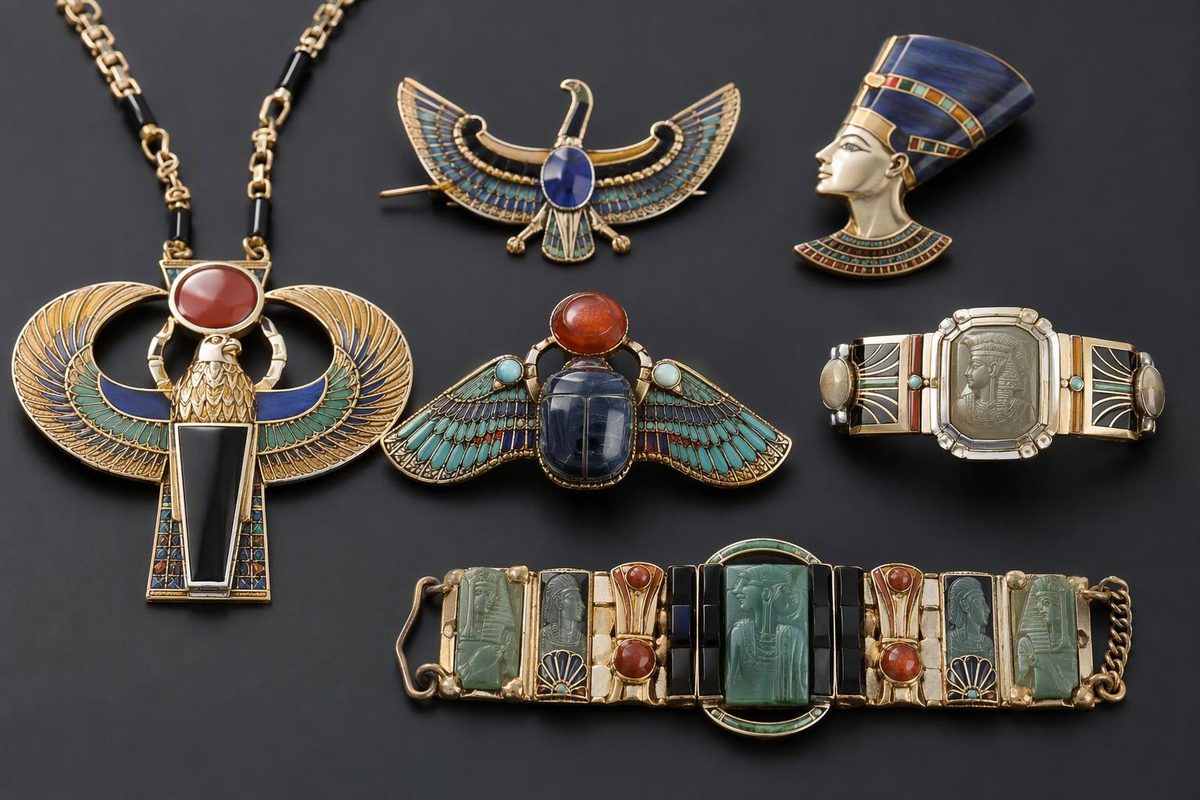
Look beyond pyramids and pharaoh heads. Documented Egyptian-inspired jewels and jeweled accessories offer a more varied vocabulary:
| Motif | What to look for |
|---|---|
| Scarab | A beetle-shaped carving, bead or central ornament; sometimes accompanied by wings |
| Falcon-headed terminals | Bird heads at the ends of a collar-like or U-shaped element, as on this Cartier necklace |
| Lotus and papyrus | Stylized blossoms and upright plant forms, sometimes repeated along a border |
| Cobra or uraeus | A rearing cobra, including one placed above a divine or royal head |
| Ankh, djed and nefer | Distinct Egyptian signs used as charms or amulet forms |
Other examples appear in the documented Philippe bracelet, Cartier Sekhmet brooch and a Cartier evening bag catalogued by Christie’s.
The Deco character lies in how the imagery is organized: controlled outlines, repeated stylized forms and strong contrasts. On the Cartier evening bag, diamond lotus and papyrus motifs sit against black enamel; Christie’s identifies its black-and-white scheme and platinum construction as Art Deco features. This is Egyptian imagery translated into contemporary design, rather than necessarily copied from one ancient jewel.
Materials do not provide a date by themselves
The documented Cartier examples show why a simple color checklist fails. The Sekhmet brooch combines faience, lapis lazuli, diamonds, enamel, platinum and gold. Another Cartier necklace from the 1920s combines diamonds, cabochon rubies, black and red enamel, onyx beads, platinum and gold. There is no requirement that an Egyptian-inspired Deco jewel be turquoise blue. Woolley & Wallis necklace record
Nor does a green or blue scarab establish faience, natural stone or ancient origin. Record those as material claims to verify, not conclusions drawn from color. A glass-and-base-metal jewel should be compared with documented costume jewelry rather than judged solely against Cartier’s precious-metal work.
Most importantly, the date of an ancient component is not the date of its setting. The Michael C. Carlos Museum describes a scarab necklace containing ancient material as a modern “statement” necklace, loosely patterned after an Egyptian broad collar, and explicitly lists modern restringing. Old beads can form a much newer necklace. Carlos Museum collection record
Check the jewel in layers
Before accepting a seller’s “1920s Egyptian Revival” attribution, ask for:
- Complete photographs. Include the back, clasp, pin mechanism, bead junctions, settings and every mark—not just the decorated front.
- Separate evidence for maker and date. Request a dated catalogue match, archival reference, invoice or contemporary photograph. A signature needs assessment; an Egyptian motif does not supply the missing date.
- Component-by-component descriptions. Ask whether the pendant, chain or beads, clasp and mounts are considered contemporary with one another.
- An alteration and condition history. Look for disclosed restringing, replaced fittings, remounting, enamel loss, damaged carvings and repairs. Seek specialist examination where authenticity or fragile components materially affect the decision.
The Woolley & Wallis Cartier necklace illustrates why this matters. Its pendant is signed and numbered, while the necklace is unsigned. The catalogue states that Cartier altered the design, probably around 1925, adding rubies and the beaded onyx necklace; it also notes that the platinum clasp was possibly added later. A genuine period jewel need not be untouched, but its different stages should be described. Auction catalogue
For broader checks on metals, marks and construction, use our practical guide to identifying Art Deco jewelry.
When cataloguing an uncertain piece, separate what you can see from what you can prove: “Egyptian-inspired scarab necklace; materials and date unverified” is more useful than an unsupported “Art Deco, circa 1925.” Reserve the period attribution for evidence that dates the jewel—not merely its inspiration.