
How to Identify Art Deco Jewelry: A Practical Evidence Guide
Identify Art Deco jewelry through design, cuts, metals, marks and construction—then separate period pieces from revivals, repairs and seller attribution.
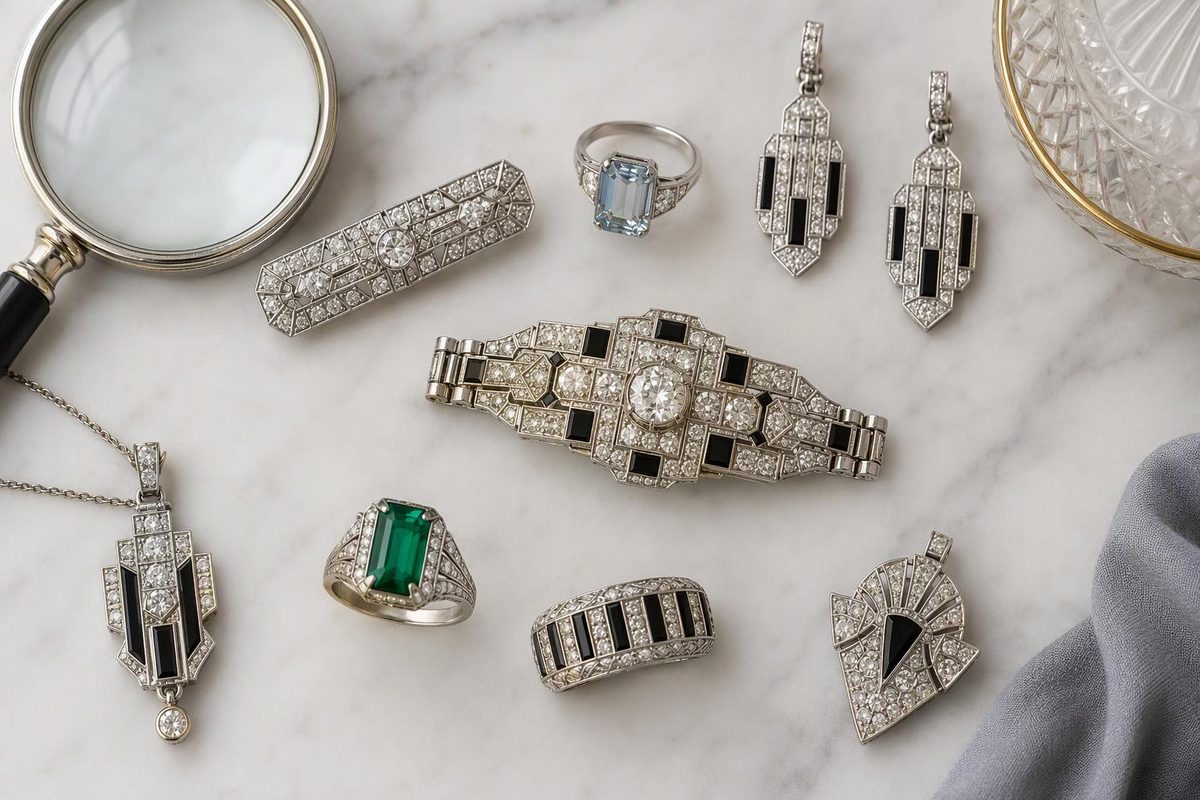
A white-metal ring has an emerald-cut diamond, a black onyx border and crisp symmetry. It looks Art Deco. That establishes a useful stylistic resemblance—but not that the ring was made in the 1920s or 1930s.
Period identification depends on several clues agreeing: design, materials, gem cuts, construction, marks and documented history. A contradiction may instead indicate a later revival, a replacement stone or a substantially rebuilt jewel.
Begin with the right question
Separate these three conclusions:
- Art Deco in style: the design uses Deco vocabulary, whatever its date.
- Period Art Deco: the jewel was made during the historical period, principally the 1920s and 1930s.
- Attributed to a maker: marks, records and construction support a specific workshop or jewelry house.
Geometry is evidence for the first conclusion, not sufficient proof of the other two. Even the period itself has soft boundaries. GIA’s historical survey places early manifestations around 1910, with Art Deco predominant in Europe and the United States in the 1920s and 1930s until World War II. It also cautions that not every jewel made in those decades was Art Deco (GIA, Gems & Gemology).
1. Read the composition before the motif
Look at the whole jewel from directly above. Strong candidates often organize their components as architecture: mirrored halves, stepped outlines, repeated rectangles, concentric borders or a central stone contained within a disciplined frame.
Typical clues include:
- bilateral symmetry;
- squares, rectangles, circles, chevrons, fans and stepped forms;
- sharply controlled openwork;
- alternating dark and light areas;
- stylized flowers rather than naturalistic, freely curling stems;
- Egyptian, East Asian, South Asian and other historicizing motifs translated into modern geometry.
Early Deco can retain bows, flower baskets and garlands from Edwardian jewelry. Later work generally becomes more austere and rectilinear. GIA describes geometry, symmetry and bold color as central characteristics, while noting that the style ranges from formalized floral designs to scarabs, ziggurats and lightning bolts (GIA). For the movement’s wider design chronology, see what defines Art Deco design.
Do not reject every asymmetrical jewel, but demand stronger evidence elsewhere. Conversely, a perfectly symmetrical modern ring remains modern if its marks, manufacture or documented sale date say so.
2. Check whether the materials make historical sense
In fine Deco jewelry, platinum and diamonds are an important pairing. Platinum’s strength allowed narrow settings and intricate outlines with relatively little visible metal. White gold—and sometimes yellow gold—also appeared, particularly as more affordable alternatives during the Depression. Period costume jewelry could instead use chrome, aluminum, marcasite, glass, imitation pearls and plastics such as Bakelite (GIA).
That breadth matters. “Not platinum” does not mean “not Art Deco,” and inexpensive materials do not automatically mean a modern copy.
Common period palettes include:
- diamond or rock crystal against black onyx or black enamel;
- diamonds with ruby, sapphire or emerald accents;
- jade, coral, turquoise or mother-of-pearl used as color blocks;
- monochrome white-on-white compositions;
- carved multicolored gems in Indian-inspired designs.
Cartier’s documented 1925 Tutti Frutti bracelet, for example, combines diamonds, carved sapphires, emeralds and rubies with onyx and black enamel on platinum (Cartier). The Metropolitan Museum of Art records a different Cartier jewel made around 1920: a seventeenth-century carved Mughal emerald remounted in platinum with emeralds and sapphires (The Met). These examples show why “Art Deco equals colorless diamonds in a geometric grid” is too narrow a rule.
Color is not gem identification. Period jewelers used flame-fusion synthetic ruby and sapphire, sometimes as small calibré-cut accents; GIA notes that natural gems, synthetics and simulants can also be mixed in one older jewel (GIA’s antique-ring guide). A synthetic accent stone therefore does not by itself expose a reproduction, just as an apparently valuable red stone does not establish ruby.
3. Use gem cuts as supporting evidence
Art Deco designers treated stones as components of a pattern. Baguettes, emerald cuts, triangles, shields and narrow calibré-cut colored stones could define edges, fill channels and sharpen a composition. Old European-cut diamonds also remained common. GIA describes an old European cut as having a higher crown, very small table and greater depth than a modern round brilliant, and places it across the late Victorian, Edwardian and Art Deco periods (GIA).
A period-appropriate cut supports a date but cannot settle it:
- old stones are routinely reset into new mountings;
- modern cutters can reproduce old cuts;
- a damaged original stone may have been replaced;
- a genuine old mounting may contain a mixture of original and later stones.
Study how the cuts cooperate. An emerald-cut center, precisely fitted dark border and graduated baguette shoulders are more informative as a coherent design than any one cut in isolation. The V&A’s catalogued 1920s Cartier ring offers a useful documented comparison: a sugarloaf emerald in an open-back platinum setting with baguette-cut diamonds on the shoulders and a “Cartier, Paris” inscription on the bezel (V&A).
4. Turn the jewel over
The back often reveals what the face conceals. Use a loupe and good diffuse light, but do not clean, polish, acid-test or dismantle the piece first.
Record:
- the shape and finish of the gallery beneath the stones;
- whether openwork seen from the front continues logically through the back;
- hinge, pin, clasp, clip and safety mechanisms;
- solder seams and changes in metal color;
- misshapen or newly bright prongs;
- extra holes, unused fittings or scars from a converted brooch, clip or dress ornament;
- evidence that a ring shank was replaced or resized;
- whether wear is plausible in protected and exposed areas.
The aim is not to find “handmade irregularity.” Fine period jewels can be exceptionally precise, while a reproduction can be deliberately distressed. Instead, ask whether the construction forms one consistent object. A bright replacement clasp does not make the entire brooch modern, but it should be disclosed. A new ring shank can also remove the original marks.
Condition is separate from age. GIA warns that old rings may have thinning prongs and shanks, and that stones in antique or vintage pieces may have been replaced (GIA). Have a jeweler assess mechanical safety before wearing a fragile piece; identification and wearability are different judgments.
5. Read every mark as a group
Photograph marks before interpreting them. Capture the complete interior of a ring, the reverse of a brooch, clasp tongues, pin stems and detachable components. Write down exactly what appears rather than what it seems likely to say.
Marks can indicate:
- metal fineness, such as a gold or platinum standard;
- an assay office and, in some systems, a date;
- a sponsor, manufacturer or retailer;
- a model, inventory or serial number;
- a later repair or import control.
Their meaning depends on country and date. British hallmarks, for example, must be read as a set rather than from one symbol: Sheffield Assay Office explains the roles of sponsor, fineness and assay-office marks and notes that date letters are useful but have been voluntary since 1999 (Sheffield Assay Office). In the United States, current FTC consumer guidance treats a karat mark as a statement of gold content and tells buyers to look nearby for the name or registered trademark of the party standing behind it (FTC). Neither kind of purity mark is automatically a manufacturing date.
A signature is a lead, not a verdict. Check its lettering, placement and surrounding surface against documented examples of the same maker and period. A suspiciously sharp signature on an otherwise worn surface, interrupted plating, displaced metal or mismatched component deserves investigation. Equally, absence of a signature does not disqualify a period jewel; GIA notes both that many designers signed their work and that signed status does not itself determine quality (GIA).
6. Compare exact objects, not search-result lookalikes
A useful comparison matches object type, maker, decade, material, mechanism and proportions. A documented 1930s double clip is a better reference for another clip than a page of vaguely geometric rings.
Prefer, in order:
- a maker archive or period stock book;
- a museum catalogue record with accession number;
- a period advertisement, patent or trade catalogue;
- a reputable auction record with full cataloguing and provenance;
- dealer listings only as leads.
Compare the back and mechanism as carefully as the face. Save the source, accession or lot number and date. Asking prices do not prove either age or market value.
7. Know where home inspection stops
A loupe can reveal repairs and construction, but it cannot reliably distinguish platinum from every white-gold alloy or establish whether a colored stone is natural, synthetic or treated. Do not scratch the metal or apply bleach or improvised acids to an assembled jewel.
For a consequential purchase, ask for written findings from an independent qualified appraiser or gemologist. The scope should state which stones were tested, whether they were tested loose or mounted, the metal-analysis method and any limitations. X-ray fluorescence can provide nondestructive elemental analysis and is widely adapted for precious-metal testing, although interpretation and equipment quality still matter (GIA). It can support a metal-composition finding; it does not date the jewel or authenticate a maker’s signature. A maker attribution may additionally require archive research, and a gem report does not authenticate a Cartier signature.
A defensible final description
After inspection, use the narrowest wording the evidence supports:
- “Art Deco-style platinum and diamond ring, modern” when the vocabulary is Deco but the date is known to be later.
- “Probably 1920s–30s, maker unknown” when design, construction and materials agree but documentation is absent.
- “Period mounting with later replacement stone” when the components have different histories.
- “Cartier, Paris, 1920s” only when marks, workmanship, records and specialist verification support all parts of that claim.
For bracelets specifically, the same discipline applies: style is visible, but age needs proof. The strongest identification is not the most glamorous label. It is the one that explains what was observed, what was tested and what remains uncertain.