
Art Deco Marcasite Jewelry: Materials, Marks and Dating Clues
Identify Art Deco marcasite jewelry through materials, settings, silver marks and provenance—and separate period pieces from later Deco-style work.
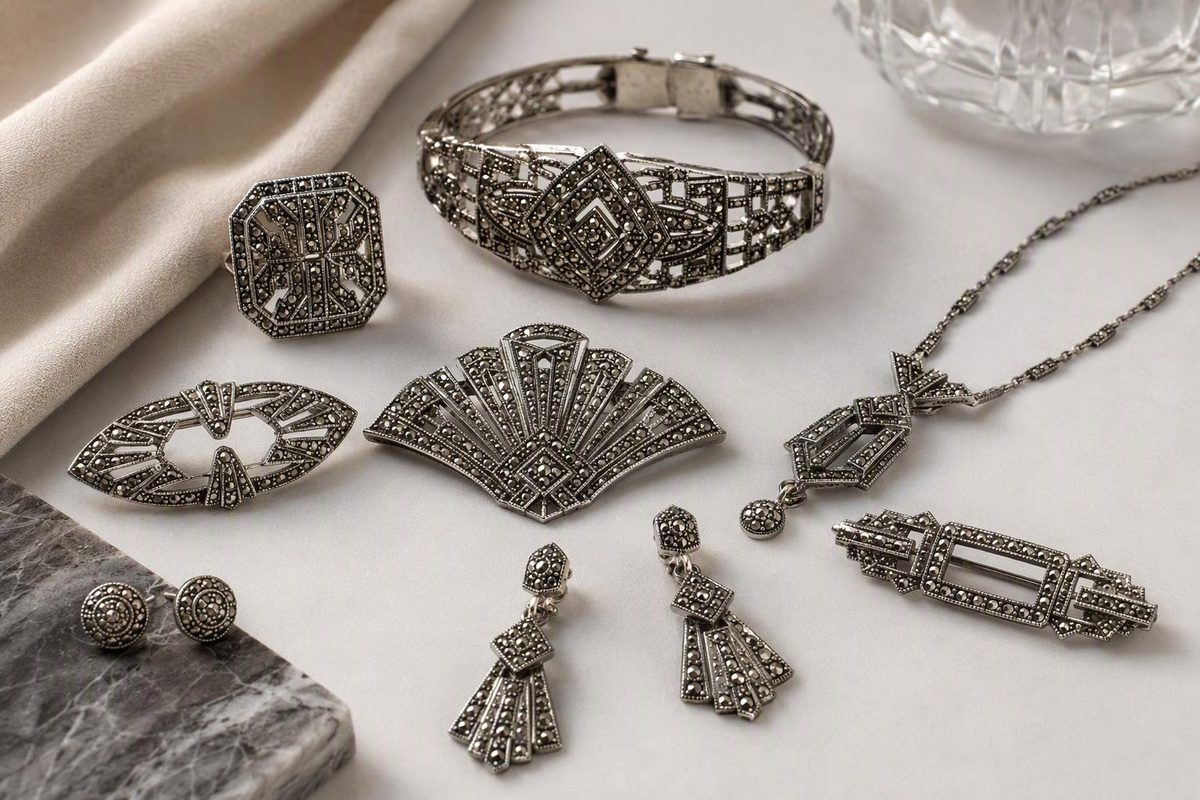
A Theodor Fahrner bracelet in the V&A is built from curved rectangular panels, with filigree spirals and grains separated by rows of marcasite. It offers a useful comparison for collectors—but not a precise date template. The museum describes it as German silver-gilt work made circa 1920–1950, a range extending beyond the interwar years. Even a named maker and a museum record may leave the date broad. V&A bracelet record
That is the central problem with Art Deco marcasite jewelry: the material, the design and the date are three separate questions. A geometric silver brooch can look convincingly Deco without having been made in the 1920s or 1930s.
What “marcasite” means in jewelry
The little metallic stones sold as marcasite are generally faceted pyrite, rather than the mineral marcasite. Both are iron sulfide, but their crystal structures differ. The International Gemological Institute explains that jewelry terminology often uses “marcasite” for pyrite because pyrite is more stable and durable. This established trade usage does not, by itself, mean a piece is fake. IGI mineral guide
Nor is marcasite an exclusively Deco material. The V&A holds a heart-shaped silver brooch set with faceted marcasites that it dates, provisionally, to the eighteenth century. V&A brooch record
In its collecting guide, the Antique Jewellery Company identifies the 1920s and 1930s as an important period for marcasite, describing combinations with silver, onyx, chrysoprase, carnelian and enamel. The dealer also notes substantial later production from the 1950s onward. Those combinations help explain the Deco association; none independently dates an object. AJC collecting guide
Recognize the design, then test the date
For a Deco-style assessment, look at how the jewel is organized: repeated panels, strong symmetry, stepped or angular outlines, and clearly separated areas of metallic sparkle and contrasting color. A dark central stone framed by marcasite may fit that vocabulary, but “black stone” should not silently become “onyx” in a description without identification.
Do not make geometry an absolute rule. Bonhams catalogued a marcasite and opaque red-glass buckle with a matching brooch as Art Deco, although the design was stylized floral. It also described the metal as silvered, not sterling silver. That record is a useful reminder that both rigid style rules and assumptions about white metal can mislead. Bonhams lot description
To support an interwar date, ask for evidence beyond the front view: an identifiable hallmark, a documented maker or model, a period catalogue match, or provenance tied to the particular object. A similar museum piece supplies comparison, not a transferable date. Our broader Art Deco jewelry identification guide explains how to weigh these clues together.
Five checks before buying or cataloguing
1. Photograph every mark. Request sharp, straight-on photographs of the reverse, clasp and stamps. A numerical silver stamp states a fineness claim, not an age; it should not be treated as independent proof of the metal either. In the UK system, Sheffield Assay Office distinguishes fineness, sponsor and assay-office marks from the date letter; identifying a letter requires attention to its typeface, case and shield. Use the relevant office’s historical chart rather than guessing from the letter alone. Sheffield hallmark guide
2. Treat a maker’s mark as a claim to verify. The Antique Jewellery Company identifies a “TF” within a circle as a Fahrner mark and notes 935 silver marks on German pieces. Record the mark exactly, then compare it with documented examples. A Fahrner attribution does not automatically narrow an object to the 1930s—the V&A bracelet’s broad date demonstrates why. AJC collecting guide
3. Examine how the stones are held. Under magnification, look for small beads of metal retaining individual stones and for visible adhesive. The AJC guide favors bead-set work and warns about glued stones working loose. Use this primarily as a construction and condition check, not a universal dating test: adhesive could also relate to a repair, and secure metal settings do not establish an interwar date. AJC construction advice
4. Count losses and inspect replacements. Request close-ups of every decorated panel. Note empty seats, chipped stones, conspicuous adhesive and stones that differ from their neighbors in size or sparkle. Ask which replacements or repairs the seller knows about. Do not assume that a dark recess is simply tarnish.
5. Inspect the fittings separately. Ask for views of the pin hinge and catch, or the bracelet clasp and connecting links. Establish whether fittings have been replaced and whether the mechanism works securely. For a bracelet, our bracelet assessment guide covers construction and repair questions in more detail.
Value and care: keep the whole object in view
Do not price a jewel from “marcasite” alone. Compare sold examples with similar attribution, metal, form, completeness and repairs. Bonhams’ buckle-and-brooch lot sold for £35.25 including premium on 13 December 2006, with seven missing marcasites across the two pieces. That is a historical result for a damaged silvered-metal set—not a current price guide for a complete sterling or documented Fahrner jewel. Bonhams sale record
For a piece with uncertain settings or repairs, keep initial cleaning modest: a gentle wipe with a soft, dry cloth rather than soaking. The Antique Jewellery Company recommends dry cleaning and warns that water can loosen glued stones. Have loose stones, heavy deposits or failing fittings assessed before attempting more intensive cleaning. AJC care advice
When documenting an uncertain piece, separate observation from attribution: “Marcasite-set brooch in Art Deco style; stamped 925; maker and date unconfirmed.” That is more useful than a confident decade unsupported by the evidence.