
Art Deco Apartment Interiors: Period Clues and Modern Choices
Recognize an Art Deco apartment interior, check surviving period details, and adapt its materials and geometry to a smaller modern home.
Jeanne Lanvin’s private apartment offers a reference beyond the familiar black-and-gold Deco scheme. Armand-Albert Rateau decorated its bathroom, bedroom and boudoir in 1924–1925 with furniture in patinated bronze, oak and gilt wood, drawing on classical art and an imaginative animal vocabulary. These were private rooms within a Paris mansion—not a model for a compact rental—but they show how much broader period Deco could be than its familiar motifs. The Musée des Arts Décoratifs documents the commission and materials.
For an apartment today, separate two questions: does the interior use an Art Deco design vocabulary, and does any of it actually date from the period? You can create a convincing Deco-inspired room without antiques; you can also live in a period building whose apartment interiors have been replaced.
What makes an interior read as Art Deco?
Look at the relationship between forms, surfaces and furnishings rather than counting sunbursts.
High-style Parisian Deco of the 1920s often combined traditional craftsmanship with a deliberately modern appearance. The Metropolitan Museum identifies rare woods, lacquer, elaborate inlays, gilding and other precious finishes in this work. Its examples include furniture by Süe et Mare, lacquer by Jean Dunand and metalwork by Edgar Brandt. These materials and techniques belong to a documented luxury tradition, not a compulsory shopping list.
American design of the same decade offers another reference: skyscraper-inspired geometry, abstract decoration and bold color pairings. Cooper Hewitt’s account of The Jazz Age highlights Paul T. Frankl’s “Skyscraper” combination desk and bookcase and Donald Deskey’s screen. It also places chrome furniture within the broader exchange between European modernism and American design. Chrome alone therefore does not establish Art Deco. The museum’s exhibition account explains these overlapping influences.
For a modern apartment, useful translations are:
- A cabinet with a strong silhouette and expressive wood grain, rather than ornament on every surface.
- A repeated geometric shape linking a rug, mirror or light fitting.
- Contrast between a reflective accent and quieter wood or textile surfaces.
- A deliberate furniture arrangement that leaves the principal forms visible.
These are design choices, not tests of age. For motif comparisons, see our guide to Art Deco geometric patterns.
A period apartment need not be Deco in every room
The Weil-Worgelt apartment at 525 Park Avenue makes the point neatly. Brooklyn Museum’s archival description records decoration by Martin Becker of the French firm Alavoine between 1928 and 1930: the study was Art Deco, while the rest of the apartment used French eighteenth-century revival furnishings. The photographic archive documents this mixed interior.
That distinction matters when describing your own home:
| Description | What it should mean |
|---|---|
| Period Art Deco interior | Surviving interior work whose date and design are supported by records and physical evidence. |
| Apartment in an Art Deco building | A description of the building; it does not establish the age or style of the rooms inside. |
| Art Deco-inspired interior | A later scheme borrowing Deco forms or materials, whether furnished with new pieces, antiques or both. |
An old building, a period cabinet and a newly installed geometric wall treatment can all have different dates. Describe them separately.
Check surviving details before redecorating
If your apartment may retain historic work, start with an inventory, not a demolition plan. Photograph room layouts, doors, trim, floors, built-ins, hardware and light fittings. Gather original plans, dated photographs and renovation records where available, then compare what they show with what survives.
The US National Park Service’s Preservation Brief 18 treats plans, room sequences, architectural features and finishes as potential contributors to historic character. It specifically includes parquet floors, millwork, hardware and visible elements of building systems. It also notes that later alterations can themselves be significant. Its guidance is a useful assessment framework, not a statement of the legal rules governing your apartment.
A geometric border or stepped molding is a clue to investigate, not permission to call it original. For a closer assessment, consult wall moldings and panels. Before altering fixed features, establish ownership permissions and any applicable local heritage requirements.
Translate the style to a smaller apartment
Treat the following as a contemporary scheme, not a reconstruction of a universal period interior.
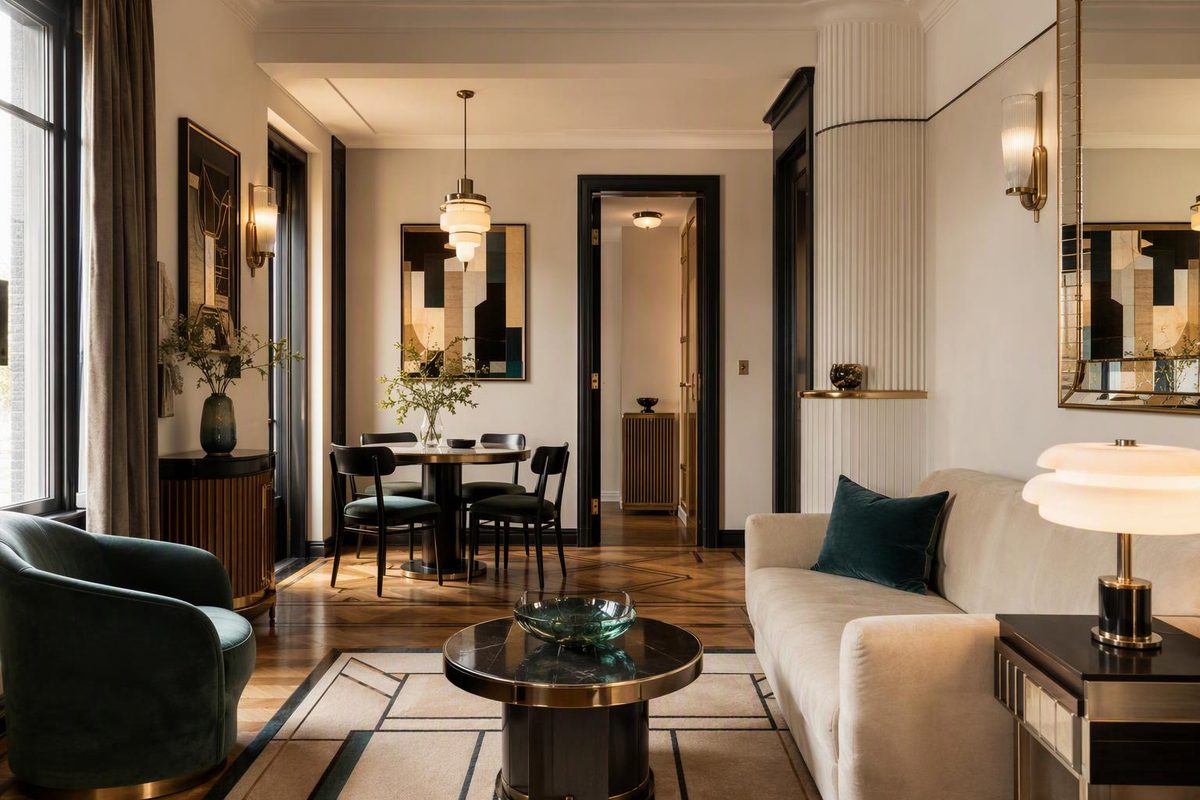
Living room: Begin with the sofa and one storage piece. Give either the cabinet’s veneer or a patterned rug the strongest visual role; let the other remain quieter. A single distinctive mirror or lamp can supply the geometric accent without surrounding it with competing motifs.
Dining corner: Use the table and chairs as a compact group rather than trying to reproduce a grand dining suite. Measure chair pull-back space and the route past the table before buying. A small cabinet can provide storage without requiring a separate display arrangement.
Bedroom: Let the headboard establish the main shape. Repeat a finish or color at the bedside instead of adding a second large pattern. Choose a limited palette you enjoy; black and gold are an option, not an authenticity requirement. Our interior color guide separates documented palettes from modern choices.
Rental: Put the style into movable furniture, rugs, curtains and lamps rather than permanent paneling or replacement fittings. Confirm permission even for supposedly reversible changes, and avoid adhesives on historic finishes.
For every substantial piece, measure both its final position and its delivery route through the building. A cabinet that suits the room but cannot pass the lift or stair turn is the wrong cabinet.
If you buy period furniture, ask for evidence
A seller’s “Art Deco” label may describe appearance rather than manufacture date. Request photographs of marks, labels, the underside or back, and relevant construction details. Ask what supports the stated maker and date, and what has been restored or replaced.
Keep attribution separate from condition: documented period furniture can still have replacement hardware, renewed upholstery or finish repairs. Our guides to Art Deco couches and cabinet pulls explain those component-level checks.
Keep invoices, attribution documents and before-and-after photographs with your apartment records. They will help the next owner distinguish what survived, what was restored and what you added.