
Vintage Art Deco Torchiere Floor Lamp: Identify Before Buying
Assess a vintage Art Deco torchiere floor lamp through maker evidence, shade fit, restoration and safety, with two published auction results.
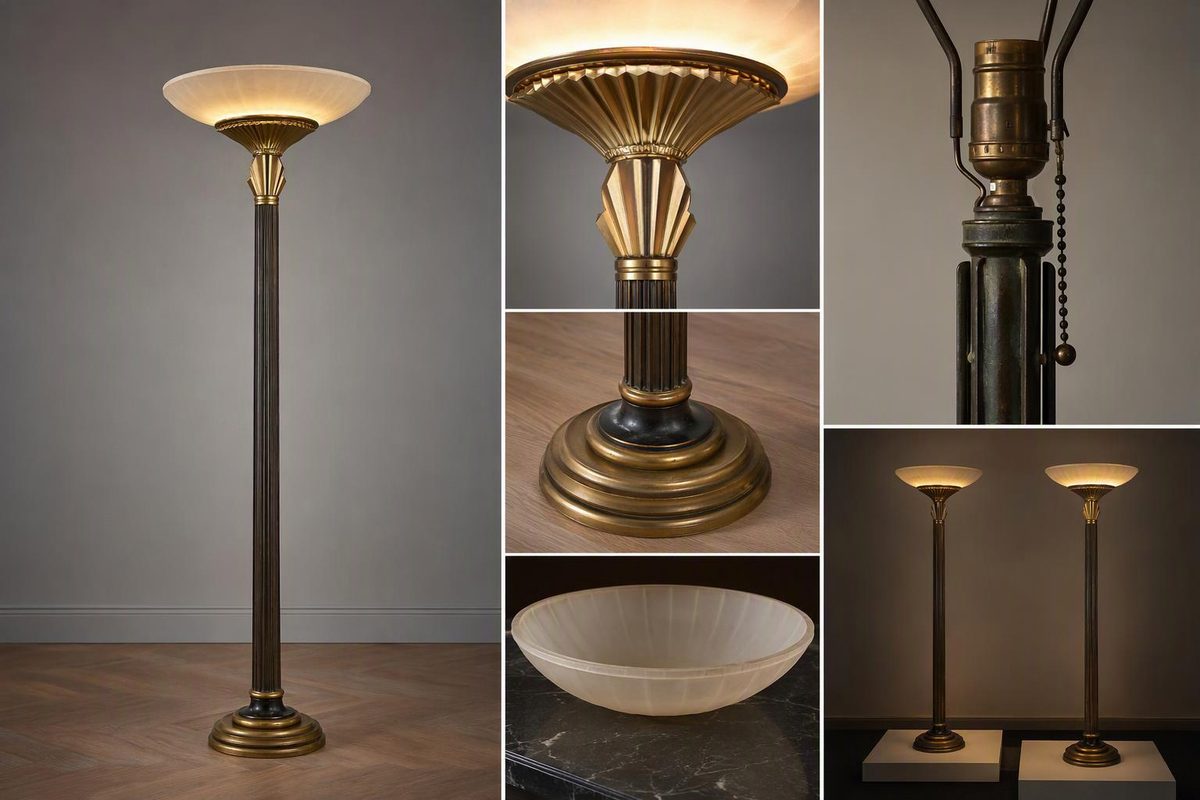
An unmarked lamp can be worth investigating without acquiring a famous designer’s name. In October 2024, Bonhams Skinner sold an aluminum torchiere catalogued as Art Deco, circa 1930, for US$896 including premium. It stood 64½ inches high on an 8-inch-square base. The catalogue identified its material, approximate date and lack of a mark—not a maker. That is a useful level of precision to expect when assessing another lamp. See the Bonhams lot record.
For a vintage Art Deco torchiere floor lamp, separate four questions: does the design look Deco, when was it made, do its components belong together, and can it safely be used? Evidence for one does not settle the others.
Recognize the form, then assess the style
In electric lighting, a torchiere is principally an uplighter: a tall standard carries an upward-facing bowl or shade. The word describes a lighting format, not an Art Deco date. Arkansas Lighting’s description of the form.
Look at the whole silhouette before concentrating on decoration. Useful features to compare with documented period designs include:
- A stepped or strongly geometric base.
- A shaft organized into clear sections, collars or repeated rings.
- A flared bowl whose profile continues the geometry below it.
- Stylized ornament rather than naturalistic detail alone.
- Contrasts between metal, glass, wood or stone.
These are comparison prompts, not a dating formula. The V&A describes Art Deco as a mixture of influences, including both adapted plant forms and modern geometry. A floral detail does not automatically exclude Deco, just as a stepped base does not prove it. V&A’s introduction to Art Deco.
Nor must a period lamp be chrome and glass. Nessen Lighting’s account of Walter von Nessen’s work records satin-chrome brass, spun aluminum and natural woods, alongside torchiere variations in polished chrome and brass. Material and finish should be checked against the particular design being claimed. Nessen’s maker history.
Establish a date and maker separately
Start with photographs of the complete lamp, the underside of the base, any labels or stamps, the shade interior and the switch and socket area. Keep the lamp unplugged; do not dismantle it simply to look for marks.
Transcribe markings exactly. A seller’s identification becomes more persuasive when a mark, model number or documented provenance agrees with a period catalogue or institutional record. Compare proportions, dimensions, bowl profile, base construction and switch position—not merely the general resemblance.
A manufacturer’s name alone may not establish a prewar date. Nessen’s history, for example, records the studio’s postwar revival and subsequent designs as well as Walter von Nessen’s earlier work. A Nessen-labelled lamp therefore still needs model-specific dating evidence. Nessen’s company chronology.
Ask what supports each part of a description such as “1930s French lamp by…”:
| Listing claim | Evidence to request |
|---|---|
| “Art Deco” | A convincing comparison of the complete design with documented examples |
| “1930s” | A dated model record, period photograph or credible ownership documentation |
| Named maker or designer | A relevant mark, catalogue match or documented attribution |
| “All original” | Disclosure of changes to the bowl, glass, finish, switch and wiring |
Wear is supporting context, not a calendar. Likewise, a modern cord should prompt a question about rewiring rather than an automatic rejection of the lamp’s age.
Check whether the shade belongs
A convincing standard with an ill-fitting bowl is not a convincing complete lamp. Assess the shade or reflector separately from the base.
For glass, request its diameter, height and fitter measurements—the dimensions of the opening, rim or seating surface by which it mounts to the lamp. Ask how it is retained and for close photographs of that contact area. A measurement of the wide upper rim alone will not establish fit.
Look for chips and cracks, especially around the mounting area, and ask whether the shade rocks, sits crookedly or depends on improvised spacers. For a metal bowl, ask about dents, repairs and altered mounting holes. A matching colour or comfortable fit is not proof that the parts originally belonged together; a model comparison is more useful.
A replacement can make a lamp usable, but it should be described as a replacement. For a closer component assessment, see vintage Art Deco glass lamp shades: identification and fit.
Treat electrical condition as a separate purchase decision
“Working” means little more than that the lamp lit during a test. Before using an unfamiliar vintage lamp, arrange inspection by a qualified electrical professional or a lamp-restoration specialist qualified to assess its electrical safety. Ask the seller what was replaced during any reported rewiring, and whether there is a dated service record. Also ask about a leaning shaft, loose joints or a base that rocks; electrical work alone does not settle structural condition.
Do not use a lamp with a damaged cord. CPSC’s home electrical checklist identifies frayed or cracked cords as shock and fire hazards and warns that excessive bulb wattage can overheat fixtures and wiring. Have suitable bulb type and maximum wattage established for the actual assembly rather than guessing from its size. CPSC electrical safety checklist.
There is also a useful distinction from later “vintage” lighting. CPSC’s 1997 recall notice states that the shallow-bowl torchieres using tubular halogen bulbs first became available in the United States in 1983. That particular format is not evidence of a 1930s lamp, and the notice documents its fire hazard. This does not mean every halogen bulb proves a lamp’s body is modern: alterations must still be considered. CPSC halogen-torchiere notice.
Use sold prices, not a universal price range
Two published results illustrate why the broad label is insufficient for valuation:
| Auction and date | Catalogue description | Published result |
|---|---|---|
| Bonhams Skinner, 6–16 October 2024 | Unmarked aluminum Art Deco torchiere, circa 1930; 64½ inches high | US$896 including premium |
| McLaren Auction Services, 23 April 2025 | Brass Art Deco torchiere with marble base, catalogued circa 1920s; 64½ inches high | $110, with a separately listed 20% buyer’s premium |
These are different objects, not endpoints of a reliable market range. Retain the auction houses’ qualifications about dates and attribution. For a meaningful comparison, seek the same model or closely comparable construction, completeness and condition, then budget separately for fees, transport and electrical work.
Before committing, write the description you can actually defend: Art Deco-style, date unconfirmed; plausibly period, maker unknown; or documented period model, with specified replacements. If the seller’s price depends on a stronger description, request the evidence that closes that gap.