
Art Deco Sculpture: How to Identify and Date It
Learn to identify Art Deco sculpture by silhouette, materials, marks and model evidence, then judge whether a figure is period, later or Deco-style.
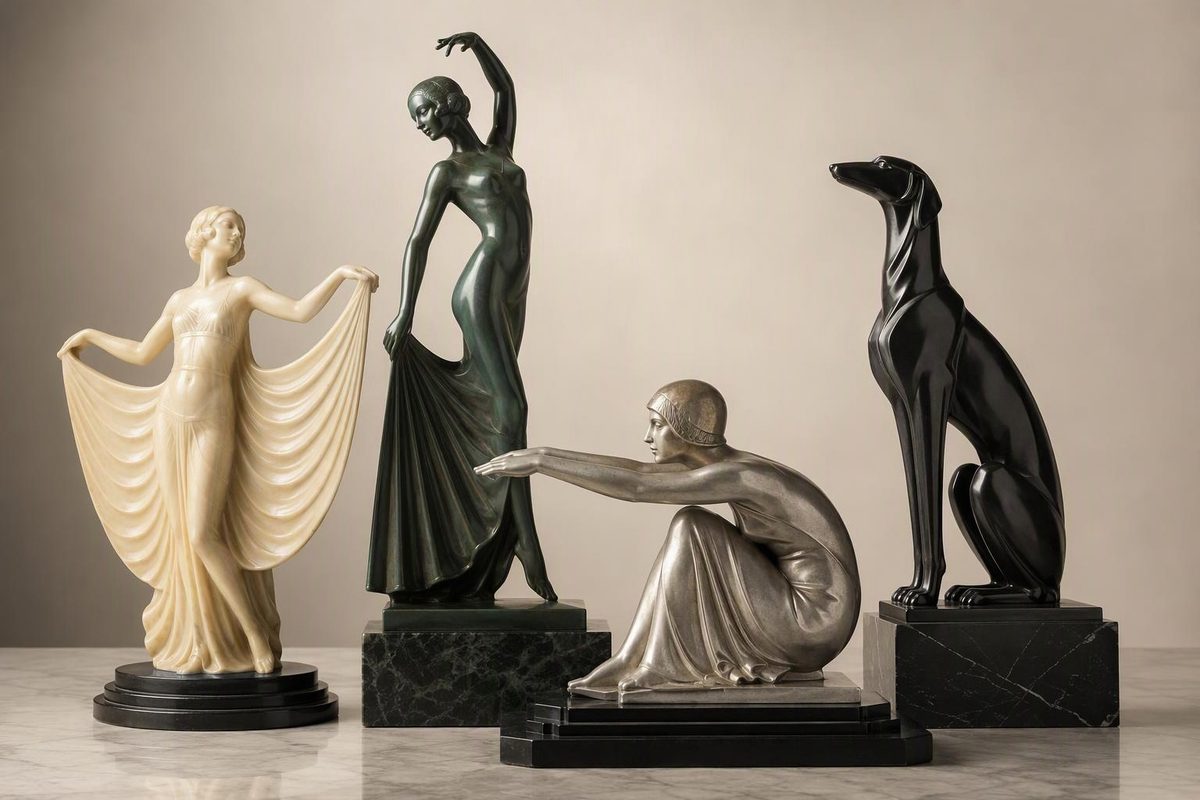
Art Deco sculpture is identified by a combination of controlled silhouettes, simplified forms, decorative surfaces and period subjects—not by one pose, material or signature. Those features support a stylistic description, but calling a sculpture a period work or lifetime cast requires evidence for the model, maker and individual cast or carving.
Select the evidence you have; the tool shows the strongest description it can support.
Evidence-To-Description Check
Choose only what records or exact-model research support. The result is a wording ceiling, not an authentication.
The appearance may be Art Deco, but no period manufacture or authorship evidence has been selected.
Source framework: College Art Association guidance on sculpture editions, authorship, foundries and lifetime or posthumous casts.
A woman resting her hands on two slender borzoi, a polar bear reduced to one heavy volume and an allegorical figure compressed into flat architectural geometry can all be Art Deco sculpture. They share neither material, scale nor subject.
That range is the first identification lesson. Art Deco sculpture is not synonymous with a bronze dancer, and a dramatic zigzag pose does not establish a 1920s date. Style recognition establishes where research should begin, not when a particular object was made.
Art Deco Sculpture Appears In Three Main Forms
The style developed before the 1925 Paris exposition, flourished between the world wars and continued through the 1930s. The exposition supplied the movement’s later name, but the Metropolitan Museum of Art cautions that “Art Deco” is a broad label covering an enormous range of interwar decorative art and architecture. Sculpture could be treated as fine art or decoration, with human figures, animals, plants and geometric abstraction among its recurring subjects (The Met).
For the broader chronology, see our decade-by-decade Art Deco guide.
Theatrical Cabinet Figures
The dancers, athletes, fashionable women and performers commonly associated with Art Deco sculpture belong to this category. Bodies may be elongated, poses sharply balanced and garments treated as rhythmic patterns. Contrasting materials heighten the theatrical effect.
Demétre Chiparus’s Friends Forever, made about 1927, combines cold-painted bronze and ivory on a marble base. The Victoria and Albert Museum identifies the technique as chryselephantine—a combination of bronze and ivory—and records that the model was produced in three sizes (V&A).
That production detail matters. A different size is not automatically a copy, but it should correspond to a documented version. Measurements must be compared consistently, distinguishing the figure’s dimensions from its overall height on the base.
Simplified Animals
Art Deco animals can be smoothly streamlined rather than geometrically faceted. François Pompon reduced anatomy to continuous profiles and rounded masses. His life-size plaster Polar Bear appeared at the 1922 Salon d’Automne; its success led to related models in several sizes and in plaster, porcelain, marble and bronze. The Met’s marble example dates to about 1923 (The Met).
This makes material shortcuts unreliable. A white bear may be ceramic, stone, plaster or resin, while a documented period model may exist in more than one medium. Neither whiteness nor weight identifies the maker or date.
Sculpture Integrated With Architecture
Reliefs, entrance figures, grilles and monumental groups translated the same vocabulary into buildings. Lee Lawrie’s Progress, above Rockefeller Center’s 49th Street entrance, uses flat geometric shapes, strong color, stylized figures and allegorical subjects (Rockefeller Center). His Wisdom is the focal point above the main entrance to 30 Rockefeller Plaza rather than an independent statuette (Rockefeller Center).
Architectural sculpture cannot always be judged by the conventions applied to tabletop bronzes. Its scale, shallow relief and simplified detail may have been calculated for a particular viewing distance, façade or entrance sequence.
Several Characteristics Must Support The Attribution
No single feature establishes Art Deco authorship or date. A persuasive stylistic attribution normally combines several kinds of evidence:
- A controlled silhouette: long diagonals, arcs, symmetrical groupings or compact streamlined masses.
- Selective simplification: anatomy, hair, feathers or drapery reduced to clean planes, repeated ridges or smooth volumes.
- A modern subject or treatment: dancers, sports, speed, fashion and machine-age polish—or an ancient myth recast with contemporary economy.
- Decorative surface: gilding, colored patina, painted detail or contrast between dark metal and pale inserts.
- An architectural base: a stepped, faceted or strongly horizontal plinth in marble, onyx or another stone.
- A relationship to an interior or building: some sculptures were conceived as parts of larger decorative schemes rather than isolated gallery works.
These characteristics may justify “Art Deco” as a style description. They do not prove “made circa 1925.” Later manufacturers and revival designers have reused the same dancers, animals, materials and stepped bases.
The whole composition matters more than a checklist score. A genuine model may be restrained rather than overtly geometric, while a recent decorative figure may combine every familiar Deco cliché.
Date The Object Separately From The Design
Bronze complicates dating because the sculptural model and a particular cast can have different dates. A design conceived in 1927 could be cast decades later without changing its pose or nominal model title.
The College Art Association notes that sculpture is often made in multiples and may involve an artist, foundry and other craftspeople. It recommends establishing when, by whom, in what quantity and how well a cast was made. It also notes that scholars and collectors generally prefer lifetime editions, although some authorized posthumous editions have gained acceptance (CAA).
Separate the investigation into four questions:
- When was the model conceived? Establish the design’s history independently of the object’s apparent age.
- When was this example made? Look for documented ownership, dated photographs, invoices, exhibition records and old catalogues.
- Who authorized and produced it? Record the sculptor, foundry or éditeur, estate and retailer separately.
- Is it a documented size and material? Compare exact measurements without the base as well as overall dimensions.
A period-looking base is not sufficient evidence. Bases break and are replaced, figures are remounted and plaques migrate from one object to another. Photograph the underside, attachment points and every face of the plinth before accepting the base as original.
The same distinction applies to carved stone, ceramic and mixed-media figures. A period model can remain in production, be reissued or inspire an unauthorized copy. The model’s date and the object’s manufacture must not be collapsed into one claim.
Marks Are Claims, Not Certificates
Transcribe every mark exactly before searching for the name you expect to find. Preserve capitalization, punctuation, spacing and letter forms. Record any:
- artist signature or monogram;
- foundry or éditeur mark;
- edition fraction or cast number;
- country-of-origin wording;
- retailer label;
- inscriptions on both sculpture and base.
A period example may carry both an artist’s signature and a production mark. Christie’s, for example, catalogued two Chiparus bronze-and-ivory figures bearing variants of the artist’s name and the mark ETLING PARIS (Christie’s). Familiar lettering proves only that the lettering is present. Signatures and foundry marks can pass into later molds or be added afterward.
The next step is an exact-model comparison. Match the pose, fingers, costume pattern, accessories, base profile, mark location, material and dimensions against museum records, catalogues raisonnés and well-documented auction lots. Another sculpture by the same artist is not an adequate comparison.
Differences do not all have the same significance. A replacement base may leave the figure substantially intact, while altered fingers, missing accessories or simplified costume details may point to a later mold, repair or derivative version. Each discrepancy should be recorded rather than explained away.
Physical Inspection Has Strict Limits
Under bright, raking light, document seams, joints, fasteners, repairs, cracks, filled losses, finish and tool marks. Examine where ivory or other inserts meet metal and where the figure meets its base. Differences may reveal replacement parts or restoration, but they do not create a reliable home-authentication formula.
The Getty’s technical guide treats casting process, metals, defects, repairs, assembly, tool marks, gilding, plating and patina as separate fields of examination. Advanced study may also involve radiography, metal analysis and dating methods (J. Paul Getty Museum). A seam does not by itself mean “fake,” and a convincing patina does not by itself mean “old.”
Do not polish the metal, remove the base or test a pale component with a hot needle, solvent or scratch. Those actions can damage the object and erase evidence. When authorship or value is consequential, use a specialist who can compare the object with the documented model and involve a conservator or materials laboratory where necessary.
Ivory Can Determine Whether A Sale Is Legal
“Bronze and ivory” is not merely a materials description. It can determine whether an object may legally be advertised, sold, shipped, imported or exported.
Rules differ by species, transaction and jurisdiction. In the United States, commercial import of African elephant ivory is prohibited. Interstate sale is generally prohibited unless an item qualifies for an exception, such as the Endangered Species Act antiques exception, and state law may impose additional restrictions. The U.S. Fish and Wildlife Service advises buyers to request evidence of species and age (U.S. Fish and Wildlife Service).
In the UK, buying, selling, hiring or advertising an item made from ivory of a species listed under the Ivory Act requires an applicable registration or exemption. One standard exemption covers an item made before March 3, 1947, with less than 10% integral ivory by volume, but its age, proportion and construction must be supported rather than assumed (GOV.UK). Import and export controls may apply separately.
Do not rely on “antique,” “bone,” “ivorine” or “pre-ban” in a listing. Ask for the seller’s written material identification, evidence of age and any registration, exemption or permit relevant to both ends of the transaction. A stylistic date is not legal documentation.
Use The Narrowest Defensible Description
The final description should stop where the evidence stops:
- “Art Deco-style sculpture” describes appearance, not age.
- “Period Art Deco sculpture, maker unknown” requires credible evidence of interwar manufacture even if no maker is established.
- “Attributed to [artist]” signals an informed but unresolved authorship opinion.
- “After [artist]” identifies a work derived from that artist’s composition or model, not necessarily made or authorized by the artist.
- “[Artist], [model title], lifetime cast” requires model-specific scholarship and evidence that the particular cast was produced during the artist’s life. Identify the foundry separately when known.
A recognizable pose or famous signature cannot substitute for provenance, production history and exact comparison. Style identifies the research category; the individual object either supplies the evidence for a stronger attribution or does not.