
Art Deco Pendant Lights: How to Identify and Date Them
Identify Art Deco pendant lights through form, glass, metalwork, catalog matches and construction—and separate period examples from revivals.
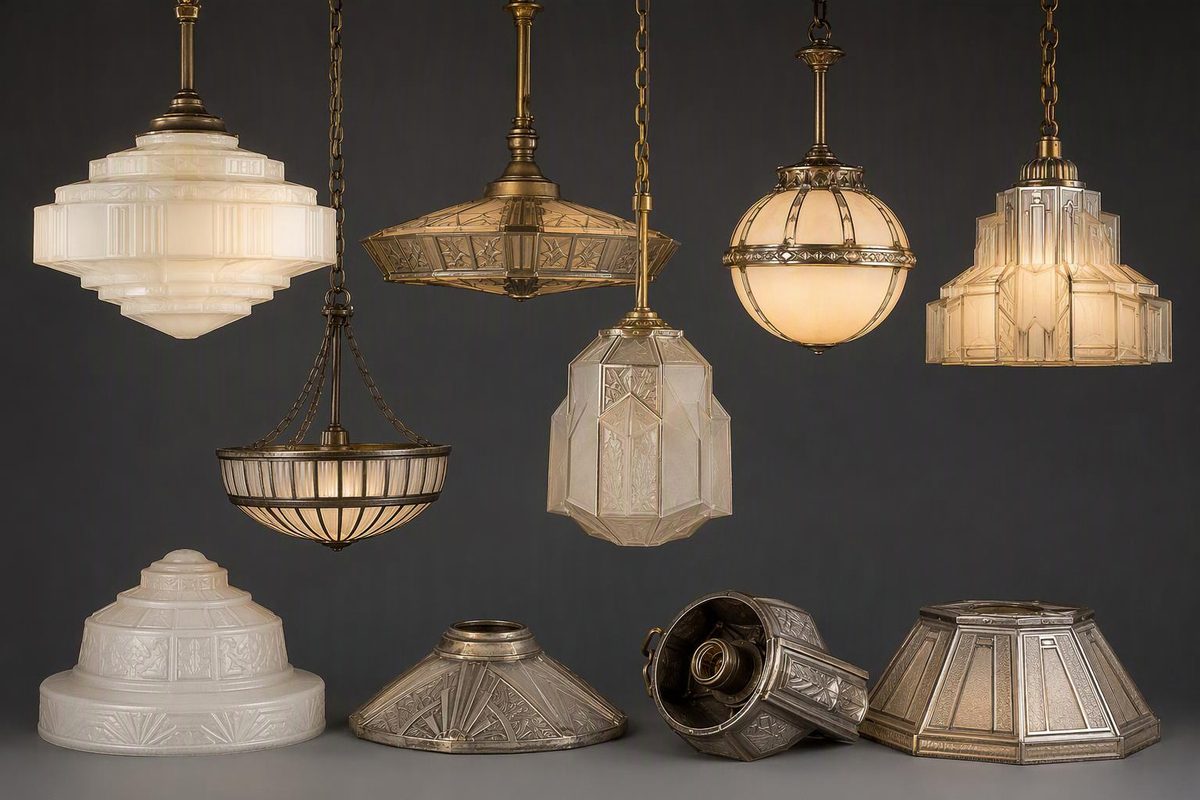
A frosted glass bowl hanging from three chains can look convincingly Art Deco. It may date from about 1930—or combine an old shade, replacement hardware and a newly made canopy. Pendant lights are particularly easy to alter because glass, fitters, sockets, chains and ceiling mounts are separable parts.
The useful question is therefore not simply “Does it look Deco?” It is: Which parts can be tied to an interwar maker, model or documented design?
“Pendant” was not the only period name
Today, a pendant generally means a light suspended from the ceiling by a cord, chain or rigid stem. Manufacturers in 1930 used less consistent terms. A Morris Sklar catalogue lists one-light “pendant” models alongside “drop,” semi-ceiling, flush-ceiling and bracket fixtures. An Estellite catalogue distinguishes “pendant type,” “chain pendant,” “drop,” semi-flush and flush forms (Morris Sklar catalogue; Estellite catalogue).
That vocabulary matters when researching a light. Search period catalogues for drop fixture, hanging fixture, ceiling fixture, hall fixture and chandelier as well as pendant. A seller’s modern product category is not evidence of the original model name.
What 1930 catalogues do—and do not—prove
A fixture made in 1930 is not automatically Art Deco. American catalogues of that year offered explicitly “modernistic” designs beside Colonial, candle, lantern and other historically inflected ranges. Date and style must be tested separately.
Within the modern lines, several forms now sold as Art Deco pendants have period counterparts:
- compact one-light pendants with glass panels or a single shade;
- multi-light “drop” fixtures with bulbs screened by glass;
- broad uplighters and shaded central fixtures designed to diffuse light;
- geometric cast-metal bodies in plated, painted or polychrome finishes.
The palette was wider than chrome, black and white. Morris Sklar described cast-aluminum metalwork, soft honey-colored glass, a brown-and-gold “Chromium Gold” effect, green-and-ivory and orchid-and-ivory colorways, bronze, burnished steel, iron and brass. Its catalogue also contains floral wrought-iron drops and Colonial brass fixtures, demonstrating why a 1930 source establishes availability but not necessarily an Art Deco classification (Morris Sklar catalogue text).
Estellite’s 1930 ranges are similarly mixed. They include pendant and drop models in antique brass, antique pewter, oxidized copper, “Swedish iron” with brass trim, enamel, gold-and-polychrome and other finishes. One range was advertised as “Colonial Mode, Modern Style”—useful evidence that period makers themselves sold hybrid designs rather than observing today’s neat style categories (Estellite catalogue text).
German production was no narrower. Two circa-1930 Meissner Glasraffinerie catalogues in the Cooper Hewitt Design Library document more than 100 fixtures. The glass could be molded, mottled, hand-painted, marbleized, etched or engraved; the designs included floral and Japanese-influenced decoration as well as Bauhaus-related forms. Oval and rectangular colored-glass uplighters appear among the central fixtures (Cooper Hewitt).
Chrome alone therefore does not make a pendant Art Deco, while color or ornament does not automatically disqualify it. Judge the complete design against dated examples. For a wider comparison of motifs and period development, see what defines Art Deco design.
A five-part identification method
1. Record the light as separate components
Photograph the canopy, suspension, frame, sockets, fitters and every piece of glass before attributing the whole fixture. Record:
- overall height and maximum width;
- number and arrangement of lights;
- chain length or stem construction;
- shade-rim and fitter dimensions;
- every stamped, cast, etched or painted mark;
- differing screw heads, finishes and patterns of wear.
A maker’s name on one shade supports an attribution for that shade. It does not establish that the frame and canopy left the same factory with it.
2. Test the design against a dated catalogue
A strong match involves more than a similar outline. Compare the number of lights, dimensions, attachment points, metal pattern, glass profile, finish and model number. Period catalogues often offered coordinated families, so a bracket sharing ornament with a hanging fixture may help identify a range—but it is not a substitute for finding the ceiling model.
Check the catalogue image as well as searchable OCR text. Old scans can misread model numbers and fractions. Allow for documented finish options and ordinary repairs, but ask for an explanation when the offered light differs materially from the published model.
3. Read construction without treating it as a date stamp
Hand finishing, cast-metal detail, thick molded glass and worn plating may be consistent with age. None is conclusive alone. Reproductions can be cast and hand-finished; period fixtures can be polished, repainted, shortened and rewired.
Look instead for agreement among construction, wear and documented design. Wear should make sense where parts move, touch or are handled. Uniform artificial distressing, pristine threads inside an otherwise heavily worn assembly, or a canopy with markedly different construction deserves further examination—not an automatic verdict.
4. Separate style, age and restoration
Use conclusions no stronger than the evidence:
- Art Deco-style: the design uses Deco vocabulary, but its age is unproved.
- Later reproduction or revival: made after the interwar period using Deco forms.
- Plausibly period, restored: period evidence is credible, with replacement parts identified.
- Documented period example: maker, model and date are supported by marks, a close catalogue match, provenance or a particularly strong combination of evidence.
New cable does not by itself make an old fixture a reproduction. The V&A records a Poul Henningsen table lamp made in 1928 whose cotton-covered flex is of an appropriate type but probably a recent replacement. The museum also notes that modified versions of the design remained in production (V&A). This is a modernist table lamp rather than an Art Deco pendant, but it illustrates two identification problems shared by lighting: wiring gets replaced, and a long-lived silhouette cannot establish production date.
5. Treat installation as a separate decision
Do not energize an unknown pendant merely because a seller says it works. A qualified electrician or lighting restorer should assess its sockets, conductors, insulation, grounding, heat exposure, weight and ceiling support for the intended installation.
The Electrical Safety Foundation International’s inspection guidance specifically calls for checking light-fixture wiring, lamp wattage, grounding, conductor size and the condition and temperature rating of insulation. It says an electrical inspection should be performed by a qualified, licensed inspector, electrician or contractor (ESFI indoor electrical-safety guide). Requirements vary by jurisdiction and installation, so a cosmetic restoration or fresh flex is not a complete safety assessment.
Ask the restorer to document replacements, and retain removed marked parts when it is safe and practical to do so. Rewiring can make a fixture serviceable; it does not authenticate the glass or metalwork.
What to request before buying
A useful listing should provide clear photographs of the light both off and illuminated, plus its measurements, all marks, the top and underside of the canopy, shade rims, sockets and attachment hardware. It should distinguish original, replaced and newly fabricated parts and identify the catalogue or provenance used for attribution.
Treat unsupported phrases such as “French Art Deco,” “Muller style,” “1930s” and “all original” as separate claims requiring separate evidence. A Deco appearance does not prove French origin; a period shade does not prove an all-original assembly; an attribution “in the style of” a maker does not identify that maker.
Finally, check whether the pendant will work physically in the room: total drop, shade diameter, direction of light, bulb access, weight and ceiling support matter as much as appearance. The broader Art Deco ceiling-light guide covers those room and specification checks. For identification, however, the decisive sequence remains simple: document the parts, find the closest dated comparison, and state only what the evidence supports.