
Art Deco vs Art Nouveau Furniture: How to Tell the Difference
Compare Art Deco and Art Nouveau furniture by dates, line, ornament and materials—and learn why identifying a style does not prove a piece’s age.
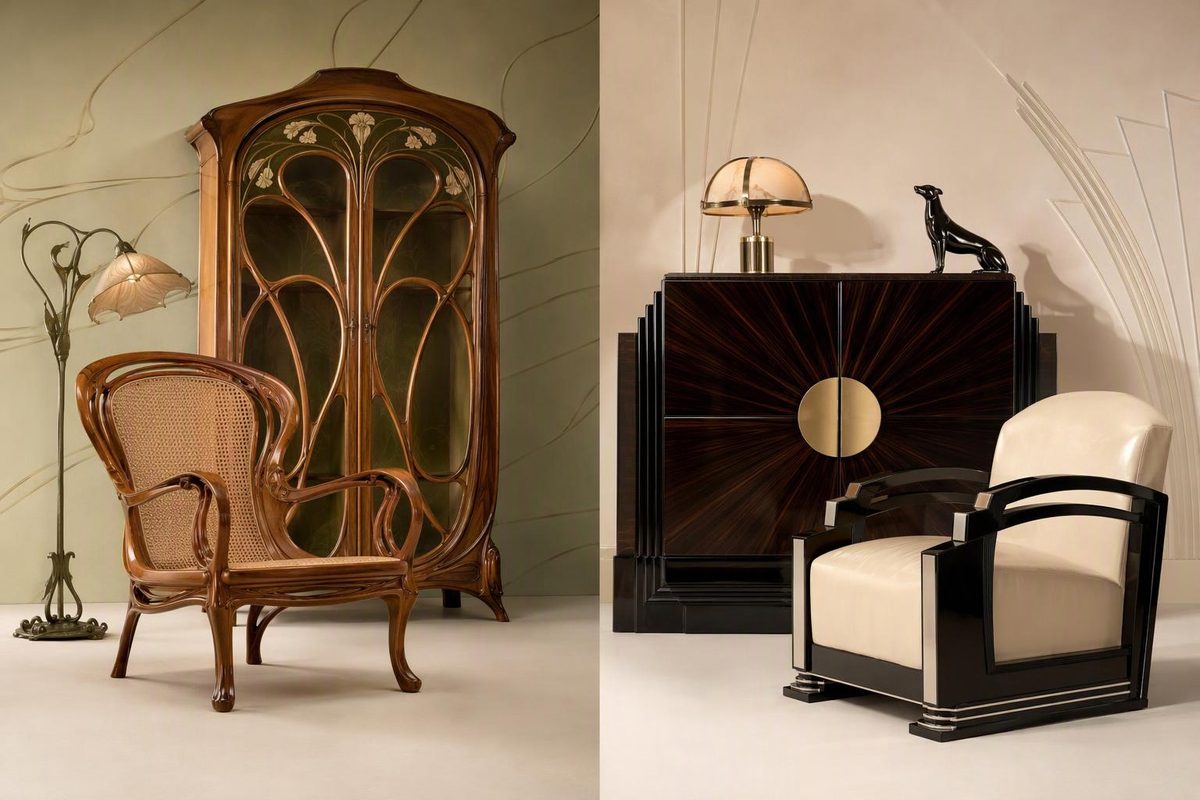
Émile Gallé’s Ombellifères cabinet, made around 1900, takes its name from cow parsley. Émile-Jacques Ruhlmann’s État cabinet, designed in 1922 and manufactured in 1925–26, carries interlocking marquetry that the Metropolitan Museum of Art compares to a jigsaw puzzle. Both use decorative veneers, but they offer different starting points: botanical inspiration for Art Nouveau, and a more ordered, abstract decorative language for Art Deco. See the museum’s records for Gallé’s cabinet and Ruhlmann’s cabinet.
The quickest distinction is organic flow versus geometric order. Art Nouveau furniture often makes wood and ornament seem to grow like plants; Art Deco often organizes its forms and surfaces into clear shapes and controlled patterns. That is a useful first impression—not a rule that every curved chair is Nouveau or every rectangular cabinet is Deco.
The main differences at a glance
Read these as tendencies, especially in French decorative furniture, rather than an authentication checklist.
| Feature | Art Nouveau furniture | Art Deco furniture |
|---|---|---|
| Main period | Developed from the 1880s to the First World War | Roots before the First World War; chiefly associated with the 1920s and 1930s |
| Line | Sinuous, branching or “whiplash” curves | Clear geometry, controlled curves and simplified planes |
| Ornament | Plants and flowers treated as sources of flowing line | Geometric patterns alongside stylized flowers, animals and figures |
| Useful first question | Does the design suggest growth or organic movement? | Does it organize decoration into an ordered composition? |
| Materials | Carved wood, decorative veneers, inlay and metal mounts | Decorative veneers, marquetry, lacquer and metal fittings; luxury examples may include ivory or sharkskin |
The Met traces Art Nouveau from the 1880s to the First World War and connects its whiplash line to botanical and biological studies. Its account of French Art Deco places the style chiefly between the world wars, while emphasizing that natural motifs remained important alongside geometry. Materials overlap substantially. Art Nouveau history; French Art Deco history.
Look at how the furniture uses its lines
On a chair, follow the back, arms and legs before concentrating on the upholstery. On a cabinet, examine the outline, supports, door divisions and ornament together.
For Art Nouveau, look for a line that changes direction like a stem or tendril. A carved leaf is more persuasive when its movement belongs to the larger design, rather than appearing as an isolated decoration on otherwise conventional furniture.
For Art Deco, look for the way shapes are simplified and arranged. A cabinet may rely on a striking veneer composition rather than elaborate carving. Flowers do not disqualify it: the question is whether they are rendered as flowing growth or organized into a stylized decorative pattern.
The distinction reflects continuity as well as change. The V&A identifies Art Nouveau as a major source for Art Deco, with plant forms borrowed and adapted into an updated visual language. V&A introduction to Art Deco.
Two shortcuts that can mislead
“Straight lines mean Art Deco”
Some Art Nouveau-associated work is strongly geometric. The V&A specifically identifies Charles Rennie Mackintosh and Josef Hoffmann as practitioners of a linear, geometric variant that helped shape Art Deco.
Mackintosh’s 1904 washstand for Hous’hill is a useful comparison: the Met describes its uncompromising shape and abstract glass panel. A rigid outline alone cannot make an object a 1920s design. Mackintosh washstand record.
“Exotic wood or shiny metal means Art Deco”
Materials are clues, not exclusive signatures. Louis Majorelle’s dressing table with sink, dated 1900–1910, combines mahogany, Macassar ebony, gilt bronze and nickel-plated brass. Ruhlmann’s later État cabinet also uses Macassar ebony, but in a different decorative scheme. Dark striped veneer cannot distinguish the movements by itself. Majorelle dressing table record.
Nor does plywood automatically indicate a modern reproduction: the museum records plywood in Gallé’s circa-1900 cabinet and lumber-core plywood in Ruhlmann’s 1925–26 example.
Identify the style, then test the date
A piece can be convincingly Art Deco in appearance without having been made during the Art Deco period. Keep three questions separate:
- What style does it resemble? Describe the outline, ornament and materials before accepting a seller’s label.
- Who designed or made it? Ask for photographs of marks and labels, plus the catalogue or documented model used to support an attribution.
- When was this particular example manufactured? Request provenance and clear photographs of the back, underside, drawer interiors, joints and hardware. Compare dimensions and construction with documented examples, not just a similar front view.
Design date and manufacture date need not be identical: Ruhlmann’s État cabinet demonstrates that explicitly. It also shows why an exact visual match is not always straightforward—the Met notes that Ruhlmann varied forms and surface decoration between commissions.
Treat “Art Deco style” or “Art Nouveau style” as a description of appearance unless separate evidence establishes age and maker. If the evidence supports only resemblance, retain that narrower description. For a closer look at documented makers and materials, use our French Art Deco furniture guide.