
Art Deco Wall Moldings and Panels: Identifying Period Work
Assess geometric wall trim through documentary history, materials, installation evidence, finish layers and comparisons with documented interiors.
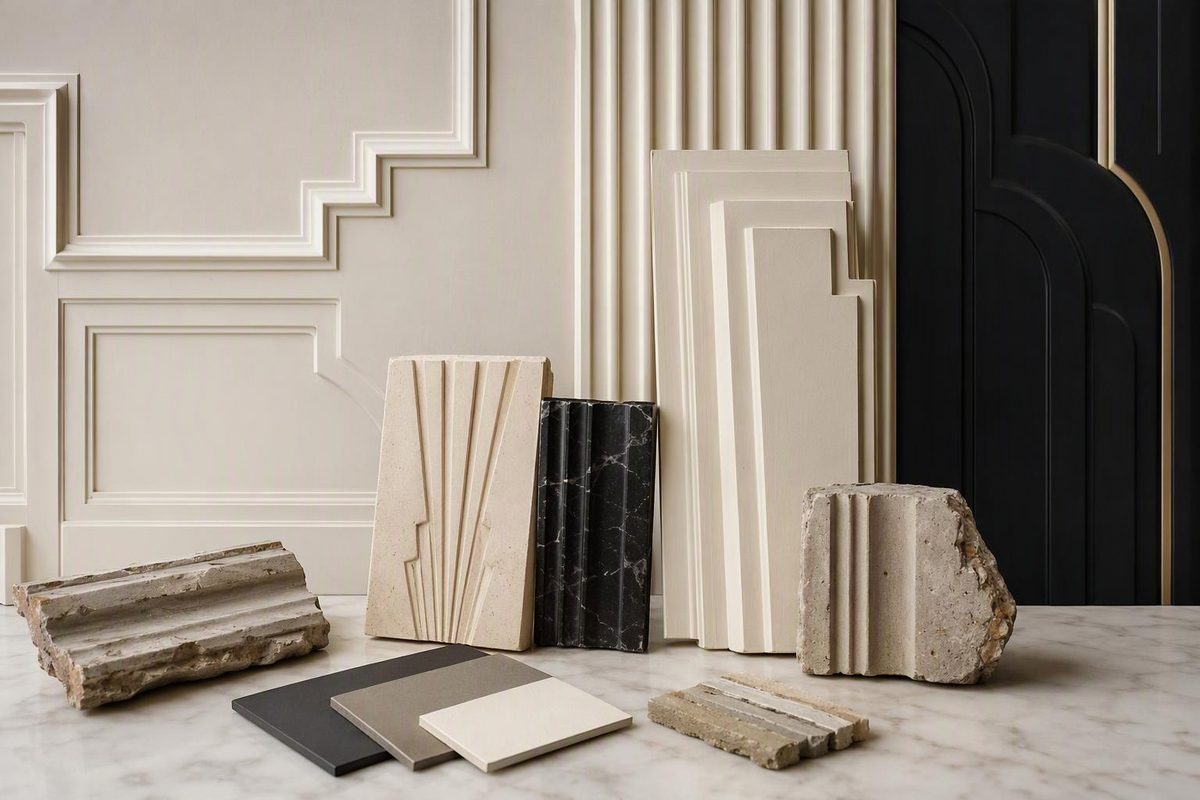
No molding profile proves that wall moldings or panels are period Art Deco. A stepped border, sunburst or run of fluting supports the description only when the room’s date, construction and overall composition agree. Newly installed rectangular trim is better described as Art Deco-inspired panel molding unless it reproduces a documented scheme.
Select the evidence you have; the tool assigns the most defensible description.
The composition looks deliberately Deco, but its installation date and physical relationship to the room are unproved.
This is a description aid, not authentication. A dated record must identify the wall or room; a building date alone is insufficient.
Basis: documented room examples and National Park Service Preservation Briefs 18 and 28 cited in the accompanying article.
In 1928, designer Herman Rosse made an entire dining room from Monel metal, painted and chrome-plated metal, glass and corduroy. The wall panels now in the Metropolitan Museum of Art’s collection are sheet metal. The room demonstrates that period Deco walls were defined as much by material, proportion and architectural integration as by an applied geometric outline (The Met; individual wall-panel record).
Period Art Deco Walls Took Several Forms
Art Deco interiors did not use one universal panel system. Documented examples include restrained plasterwork, figured wood surfaces, luxurious coverings and elaborate metalwork.
Molded Plaster And Painted Relief
Simple geometric bands, stepped forms and low-relief ornament suited the smoother interiors of the 1930s and 1940s. The National Park Service notes that Art Deco and Art Moderne interiors of this period were often decorated with simple molded plaster designs accented with metallic paints (Preservation Brief 28).
Such work may be shallow enough to disappear under later paint. Its significance comes from the complete arrangement—cornice, wall fields, openings and ceiling—not merely from one surviving piece of relief.
Veneered And Plywood Walls
Paneling could turn wood grain into part of the geometry rather than imitate traditional raised-and-fielded joinery. Frank Lloyd Wright’s 1937 Kaufmann office used swamp-cypress plywood and cypress-veneered blockboard. Its layered “marquetry plywood wall” formed triangles, rhomboids and hexagons through grain direction, cut and relief (V&A).
Wright’s work should not simply be relabeled Art Deco. This documented contemporary room nevertheless shows why plywood alone does not indicate a recent alteration.
Luxury Surface Treatments
Jean-Michel Frank used walls and ceilings upholstered in parchment or straw in a 1929 San Francisco interior. His wider palette included lacquer, wood veneer, parchment, textured gesso and humble plaster alongside more expensive finishes (Cooper Hewitt).
These treatments often depend on broad planes, subtle texture and precise junctions rather than applied molding. A plain-looking wall can therefore belong to a sophisticated period scheme.
Decorative Metal Panels
Edgar Brandt’s lift enclosure for Selfridges combined lacquer, iron, bronze and wood. Designed in 1922 and made in 1928, its stylized storks circle a sun inside a hexagon while rays and spirals extend outward (V&A).
The documented examples range from restrained planes to conspicuous ornament. Geometry matters, but material and placement matter just as much. The guide to Art Deco geometric patterns provides motif terminology without treating a motif as proof of age.
Rectangular Molding Is Not Automatically Deco
Picture rails, chair rails, cornices, baseboards and rectangular panel molding were already standard architectural vocabulary. A 1920 trade catalogue presented full-size profiles for commercially produced moldings before mature Art Deco interiors became widespread (The Standard Moulding Book). Traditional trim also remained in production while Deco flourished.
This creates two common attribution errors. The first is dating every old-looking molding to the building’s construction: a 1930 house may contain trim added decades later. The second is calling any symmetrical rectangle Art Deco. Plain box molding may be Georgian Revival, Colonial Revival, generic builder trim or a recent decorative treatment.
A stronger Deco attribution usually comes from a coordinated composition: stepped door surrounds continuing into wall bands, repeated vertical flutes, angular relief aligned with lighting, or panel proportions that echo windows, grilles and hardware. Even then, style classifies appearance; it does not establish installation date.
Date The Room Rather Than The Building
Establish the building’s construction date, then look for permits, alteration drawings, historic photographs, sales particulars and early descriptions of the room. A wall installed during a documented 1938 remodeling may be period work even if the building dates to 1905. Conversely, a 1928 building can contain a recent Deco revival.
A maker’s label, architect’s drawing or dated photograph is stronger evidence than a real-estate listing. The record must also connect to the particular room or wall under examination rather than merely establish the building’s age.
Examine adjoining elements. Original doors, switch plates, lighting and door hardware may reveal whether the scheme was conceived together or assembled later.
Read The Wall As A Complete Composition
Stand back before inspecting individual profiles. Check whether vertical divisions align with doors, windows or structural bays. Follow a stepped cornice around corners and note whether it turns coherently. Compare the proportions and finishes of the baseboard, casing, wall panels and ceiling treatment.
Services can also reveal sequence. Later outlets may cut awkwardly through an earlier scheme, while a recent panel layout may accommodate them precisely. Neither condition is conclusive: old rooms are altered, and later services can be installed carefully. The useful evidence is the relationship among all the parts.
A coherent composition does not prove age. Isolated decorative strips fitted neatly around recent services warrant a more cautious label, especially when the surrounding architecture does not repeat their proportions or motifs.
Examine Materials, Edges And Assembly
Record the substrate, face material, edge profile, fasteners and joints. Look behind a removable switch plate or at an already exposed edge rather than damaging the wall.
Period work may include solid timber, veneer, plywood, plaster, gesso, lacquered surfaces or fabricated metal. Neither plywood nor metal is inherently too modern. Crisp machining is not proof of a new installation either; period interiors could be factory-made and highly precise.
Adhesive beads, fresh pin holes, flexible caulk, new cut edges or materials inconsistent with the rest of the room can point to later installation. These remain clues rather than a verdict. An old scheme may have been repaired, while a revival may reuse old timber.
Finish Layers Can Establish Sequence
Where trim crosses older paint or wallpaper, concealed edges may reveal installation sequence. Multiple finish layers continuing from molding to adjacent plaster can support age. One fresh coating over both may merely conceal the underlying evidence.
Professional paint analysis is much stronger than casual scraping. The National Park Service explains that microscopic examination can associate paint layers with alterations and may help identify or date changes where documentation is sparse. It recommends combining physical analysis with written, pictorial and field evidence (Preservation Brief 28).
Do not sand or cut old coatings merely to investigate them. Paint removal can release hazardous lead dust, and decorative surfaces may hold evidence that stripping would destroy. Applicable safety and disposal rules depend on the jurisdiction and project.
Document The Wall Before Altering It
Even modest paneling can be character-defining when it survives in its original location. National Park Service guidance includes cornices, baseboards and paneling among the features that may define a historic interior. It recommends thorough photography before rehabilitation and notes that measured plans of existing conditions are especially useful (Preservation Brief 18).
If a scheme may be original, photograph complete walls, corners, profiles, joints, damaged areas and already exposed edges before cleaning, repainting or removal. Record dimensions and the relationship between panels, openings and fixed fittings.
For a listed, designated or landmarked property, check the applicable approval requirements before work begins. The governing rules depend on the property and jurisdiction.
Use A Confidence Label That Matches The Evidence
Documented period Art Deco requires dated plans, photographs, records or firm provenance connecting the wall treatment to the period. The documentation should identify the room or installation, not simply the building.
Plausibly period fits a scheme whose materials, installation sequence and room context agree but whose decisive documentation is absent.
Later Deco revival applies when the work demonstrably postdates the principal Art Deco period and deliberately revives its vocabulary.
Art Deco-style describes geometry that evokes Deco while its age or historical connection remains unproved.
Generic panel molding is the appropriate label when rectangular trim lacks enough distinctive or contextual evidence for a Deco attribution.
A fashionable chevron can be copied quickly. A wall whose finish layers, joints and documentary record belong to a 1930s interior represents a different kind of historical evidence.