
French Art Deco Furniture: Makers, Materials and Dating Clues
Recognize French Art Deco furniture through documented makers, materials and models—and separate period pieces from later revivals and loose attributions.
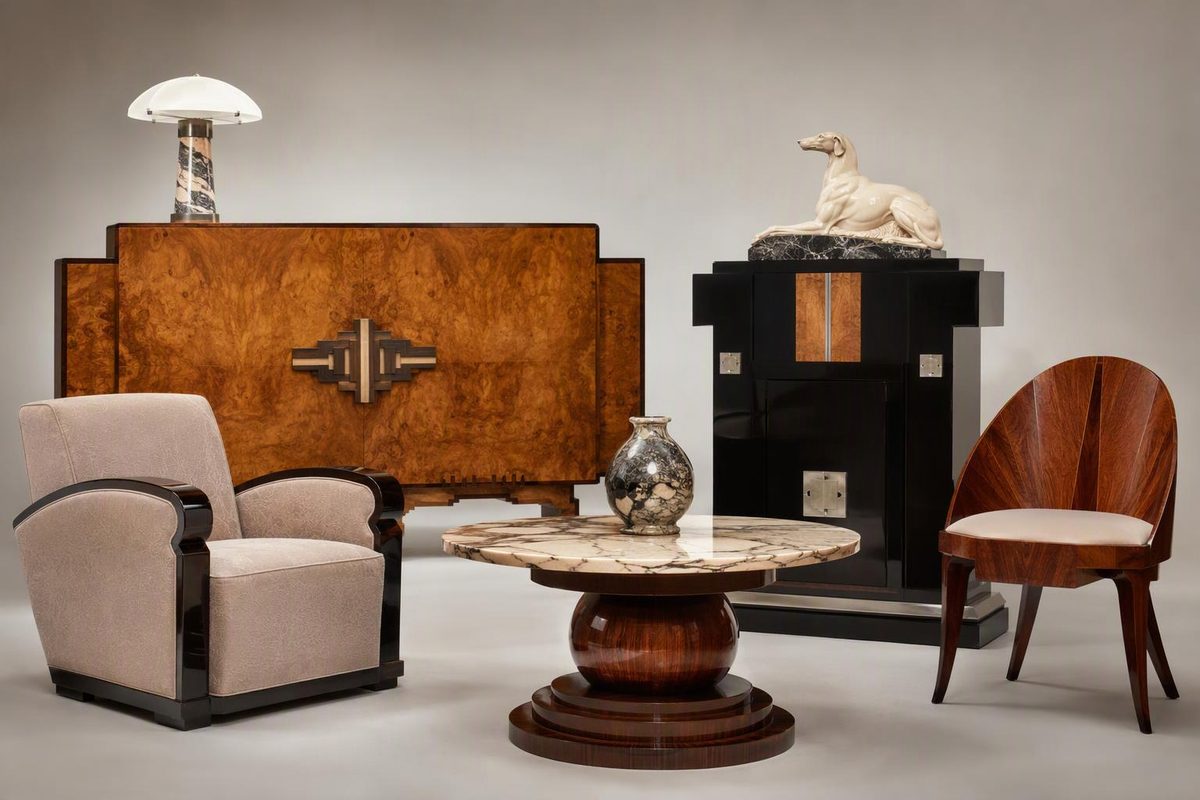
Ruhlmann’s État cabinet offers a useful correction to two common assumptions about French Art Deco furniture. Its design dates to 1922, before the celebrated Paris exhibition of 1925. And beneath its luxurious Macassar ebony, amaranth and ivory, its construction includes lumber-core plywood. Neither a pre-1925 design date nor plywood automatically disqualifies a piece from period Art Deco. The Metropolitan Museum commissioned this example in 1925; it was manufactured in 1925–26. The Met’s object record documents both dates and its materials.
For an unfamiliar cabinet, desk or chair, separate three questions: Does its design fit Art Deco? Was it made in the period? What supports its French origin and maker attribution? A convincing answer to the first does not settle the other two.
When was French Art Deco furniture made?
The 1925 Exposition Internationale des Arts Décoratifs et Industriels Modernes in Paris gave Art Deco its eventual name, not its starting date. Originally planned for 1915 and postponed by the First World War, the exhibition presented a style that was already mature. Its commercial success helped sustain production across Europe into the 1930s. The interwar years are the core reference period, but individual designs can be earlier. Jared Goss’s history for The Met explains this chronology.
Ruhlmann’s David-Weill desk, dated about 1918–19, illustrates the earlier development. Its kidney-shaped form draws on eighteenth-century French and English desks, and it was designed to harmonize with its patron’s historic furnishings. French Art Deco could modernize tradition rather than reject it. The museum’s desk record identifies both the date and those precedents.
Nor does every French piece made in the 1930s belong to Art Deco. International Style modernism developed alongside it, favoring plain, undecorated surfaces and geometric forms. Date and nationality alone are not a style classification. The Met’s account distinguishes these contemporary approaches.
What to look for—and what not to demand
French Art Deco is broader than black lacquer, chrome and zigzags. In documented luxury furniture, useful clues include:
- Expressive wood and veneer. Ruhlmann used Macassar ebony, amaranth and amboyna, sometimes with contrasting ivory decoration. Veneer belongs to the period vocabulary; “solid wood” is not a requirement for authenticity. See the documented materials of the État cabinet and David-Weill desk.
- Decoration integrated with form. Marquetry—patterns assembled from fitted pieces of veneer—could animate a cabinet’s surface. Lacquer and gold could instead turn an entire screen into a composition, as in Dunand’s Sunrise/Sunset.
- More than abstract geometry. Flowers, plants, animals and human figures were recurring motifs alongside geometric ornament. A floral or bird-decorated piece is not automatically Art Nouveau. The Met’s survey documents this range.
- Historic forms with a modern treatment. Classical and eighteenth-century references persisted. Süe et Mare’s desk suite at the 1925 exposition looked back to Louis XV, while Rateau’s dressing table drew on antiquity. Their records show why curved forms do not exclude Art Deco: Süe et Mare’s desk and Rateau’s dressing table.
These materials also have a history beyond their decorative effect. Goss connects the French industry’s use of imported woods, ivory and sharkskin to colonial resources and labor, alongside its interest in Asian and African art. That context matters when describing the luxury trade.
Five maker reference points
Use these names to find documented comparisons, not to assign a maker from a resemblance.
Émile-Jacques Ruhlmann: A leading exponent of high-style French furniture, associated with refined construction and sumptuous materials. He also worked as an ensemblier, designing coordinated interiors rather than simply assembling existing furnishings. Importantly, he sometimes varied a furniture model for different commissions, so a mismatch with one museum example is not necessarily decisive. The État record explains both practices.
Louis Süe and André Mare: Their work demonstrates Art Deco’s colorful, historically informed side. The Met’s desk from the 1925 exposition, manufactured by the Compagnie des Arts Français, is catalogued as ebonized wood (probably beech), oak, zebrawood, gilt bronze and leather. “Ebonized” describes a darkened finish; it should not be silently rewritten as solid ebony. Object record.
Jean Dunand: A key reference for lacquered furniture and screens. He learned traditional Asian lacquering from the Japanese master Seizo Sugawara in Paris in 1912. His Sunrise/Sunset screen, about 1930, combines lacquered wood and gold with an abstract solar composition. Object record.
Armand-Albert Rateau: His work broadens the material picture beyond veneered cabinetry. The Met’s dressing table, about 1925, uses bronze, basalt and mirror glass, with form and decoration inspired by Pompeiian models. The museum purchased it directly from Rateau. Object record.
Jules Leleu: Documented auction pieces can provide useful evidence of materials and marks. Christie’s catalogued a cabinet about 1930 in rosewood and silvered bronze, signed on an inlaid plaque J. Leleu 2526. That is a comparison for that object—not a universal stamp or dating rule for all Leleu furniture. Auction record.
How to test a listing before buying
1. Ask for the claims separately. Request the proposed manufacturing date, country of manufacture, designer and manufacturer. “French Art Deco style” is not, by itself, evidence of French production or interwar manufacture. If a listing says “attributed to” or “in the style of,” ask the seller to explain the wording and the evidence behind it.
2. Request photographs beyond the polished front. Ask for the back, underside, drawer interiors, joints, locks, hinges and every mark or label. Record dimensions too. For cabinet anatomy, use our guide to the parts of a commode.
3. Compare a specific model, not a general silhouette. Check proportions, supports, internal layout, fittings and decoration against museum records, period photographs or published designs. Ruhlmann’s 1924 Harmonies: Intérieurs de Ruhlmann portfolio is an example of a period reference. A model match supports the design identification; it still does not establish when the offered example was manufactured. A later reproduction can follow a period design.
4. Separate original components from restoration. Request a written account of replaced veneer, refinishing, replating, upholstery and hardware. Do not make one screw, dovetail or glossy surface carry the whole dating argument. For handles, compare mounting evidence and furniture context, not just the shape of the pull.
5. Ask what the provenance actually documents. Seek invoices, dated photographs, commission records or earlier catalogues that identify this particular piece. Note where the ownership trail stops. A previous dealer’s attribution is worth recording, but ask what supported it.
Before authorizing sanding, stripping or veneer repairs on a potentially important piece, seek a furniture conservator’s assessment. The Canadian Conservation Institute advises against stripping original finishes and recommends referring extensive repairs to a conservator.
Keep the seller’s description, photographs and supporting records together: the distinction between “French cabinet, circa 1930, maker unknown” and “by Ruhlmann” should rest on evidence, not on a more impressive name.