
Deco Floor Tile: How to Identify a Period Floor
Learn to identify Deco floor tile through material, layout, building dates and records—and distinguish period work from Victorian or modern floors.
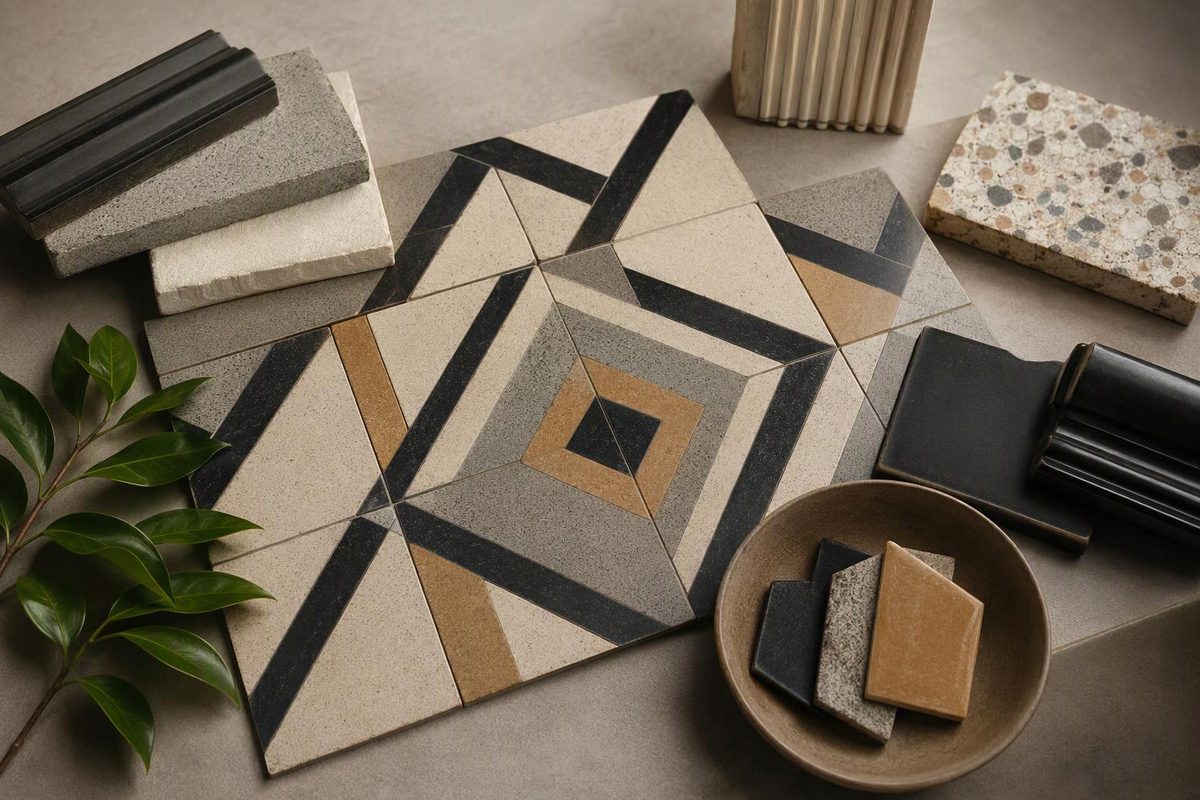
A Deco floor tile cannot be identified by pattern alone. A credible period attribution requires compatible material, an installation date tied to the building or room, and a complete design that belongs to the interwar scheme. A black-and-white hexagon floor may suit a 1930s bathroom, but the same pattern could be Victorian or newly installed.
Choose the evidence you have; the tool gives you the most defensible classification.
Floor Evidence Classifier
Use records, chronology and physical evidence—not pattern alone.
The default unknown state does not support a period attribution. Select only evidence you can verify.
Source basis: the evidence hierarchy and classifications in this guide, drawing on NPS preservation guidance, dated building documentation and catalogue comparison. This tool does not authenticate a floor.
Small ceramic mosaics were sold before the Deco period, geometric encaustic floors flourished in the Victorian era, and manufacturers still reproduce both. The useful questions are what the floor is made from, when this particular installation was laid, and how it relates to the building around it.
Art Deco Floor Tile Describes Four Floor Systems
Ceramic Mosaic Tile
Ceramic mosaic is a strong candidate in period bathrooms, vestibules and public interiors. Look for small round, square, hexagonal or octagonal pieces assembled into a field, often with a contrasting border or colored accents.
These mosaics were not invented by Art Deco designers. The Trent Tile Company and other American firms were making white and colored examples by the mid-1890s, and mosaics remained common through the 1930s. Small tiles were sold pre-mounted in patterns on 12-inch paper sheets, making elaborate installations easier to lay. White rounds, squares, octagons and hexagons were promoted particularly for bathroom floors, according to the text of the National Park Service’s Preservation Brief 40 (Grimmer and Konrad, reproduced by Vintage Design Group).
A hexagon, octagon-and-dot or basketweave field can therefore be appropriate to a Deco-period room without being specifically Art Deco.
Encaustic Or Inlaid Tile
A true encaustic tile carries differently colored clays within its body; its design is not merely printed on top. On a worn or chipped example, the pattern may continue below the surface. A Virginia Commonwealth University study of the American Encaustic Tiling Company describes colored slip filling recessed areas before firing, producing an inlaid pattern that does not simply wear away like surface decoration (VCU).
Encaustic tile has a much longer history than Art Deco. In the United States, it was especially important in later-19th-century decorative flooring. A geometric encaustic floor in a 1920s building may be original, reused, conservative in taste or part of a revival scheme. The material name does not settle the style or date.
Terrazzo
Traditional terrazzo floors are generally laid and finished in place rather than assembled from small ceramic units. They present a continuous matrix containing visible aggregate, divided by metal strips or joints. Those strips can form borders, radiating compositions, lettering and sharp geometric panels.
National Register documentation for Florida’s Larimer Memorial Library, built in 1929–30, identifies its original terrazzo floors as part of a building combining monumental Classical form with Art Deco ornament (National Park Service). The floor is assessed with the dated building, plan, lights, reliefs and other surviving finishes—not from aggregate color alone.
Resilient Floor Tile
Some interwar floors that resemble hard tile are asphalt, rubber or early vinyl compositions. The National Park Service dates the first use of asphalt floor tile to the 1920s, says plastic or vinyl began replacing asphalt as a binder in the late 1920s, and notes that semi-flexible vinyl flooring had been developed by the 1930s (NPS treatment guidelines).
That chronology can support an interwar date, but appearance is not a reliable material test. Old resilient flooring and backing may contain asbestos, which generally cannot be identified by sight. The EPA advises leaving suspect material alone and using a trained, accredited professional for sampling. Do not sand, scrape, drill, snap or lift it merely to investigate its age (EPA).
Deco Character Comes From the Complete Composition
A plausibly Art Deco floor usually combines several features rather than relying on one fashionable shape:
- bilateral or radial symmetry;
- stepped, fan, chevron, zigzag or sunburst forms;
- crisp borders organizing a room or emphasizing an entrance;
- strong contrast, such as black with white or cream;
- a restricted palette used as graphic accents rather than naturalistic shading;
- alignment with the room’s axes, fixtures, stairs or doorway.
These are stylistic clues, not date stamps. Greek-key borders, checkerboards, hexagons and geometric stars all predate the 1920s. Compare the complete floor with Art Deco’s dated defining elements. If the surface is patterned wood rather than ceramic or terrazzo, use the separate guide to parquet flooring patterns.
A modest bathroom floor can also be original Deco-period work without displaying a dramatic sunburst. Interwar manufacturers sold practical sanitary mosaics alongside conspicuous decorative schemes. A surviving 1927 Mosaic Tile Company trade catalogue shows that floor and wall tile belonged to an established commercial system, not a single “Deco pattern” category.
Date the Installation Before Naming the Style
Start With the Building And Room
Establish the construction date and every known renovation date. Permits, specifications, architects’ drawings, invoices, dated photographs and property files are stronger evidence than visual resemblance. A bathroom installed in 1931 inside an 1890 house can have a genuine Deco-period floor; a 1930s-style bathroom installed in 1998 cannot.
Study how the floor meets walls and fixtures. Tile continuing beneath an early partition or vanity may predate it. A patch outlining a removed tub, abrupt cuts around later plumbing or a threshold laid over the field can reveal the sequence of alterations. No single junction is decisive, but several compatible clues may establish which element came first.
Identify the Floor System
Determine whether the floor consists of separate ceramic units, inlaid tiles, poured terrazzo or resilient squares. Record the following where it can be done without damage:
- exact tile dimensions and thickness if an edge is already exposed;
- glazed or unglazed surface;
- body color visible at an existing chip;
- grout width and color;
- border, field and corner units;
- divider-strip material in terrazzo;
- substrate and setting bed where previous damage already exposes them.
Do not create a chip or pry up a sound tile to gather this information.
Read the Layout As Construction Evidence
Historic mosaic floors may show slight variation, cut perimeter pieces and repairs accumulated over decades. Modern reproductions can imitate these traits, while an exceptionally regular floor may still be old factory-made work. Uniformity and wear are supporting observations, not proof.
Look for repeated seams corresponding to preassembled sheets. Face-mounted paper was used historically and stripped away after setting. A regular grid in the joints may suggest sheet installation, but it cannot date the floor by itself.
At thresholds and existing damaged areas, look for changes in setting bed, grout or substrate. A repair can be old without belonging to the original installation campaign. Map patches instead of treating the room as one undivided floor.
Seek Marks Without Sacrificing Tile
Maker marks, initials and molded back patterns can be valuable, but they are generally on the reverse. Inspect only loose fragments, attic or basement spares, or pieces already removed during documented work.
The VCU study records “A.E.T.Co.” on the backs of American Encaustic tiles from 1880. It also demonstrates a stronger method than reading a mark alone: matching surviving work to dated company catalogues (VCU).
A name may establish the manufacturer without fixing the installation date. A persuasive catalogue comparison agrees in pattern, dimensions, colors, and border or corner pieces—and falls within the building’s plausible construction or alteration window.
Use A Classification That Matches The Evidence
| Classification | Evidence Required |
|---|---|
| Documented period floor | Dated plans, invoices, photographs or a well-supported original construction campaign tie this floor to the period. |
| Plausibly period | Material, layout and building context are compatible, but no decisive record or catalogue match survives. |
| Later repair or partial replacement | An older field contains identifiable patches, altered grout or substituted units. |
| Art Deco-style | The design uses Deco vocabulary, but its age is unknown or demonstrably later. |
Conflicting evidence calls for an unresolved attribution rather than a stronger label. “Original Art Deco tile” should be the conclusion, not the opening assumption.
Preserve Dating Evidence Before Restoration
Photograph the entire room square-on, then record borders, corners, thresholds, patches, cracks and any exposed backs. Measure a full pattern repeat and several individual units. Save loose fragments in labeled bags with their exact locations.
For routine ceramic-tile care, preservation guidance begins with the gentlest method: remove grit, test cleaning products in an inconspicuous area, and avoid abrasive cleaners that can wear a glaze or decorative surface (Preservation Brief 40 text). Loose tiles often point to moisture, movement or mortar-bed failure, so diagnosing the cause matters more than forcing a tile back down.
Terrazzo also needs diagnosis before grinding or patching. The GSA’s historic-terrazzo specification requires identification of the existing system, classification of cracks, small product tests and approved mockups before restoration work proceeds (GSA).
A worn floor can retain more dating evidence than a glossy restoration. Preserve the material and construction details, document the room, and let records carry more weight than a familiar black-and-white pattern.