
Vintage Art Deco Slag Glass Lamp: Check the Claim
Assess a slag-glass lamp’s Deco styling, maker marks, shade-and-base pairing and condition, with a claim checker and a published auction price comparison.
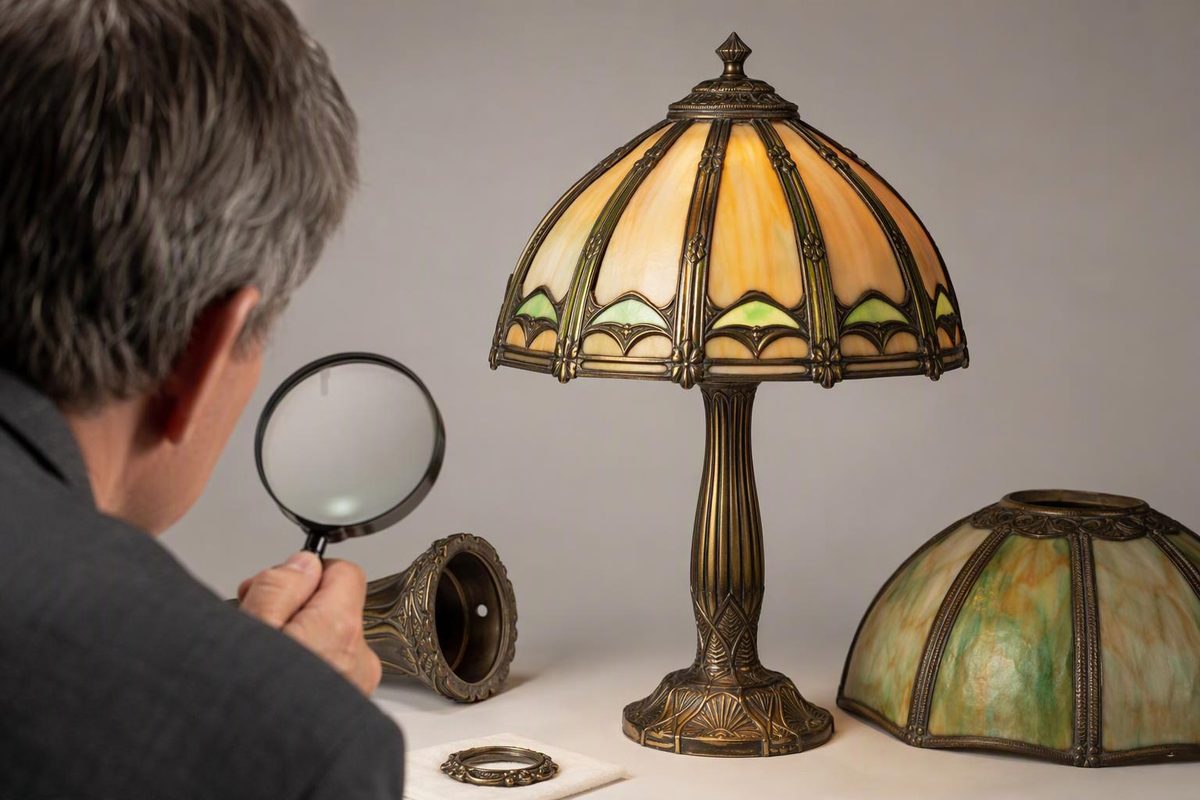
A vintage Art Deco slag glass lamp needs evidence for three separate claims: marbled glass, an Art Deco design, and a period date for the assembled lamp. Old glass and a signed base do not establish all three. If the date or shade-and-base pairing is unverified, describe that uncertainty rather than accepting the seller’s full attribution.
Select the evidence you have; the checker suggests wording the lamp can support.
Check the Attribution Wording
Supported Description
Slag-glass lamp; style, date and original pairing unverified.
Seek a documented design comparison and evidence for the shade, base and their original assembly before accepting the full Art Deco claim.
Assumes the glass has been identified separately. This checks wording against your evidence; it does not authenticate the lamp.
Sources: V&A, Art Deco history; Burchard Galleries, January 2023 Bradley & Hubbard catalogue entry. See the article for citations.
Slag Glass Identifies the Material, Not the Style
The Corning Museum of Glass’s Rakow Research Library defines slag glass as a collectors’ name for opaque pressed glass with coloured streaks, usually white or cream. Historical names included “Marble glass” and “Brown malachite.” The word slag was borrowed from the steel industry; the name alone is not evidence of a particular lamp’s ingredients or manufacturing process. Corning’s definition concerns the glass category, not a design movement, and should not be used to assume that any marbled lamp panel was pressed.
Ask for daylight photographs of the panels from outside and inside the shade. Record the colours, marbling, panel count and whether the glass is flat or curved. A photograph of the lamp glowing is less useful for comparing surface appearance and spotting repairs.
Distinguish the glass from its supporting structure. A shade with broad panels held behind cast metal ornament is not constructed in the same way as a mosaic shade divided into many small pieces. Describe what is present rather than relying on a listing that uses “slag,” “stained glass” and “Tiffany-style” interchangeably. None of those words establishes a maker.
The Whole Design Must Support the Deco Attribution
An early-20th-century lamp can have slag glass without being Art Deco. Aspire Auctions catalogued a green slag-glass lamp with a cast filigree shade, reeded stem and circular foot as Miller work, marked underneath. Yet its title called it Art Nouveau style, not Art Deco. The recorded example makes that distinction explicit.
Art Deco absorbed elements from Art Nouveau, including plant forms, while developing a more geometric decorative language. The V&A identifies the 1925 Paris exhibition as a pivotal moment and describes the growing use of geometric forms during the 1920s. Flowers therefore do not automatically rule Deco out, and geometry does not automatically prove it. The V&A’s account explains the transition.
| Design Direction | Details Worth Comparing | Limit of the Evidence |
|---|---|---|
| Art Deco | Stylised foliage; coordinated angular or geometric shade, stem and foot | One motif does not establish style or date |
| Art Nouveau | Flowing stems, curling tendrils and sinuous ornament | Plant forms also occur in Deco |
| Rectilinear Arts and Crafts | Simple framing, minimal decoration and plainly expressed construction | A square shade alone is not diagnostic |
The Metropolitan Museum describes Art Nouveau’s botanical inspiration, sinuous lines and “whiplash” curves in its Art Nouveau history. Its Arts and Crafts history discusses rectilinearity and minimal decoration in American examples. That is one strand of the broader Arts and Crafts movement, not its universal appearance.
Compare the composition with documented period designs. A geometric base beneath a floral shade may represent a mixed design—or components brought together later. For closer examination of the shade, use our guide to vintage Art Deco glass lamp shades.
Date the Shade and Base Separately
A genuine maker’s mark on the base does not prove that the shade originally belonged to it. Burchard Galleries catalogued a Bradley & Hubbard lamp with a trademark near the socket arms and dated the lamp itself to circa the 1920s, but explicitly described its floral mosaic shade as “married” to the lamp. Here, that means the components were paired rather than presented as an original combination. The January 2023 catalogue entry illustrates why a signed base is only part of the identification.
Request evidence that covers both components and their assembly:
| Evidence | What to Check |
|---|---|
| Full views and measurements | Overall height, shade width, foot diameter and proportions |
| Base underside and shade interior | Complete marks, numbers, labels and attachment details |
| Shade support and top fitting | Proper fit, adapters and alterations |
| Close-ups of every panel | Cracks, edge chips, replacements and differences in texture or colour |
| Repair and ownership records | What changed, when, and what supports the claimed date |
Transcribe marks exactly, including their location. Ask whether the attribution applies to the base, the shade or both. Seek a dated catalogue or documented collection example matching the design, dimensions and fittings—not merely another seller’s similarly worded listing.
A replacement cord does not make an old lamp a reproduction. Equally, old-looking electrical fittings do not establish that every component is original. Record restoration separately from age and style. Avoid polishing away finishes or dismantling fragile shade fittings simply to search for marks.
One Auction Result Is Not a Deco Price Range
Inspect the glass edges as well as the visible faces. The Miller lamp at Aspire was reported to have small chips on the undersides of its panels that were not visible through the shade, along with paint loss and rewiring. Its sale record lists $241.90 including buyer’s premium on 14 April 2022. That is a published result for one described Art Nouveau-style lamp—not a current valuation or a general price range for Art Deco examples. Aspire’s sale record supplies both the condition and price context.
No general Art Deco slag-glass lamp price range is established by the evidence here. For a useful comparison, match maker evidence, style, size, shade-and-base originality and condition. Keep hammer prices separate from premium-inclusive results, and account for packing, shipping and electrical work before deciding what to spend. An asking price is not a realized auction result.
Do not plug in an unassessed lamp merely to obtain a lit photograph. Have a qualified lighting repairer or electrician evaluate an old or undocumented electrical assembly before use. Cracked sockets, bare wires and loose connections can cause shock or fire—hazards the Electrical Safety Foundation identifies in its guidance for electrical decorations.
Use the Narrowest Description the Evidence Supports
“Documented period Art Deco lamp” requires support for the design, date and original assembly. “Early-20th-century slag-glass lamp in another style” preserves an established date without forcing a Deco attribution. “Period base with a replacement shade” distinguishes the age of one component from the assembled object.
When the design looks Deco but the date remains unsupported, “Deco-style lamp, date unverified” is the more defensible description. Buy and catalogue the lamp on that basis, not on the most appealing words in the listing.