
Vintage Art Deco Glass Lamp Shades: Identification and Fit
Assess vintage Art Deco glass lamp shades through documented designs, marks, condition and fitter measurements—and distinguish originals from replacements.
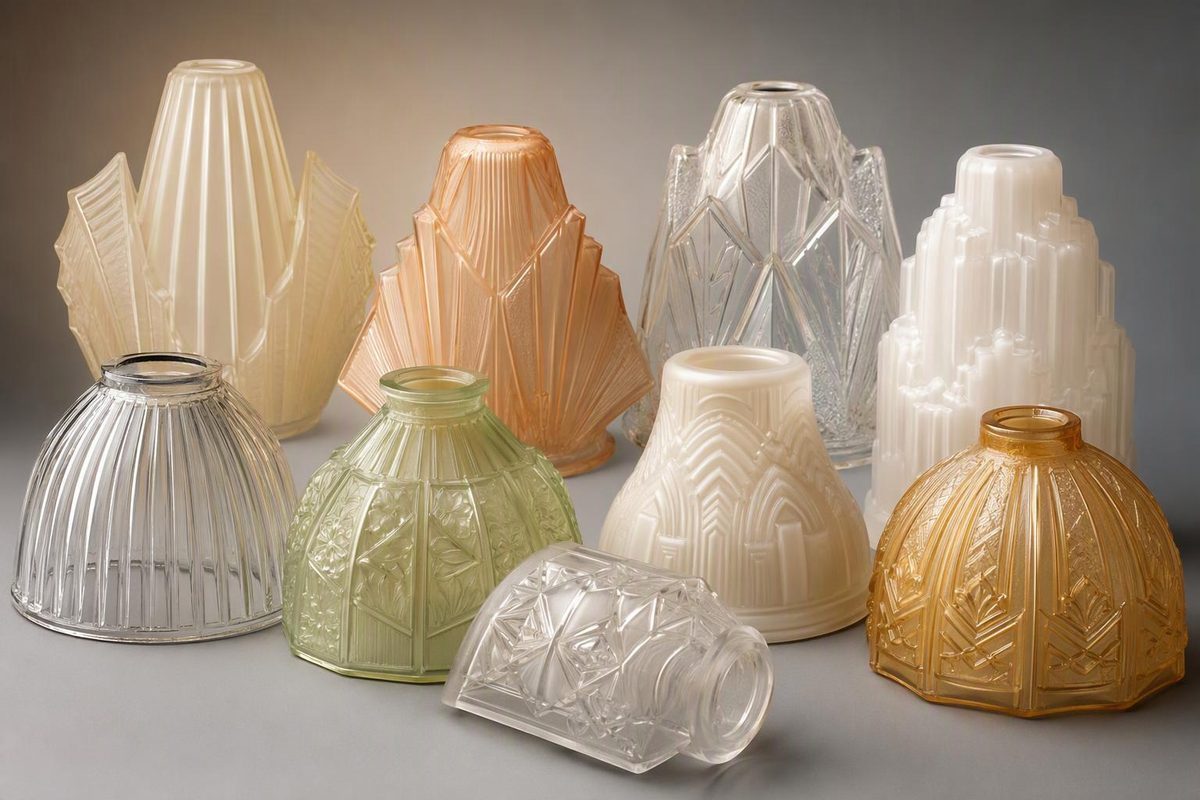
A glass shade decorated with baskets of roses need not be Victorian. In its May 2022 catalogue, Quittenbaum described a Degué ceiling light dated circa 1930 with relief rose baskets, satin-finished pressed glass and nickel-plated bronze mounting. Its signature was formed in relief. This catalogued example is a useful correction to the idea that Art Deco lighting must be all zigzags and skyscraper steps. Quittenbaum, lot 135
When assessing vintage Art Deco glass lamp shades, separate four questions: does the design belong to Art Deco, when was this particular shade made, who made it, and will it fit the intended fixture? A convincing answer to one does not settle the others.
Identify the design before assigning a maker
Record the shade’s overall shape and decoration separately. “Stepped dome with horizontal bands” is more useful than “classic Deco”; “moulded birds among flowering branches” is more useful than “Lalique-style.” Photograph the profile, underside, opening and any mounting features, not just the attractive front.
Period lighting offers several different glass treatments. These auction-catalogue examples provide comparison points, not shortcuts to attribution:
| Catalogued example | Recorded glass and decoration | What to compare |
|---|---|---|
| Degué ceiling light, circa 1930 | Satin-finished pressed glass with relief rose baskets; relief signature | Exact relief composition, outline and signature placement |
| Gabriel Argy-Rousseau Arbres table light, 1926 | Spherical pâte-de-verre shade with stylized leaves in red and dark brown; recessed signature | Leaf arrangement, colour distribution, dimensions and mounting |
| Schneider Marbré table light, 1922–24 | Cased glass with yellow, orange and dark violet powder inclusions; wrought-iron mounting | Shape, glass treatment and documented signature variant—not mottling alone |
All three appear in Quittenbaum’s catalogue, lots 135, 57 and 209, with material descriptions and, for the Argy-Rousseau and Schneider examples, published reference citations. The dates and attributions above are those given by the auction house.
A useful comparison should match more than a motif. Check the proportions, number and position of decorative elements, rim profile, openings and glass technique. A similar flower or bird on a different shape is a lead, not a model identification. For technique terminology, see our guide to period Art Deco glass versus modern designs.
Test the period claim, not just the appearance
A shade can reproduce an interwar design without being interwar glass. Vintage Hardware & Lighting explicitly sells recreated Luxart Streamline Art Deco slip shades, identifying the particular fixtures for which its replacement glass is intended. That is a legitimate restoration product, but not evidence of period manufacture. Recreated Luxart shade specification
Nor are bubbles an authentication test. The same supplier states that both antique and reproduction shades can contain small bubbles and that many of its shades use original moulds and methods. Consequently, bubbles or a familiar moulded pattern cannot establish age on their own. Supplier’s glass-shade notes
Mottled colour also needs scrutiny. Mark Chervenka reported later French lamps imitating early-20th-century forms and yellow glass with brownish-red mottling resembling Schneider production; he also noted similarities to pre-1930 Muller lighting. His report concerns particular copies, not every mottled shade, but illustrates why colour resemblance is insufficient. Real Or Repro
Ask the seller what supports the stated date: a period catalogue match, an identifiable model, an old photograph, documented ownership or a specialist assessment. Also distinguish a design’s introduction date from the manufacture date of the object offered. Christie’s, for example, catalogued a Lalique Cariatides lamp as “model introduced 1920”—wording that dates the design, rather than automatically establishing that an individual lamp was made in 1920. Christie’s lot record
Read marks on the glass separately from the fixture
Request a sharp close-up and transcribe every letter, number and symbol. Record whether the mark is raised, recessed, engraved or otherwise applied, and where it sits. Do not silently expand a partial inscription into a famous maker’s name.
For Lalique, Christie’s states that pre-war works made during René Lalique’s lifetime are usually signed R. Lalique, while post-war works normally bear Lalique France, sometimes with a circled R. Crucially, the auction house also warns that pieces may be re-signed to appear older. A plausible inscription therefore needs a matching model and physical examination, not just the right wording. Christie’s Lalique collecting guide
Keep glass and metal attributions separate. A name on a base is not a signature on its shade. If the seller claims the assembly is original, ask for evidence connecting those components; a replacement shade may fit an old lamp without having belonged to it originally.
Measure the mounting before buying
For a conventional lipped shade, the fitter is the outside diameter of the glass lip entering the holder—not the shade’s widest diameter. House of Antique Hardware explains that the actual lip measures slightly less than its nominal fitter size to allow insertion. To identify the fixture’s nominal size, measure the holder’s inside diameter. Glass-shade measuring guide
Request these measurements, preferably with photographs showing the ruler:
- Outside diameter of the fitter lip and inside diameter of the intended holder.
- Overall height and maximum width, with the measurement points stated.
- The shape and depth of the neck or lip.
- Any central opening, suspension holes, tabs, slots or retaining features.
Match the holder type as well as its diameter. Antique Lamp Supply distinguishes lipped shades retained by set screws from straight-fitter shades that rest in upright holders. Matching nominal sizes alone does not establish that the mounting arrangement is correct. Replacement-shade guide
Do not apply a circular-fitter rule to every shade. For a slip shade or suspended bowl, compare the actual mounting geometry. The recreated Luxart example’s fixture-specific compatibility list illustrates why “Art Deco slip shade” alone is not a sufficient fit specification.
If buying glass for a complete hanging light, assess the assembly as well as the shade; our Art Deco pendant-light identification guide addresses that wider task. Have a qualified lighting restorer or electrician assess the intended installation rather than forcing an uncertain fit.
Inspect condition and compare like with like
Ask for photographs of the entire rim, fitter, holes and mounting contact points. Request explicit disclosure of cracks, chips, filled holes, adhesive repairs and polishing. Christie’s notes that glass may be polished or cut down to conceal damage—an important reason to compare dimensions and edge profiles with a documented example. Condition guidance
For valuation, seek published sold results for a comparable shade alone. A complete signed lamp is not a direct price comparison for detached, unsigned glass. Match maker, model, dimensions, colour, condition and completeness before drawing a conclusion; an asking price is not a realized result.
A useful final description should state what is known without filling the gaps: “Art Deco-style glass shade, maker and date unconfirmed”; “shade plausibly dating to the 1920s–30s, attribution unresolved”; or, where the evidence supports both claims, “period glass shade with later replacement mounting.” Preserve the measurements, photographs and supporting records with that description. They are more valuable than an unqualified “vintage” label.