
Vintage Porcelain Door Knobs: Identification and Dating
Identify vintage porcelain door knobs by ceramic body, shank, spindle, lock and building context—and avoid false Bennington or Art Deco claims.
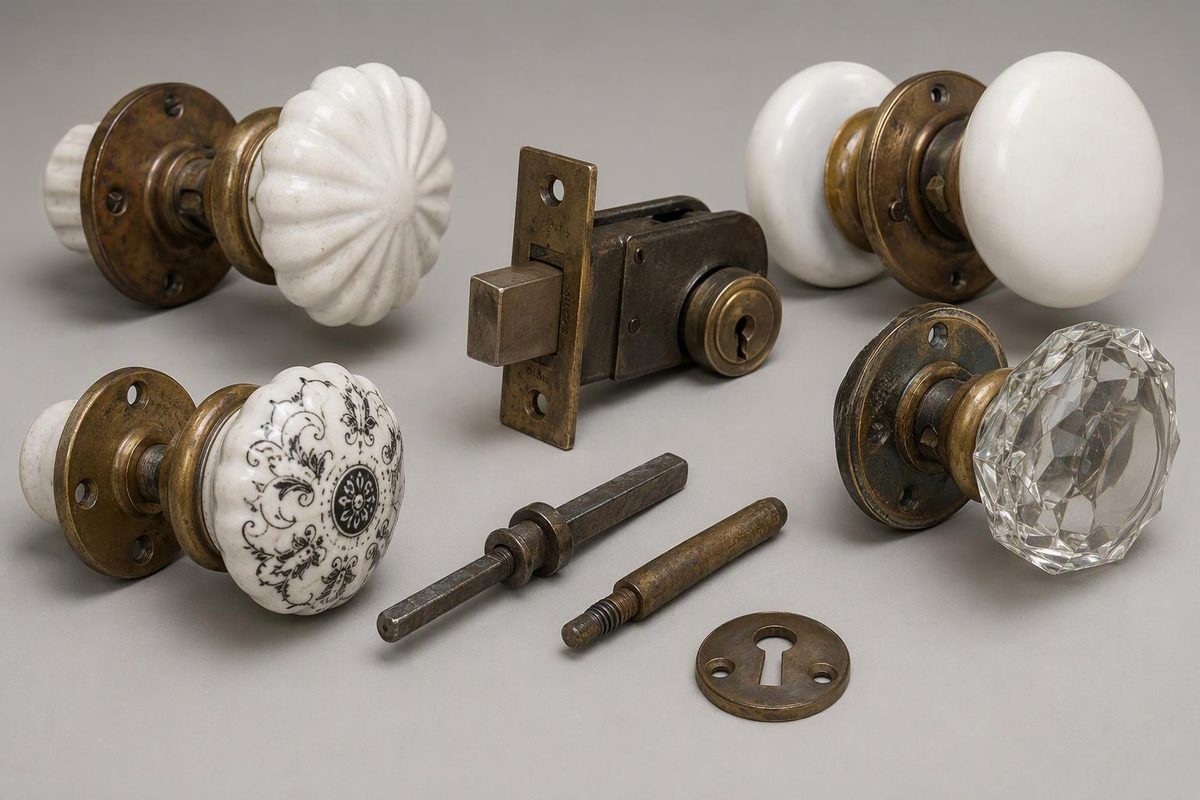
A plain white knob can look “Victorian,” “Art Deco” or merely old, depending on the plate behind it. That ambiguity is real: pottery knobs entered American hardware use in the mid-19th century and remained available well into the 20th. Color alone cannot provide a narrow date.
The useful evidence is the complete assembly—ceramic body, metal shank, spindle, rose or backplate, lock and door—not the knob viewed in isolation.
First, establish that it is porcelain rather than glass
Historic catalog terminology is more dependable than a seller’s title. A 1926 Fort Pitt Hardware Company catalog separated “pottery door knobs” from “glass door knobs” on consecutive pages. Its pottery range included jet-black and white porcelain knobs; its glass range included clear octagonal, milk-white octagonal and round opal examples. The catalog therefore shows why an opaque white knob should not automatically be called milk glass, and why a transparent faceted knob is not porcelain (Fort Pitt catalog, 1926).
Use these distinctions cautiously:
- Porcelain or pottery: an opaque, glazed ceramic body; an existing chip may expose a granular body beneath the glaze.
- Milk or opal glass: glass throughout, sometimes slightly translucent at a thin edge under strong light.
- Clear pressed glass: transparent and often faceted or molded, sometimes with bubbles or mold evidence.
- Modern resin or plastic: weight, surface and temperature may differ from ceramic, but none of those observations proves the material by itself.
Do not chip, scratch or file a knob to test it. Existing damage may reveal the body without creating further loss.
Color gives a range, not a date
White and black ceramic knobs were practical catalog staples. The 1926 Fort Pitt listing offered a 2¼-inch jet-black knob and white porcelain models for rim and mortise locks. Yale & Towne catalog no. 29 contains an October 1938 page listing porcelain and jet knobs in several sizes, with cast-bronze or brass shanks (Yale catalog no. 29). These records demonstrate continued interwar availability; they do not prove that every similar knob dates from 1926 or 1938.
Brown, mottled or swirled pottery is frequently advertised as “Bennington.” Treat that word as a pattern or glaze description unless provenance or a documented catalog match establishes a maker. Christopher W. Fenton’s 1849 patent at Bennington described colors that flowed and mingled in a transparent under-glaze to imitate variegated stone or shell. It was a patent for glazing pottery ware, however—not a maker’s mark on every brown swirl knob (U.S. patent 6,907). Visual resemblance cannot by itself attribute a knob to Fenton or a Bennington pottery.
A specialist history of American builders’ hardware places pressed glass, clay and porcelain knobs in expanding use during the 1840s and 1850s, with brown clay, swirl “mineral” and porcelain types common by the 1860s and sold into the early 20th century (Antique Homes, “The American Doorknob”). That broad span is precisely why “antique porcelain” is not a useful date on its own.
Date the hardware assembly
Turn the knob over—without dismantling it if it is still securely installed—and record five components.
1. Shank
The shank is the metal neck fixed into the ceramic. Look for its shape, material, finish, casting seams, corrosion and the way it meets the knob. A cracked or loose joint matters both to attribution and safe use.
2. Spindle and attachment
Fort Pitt illustrated multiple constructions in 1926. In one, a side screw passed through the shank into a tapped hole in the spindle. In another, a threaded spindle screwed into the knob shank and a set screw locked the adjustment. The catalog also sold plain, split, closet and swivel spindles separately (Fort Pitt catalog, 1926).
This variation defeats simple rules such as “a set screw means antique.” Instead, match the exact spindle system, dimensions and shank form to a dated catalog.
3. Rose or backplate
A small plain round rose may accompany a utilitarian installation across several decades. A long stamped or cast backplate carries more stylistic information: stepped outlines, angular geometry, sunbursts and repeated linear ornament may support an interwar Art Deco reading. Floral scrolls, Renaissance-derived ornament or Gothic tracery point elsewhere.
Even then, the plate may be older or younger than the knob. Check whether wear, screw shadows and finish agree across the set. For a fuller assembly-based method, use the Art Deco door-knob identification guide.
4. Lock and marks
Search the lock face, latch case, back of the plate and spindle for a manufacturer, patent number or model number. The ceramic face is often unmarked. A marked lock does not prove that detachable knobs came with it, but it supplies a better catalog-search term than “white porcelain knob.”
5. Door and building context
Record the building date, room, door thickness, lock type and whether matching sets survive elsewhere. Consistent hardware across several doors is stronger evidence than one isolated knob. Service rooms, later partitions and renovated bathrooms may preserve inexpensive ceramic hardware after reception rooms have been updated.
Is a porcelain knob Art Deco?
Usually, porcelain is a material description—not a style verdict. Plain black or white spheres were established before Art Deco and remained commercially available during the Deco period. A knob can therefore be:
- older hardware retained in a 1920s or 1930s interior;
- an interwar catalog product with little stylistic ornament;
- part of a genuinely Deco set because its plate, rose and lock belong to a documented geometric design;
- a later replacement or current reproduction.
Call a loose, unmarked sphere “vintage-style porcelain” or a “porcelain knob of uncertain date” until stronger evidence appears. Reserve “Art Deco” for an assembly supported by design, construction, catalog evidence or documented building context.
Condition and restoration
Inspect under raking light for hairline cracks around the shank, glaze crazing, rim chips and adhesive repairs. Do not test an installed knob by pulling or twisting it aggressively. A loose shank, stripped set screw or cracked ceramic body can fail even when the surface looks sound.
Before cleaning, remove loose dust with a soft cloth. Avoid soaking an assembled knob because liquid can enter the ceramic-to-metal joint. Do not polish plated roses indiscriminately; a dark surface may be an original finish rather than dirt.
For a historic building, retain and repair sound original material where practical. National Park Service guidance calls for preserving character-defining features and meeting access requirements with the least impact on significant historic material. Its accessibility brief specifically notes that historic knobs can be difficult to grip and turn, and discusses lever adapters, replacement levers and power-assisted openers as possible responses (NPS treatment guidelines; NPS Preservation Brief 32). If an accessible lever or other alteration is required, document the original assembly and retain significant removed hardware when feasible; the applicable solution depends on the building and local code.
A defensible listing or catalog record
Record what can actually be observed:
- quantity and whether the knobs form a functioning pair;
- ceramic color, shape and diameter;
- shank material and attachment;
- spindle type, dimensions and thread condition;
- rose, backplate and lock included;
- all marks and patent numbers;
- chips, cracks, crazing, looseness and repairs;
- known building provenance;
- the dated catalog match, if one exists.
The strongest description may be modest: “Pair of opaque white glazed pottery knobs with iron shanks and side screws, approximately 2¼ inches diameter; maker and date unconfirmed.” That is more useful than an unsupported claim of “rare 1920s Art Deco porcelain.”