
Art Deco Cane Furniture: Construction, Dating and Condition
Identify Art Deco cane furniture through documented designs, cane construction and restoration evidence—and check the weak points before buying.
A pine-and-cane chair designed for the “Trout Fisherman’s Retreat” in 1932 offers a useful corrective to the idea that Deco furniture must be all polished veneer and upholstery. Bonhams catalogued four examples as Ruhlmann’s model 2704, noting that one bore a Ruhlmann brand and citing a published photograph of the chair at the 1932 Salon des Artistes Décorateurs. Cane belonged in Deco’s material vocabulary too. (Bonhams catalogue)
But cane identifies a material and construction, not a style or date. When assessing “Art Deco cane furniture,” separate three questions: does the design belong to Deco, when was the frame made, and is the present caning original or replaced?
What “cane” means
In furniture caning, cane is the outer skin of the rattan stem, cut into thin strips. Rattan is the plant material; wicker describes a weaving technique, which can use several materials. A wooden chair with a cane seat is therefore not necessarily a rattan-framed chair, and “wicker” alone does not tell you what its strands are made from. (Maison Louis Drucker’s material guide)
The distinction matters when reading listings. Ask whether “cane” means an open woven seat or back, woven side panels, or the thicker stems used for the frame. Those are different parts with different repair needs.
Cane need not be the seating surface. Christie’s described a pair of Art Deco mahogany lounge chairs with square slatted backs, block feet and woven cane sides, accompanied by seat and back cushions. Here the caning formed the sides rather than replacing the upholstered seat. (Christie’s catalogue)
Read the attachment, not just the pattern
An open mesh can look similar from the front while being installed differently. Inspect the perimeter and, where accessible, the underside or reverse.
| Construction | What to look for | What it tells you |
|---|---|---|
| Hand caning, or hole-to-hole caning | Individual strands pass through a series of drilled holes around the frame opening. | The weave is worked directly into the frame. |
| Pressed cane, sheet cane or cane webbing | A woven sheet enters a continuous groove and is retained by a reed spline. | The panel is installed as a sheet rather than woven hole by hole. |
| Wide binding cane, or porch cane | Broader strips wrap around seat rails or rungs, forming upper and lower layers. | It is a different seat-weaving arrangement, not simply a larger open mesh. |
These distinctions are described in Cathryn Peters’s guide to three types of chair caning.
Do not turn “hand-caned” into “1920s,” or “sheet cane” into “modern reproduction.” The attachment identifies the repair system; it does not by itself establish the furniture’s age. Matching the mesh without checking how it meets the frame is also an incomplete restoration comparison.
Establish the design and the frame’s date separately
Use the Ruhlmann example as a model for evidence, not as a shortcut to attribution. Its auction description supplies a model number, a project, a design date, a mark and a literature reference. An unnamed chair needs its own supporting comparison. Similar cane, pine or proportions do not establish the same maker.
A useful comparison can also rule out an overly broad Deco label. MoMA records Marcel Breuer’s Cesca armchair, model B64, as a 1928 design in bent chromed tubular steel, wood and cane, manufactured by Gebrüder Thonet. (MoMA collection record) Knoll’s design history places the Cesca in the Bauhaus-informed Modern movement—a more specific identification than simply “Art Deco chrome-and-cane chair.” (Knoll design history)
MoMA also holds a Cesca armchair manufactured by Gavina, Italy, under the same 1928 heading. Yet Knoll records that Gavina acquired the design rights in the early 1960s. This illustrates why a design date is not necessarily an individual chair’s manufacture date. (MoMA’s Gavina example; Knoll’s production history)
For a seller’s attribution, request:
- Photographs of the complete frame, underside, reverse and any labels or brands.
- Dimensions and the exact catalogue or model comparison behind the claimed maker and date.
- A restoration history that distinguishes work on the frame from replacement of the woven panels.
For broader stylistic comparisons, see Art Deco furniture styles and period clues.
Inspect cane and frame as one structure
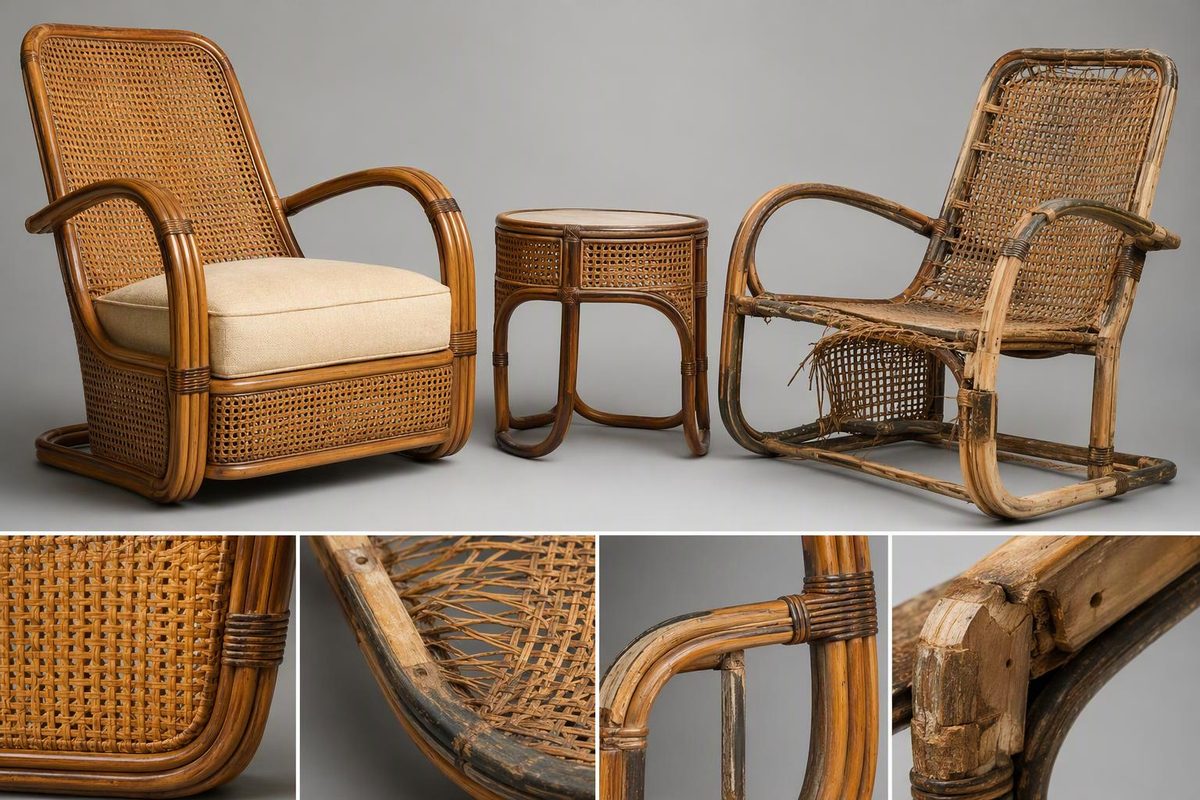
Look for broken or fraying strands, punctures, uneven sagging and failures where the weave meets the frame. Then examine the surrounding wood: cracks through drilled holes, damaged groove edges, open joints and loose components deserve attention even when the mesh looks fresh.
The Fine Art Restoration Company reports that failing frame joints can place cane under pressure and cause it to unravel. Recaning alone is therefore not a complete remedy for an unstable chair. (Restoration guidance)
Fresh cane does not automatically disqualify an old frame. Conversely, dark cane does not prove originality: Peters notes that cane darkens naturally but that replacement caning may also be stained to match a set. Color is a reason to ask questions, not a dating test. (Cane care and finishing guidance)
Before buying, obtain a preliminary repair estimate based on photographs of both the weave and its attachment; an in-person inspection may reveal additional work. Ask whether the proposal retains the existing system and whether structural repairs are required first. For an important attributed piece, have a furniture conservator assess surviving material before authorizing replacement.
For everyday care, keep natural cane away from direct sunlight, heater ducts and extremes of dryness or damp. Never kneel or stand on a cane seat: concentrated pressure differs from the distributed load of sitting. These are practical precautions in Peters’s care guide. If strands or frame parts are failing, stop using the chair pending assessment rather than testing its strength with your weight.