
Art Deco Furniture: Styles, Materials and Period Clues
Explore Art Deco furniture through documented designs, changing materials and practical clues that separate period work from later Deco-style pieces.
Edward Maufe’s 1925 writing desk looks silver, but its shimmer comes from white-gold leaf over a wooden body. Beneath that striking surface is a recognizably traditional British kneehole desk, complete with bun feet. Designed by Maufe and made by William Rowcliffe for the Paris exhibition, it captures an important feature of Art Deco furniture: modern decoration did not necessarily mean abandoning older furniture forms. The V&A’s object record documents both sides of that design.
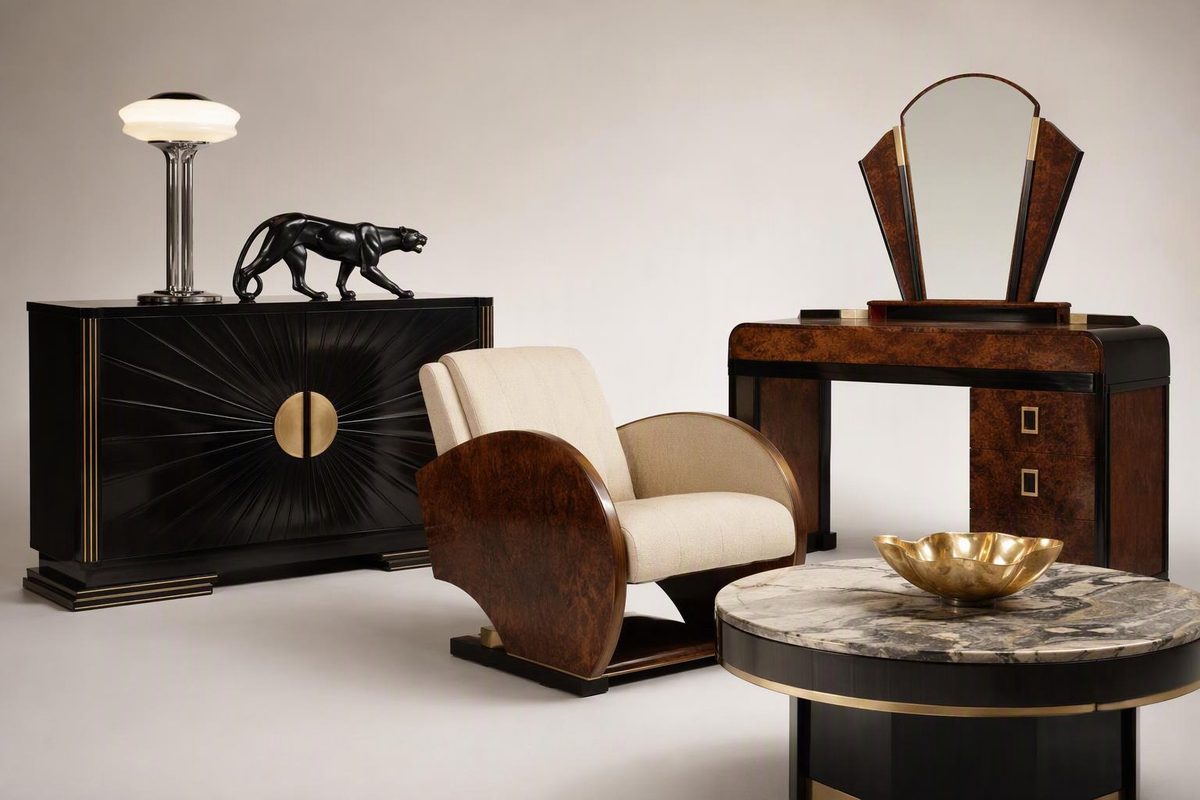
Art Deco furniture is a broad family of designs associated chiefly with the 1920s and 1930s, combining decorative geometry, carefully considered surfaces and an enthusiasm for modern life. It encompasses sumptuous handcrafted work as well as furniture shaped by industrial materials and production. A veneered dressing table and a glass-and-metal armchair can belong to the same history without looking alike. The V&A’s overview emphasizes this blend of tradition and the mechanized world.
When was Art Deco furniture made?
The 1925 Exposition Internationale des Arts Décoratifs et Industriels Modernes in Paris was a pivotal showcase, not a starting gun. The style—then known as Style Moderne—was already developing. Émile-Jacques Ruhlmann’s dressing table in the V&A, for example, dates to about 1919–1923. The exhibition history and the dressing-table record establish that distinction.
For a first comparison, concentrate on documented furniture from the interwar decades. But keep two questions separate: does the design look Art Deco, and when was this particular piece manufactured? A period-looking silhouette is a useful lead, not a date stamp.
The range: luxury, hybrid designs and factory production
Art Deco is easier to understand through its different approaches than through a single checklist of motifs.
Luxury craftsmanship and decorative veneers
Ruhlmann represents the refined, high-end side of the spectrum. His V&A dressing table has an oak carcass—the structural body—veneered in padouk and purpleheart, with ivory-and-ebony inlay and silvered bronze fittings. Its pivoting mirror recalls early nineteenth-century dressing tables, while the contrasting inlay creates the illusion of a textile draped over the top. The decoration transforms an inherited form rather than replacing it. V&A catalogue
This is also why veneer should not be treated as evidence of cheapness. In this documented luxury piece, the visible woods are deliberately applied over a different structural wood. The surface material and the underlying construction answer different questions.
For a closer account of this tradition and its designers, see French Art Deco furniture.
Traditional forms with unexpected materials
Maufe’s desk offers a British variation: mahogany construction, dark ebony writing surfaces and white-gold gilding, with elaborate handles incorporating silk, rock crystal and ivory. Its effect depends on contrast and finish as much as on its outline. V&A catalogue
Denham Maclaren’s zebra-upholstered armchair takes the mixture further. The V&A describes its industrial glass and metal fittings alongside the sumptuous animal-skin upholstery. It bridges bespoke luxury and experimentation with industrial materials—an example that resists the idea that all Deco furniture must be polished wood or densely ornamented. Art Deco in the home
Modern furniture for a wider market
Across domestic design in the 1930s, chromed steel, aluminium, mirror, coloured glass and new plastics expanded the decorative vocabulary. The Depression accelerated interest in less expensive goods and production methods compatible with industry. Plastics such as Bakelite were especially useful for moulded radio cases; this wider material shift should not be read as a claim that metal and plastic replaced wood in every furniture category. V&A history
In the United States, Gilbert Rohde helped move Herman Miller toward modern furniture, including modular, clean-lined storage pieces shown at the 1933 Chicago World’s Fair. Herman Miller’s archive-based history records that shift.
A Rohde vanity illustrated in the company’s 1939 catalogue combines rectangular and curved forms, three circular mirrors and circular acrylic drawer pulls. It shows why later interwar furniture need not be stripped of glamour to be industrially minded. Cooper Hewitt’s account identifies the catalogue and design details. This is an overlap between Deco glamour and modern furniture design, not a reason to classify every Rohde design as Art Deco.
What to look for in an unfamiliar piece
Use the documented examples as a way of looking, rather than a rigid test:
- Read the whole form. Notice the relationship between rectangular bodies, circular mirrors, curves and supports—not just an eye-catching handle.
- Separate structure from surface. Ask what the carcass is made from, what covers it, and whether the decoration comes from veneer, inlay, gilding or reflective fittings.
- Look beyond applied ornament. A piece may make its decorative statement through proportion and material contrast rather than a carved motif.
- Allow for stylistic overlap. Traditional desk forms, nineteenth-century mirror arrangements and emerging modern production all appear within these examples.
In domestic design, the later streamlined tendency used smooth curves and reflective surfaces rather than conspicuous applied decoration. The V&A’s domestic-design history illustrates that tendency through Charles Barman’s electric heater: its decorative effect comes from its surface and form. For the neighboring earlier style, consult Art Deco versus Art Nouveau furniture.
Period furniture or Deco-style furniture?
Treat “Art Deco” in a listing as a claim to clarify. Does the seller mean an interwar object, a later reproduction of a historical model, or a new design borrowing Deco features?
Before accepting a period or maker attribution, ask for the evidence behind it: a maker’s label or stamp, a matching contemporary catalogue, documented ownership, and photographs of the back, underside and drawer interiors. A mark is one piece of evidence, not a substitute for checking the object. Compare the complete construction and dimensions, not only the front view. Record restoration and replacement parts separately from the claimed manufacturing date.
Object-specific checks belong in the closer examination: cabinet pulls, dining chairs and sofas each raise different questions. The broad style helps you choose a comparison; the evidence for the individual piece determines how confidently you can describe it.