
Art Deco Dining Room Chairs: Identify a Period Set
Assess Art Deco dining chairs through documented designs, maker marks and frame details, then check restoration, structural condition and dining-table fit.
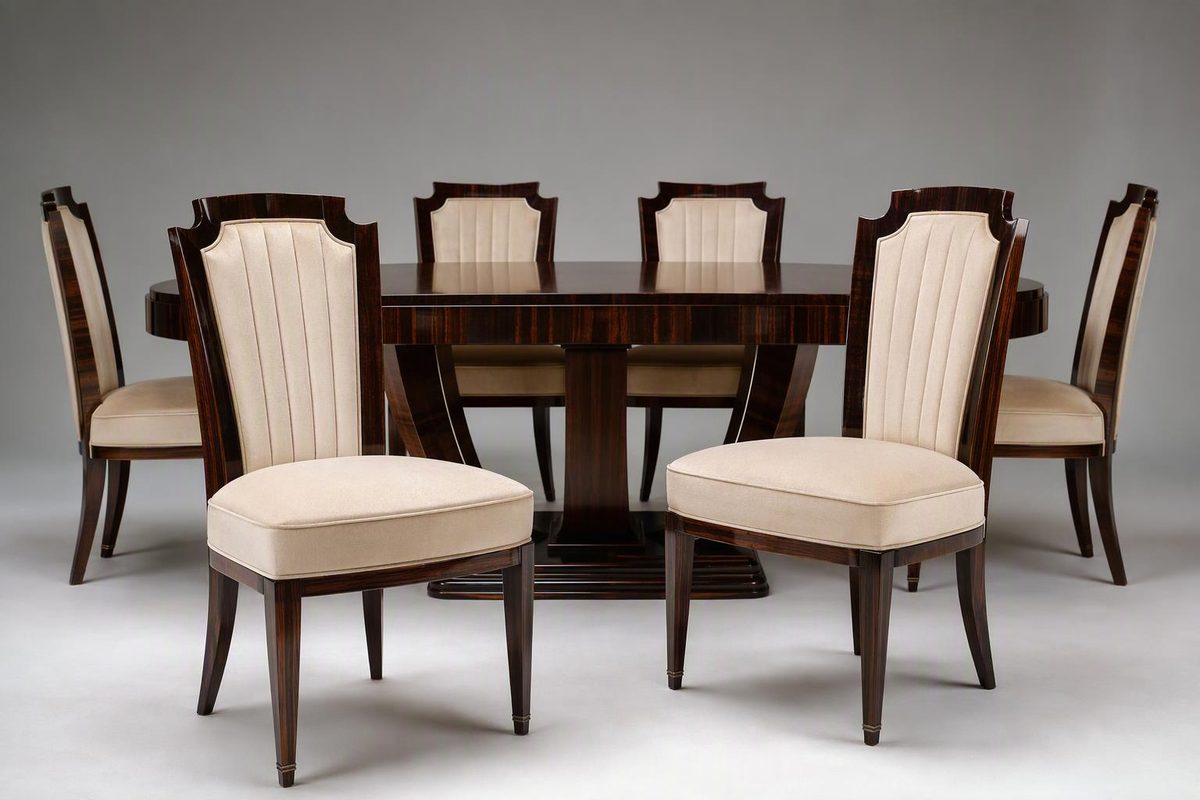
Art Deco dining room chairs are not authenticated by their silhouette alone. To identify a period set, establish when the chairs were made, what supports the maker attribution, and whether every frame belongs to the same set. Replacement upholstery does not necessarily make a period chair a reproduction; a Deco-looking backrest does not establish a 1920s manufacture date.
Assess design, date, attribution and condition separately. The description you can support may be “documented period set,” “plausibly period but unattributed,” or simply “Art Deco-style, manufacture date unestablished.”
Select the evidence you have; the tool suggests wording for the set.
Evidence-to-Description Check
Supported Wording
Art Deco-style; manufacture date unestablished.
A design resemblance does not date these frames. Request evidence of manufacture, maker attribution and consistency across every chair.
This check organizes your evidence; it does not authenticate chairs or assess structural safety. Replacement upholstery alone does not determine frame age.
Source basis: The Met’s Drouant record, Christie’s Cuillernic record and Wright’s Deskey/Hastings record, discussed below.
Recognize Deco Design Without Treating It as a Date
Art Deco’s principal interwar setting is the 1920s and 1930s. It combined traditional craftsmanship with modern design and, increasingly, industrial materials. The V&A’s account of Art Deco in the home describes both Ruhlmann’s elegant lines and exotic veneers and the later interest in chromed steel, aluminium and other materials suited to industrial production.
Do not expect every dining chair to carry a sunburst or zigzag. Émile-Jacques Ruhlmann’s Drouant chair is distinguished by curves, counter-curves and carefully controlled tapering rather than emphatic geometric ornament. Curves alone therefore do not rule out Deco.
Compare a candidate with a documented design at the level of the whole frame, not one decorative feature.
| Feature | What to Compare |
|---|---|
| Silhouette | Back outline, seat proportions and leg taper |
| Wood treatment | Solid timber, veneer, grain arrangement and finish contrasts |
| Upholstery layout | Seat-only padding, upholstered back or concealed frame |
| Fittings | Shape, material, position and attachment |
These are comparison points, not independent dating tests. A later chair can repeat them. Patterned fabric can also give an otherwise unrelated chair a Deco appearance; our guide to Art Deco geometric patterns explains why motif and age must be considered separately.
Three Documented Designs Provide Useful Comparisons
These examples are reference points, not an exhaustive catalogue of national styles. Each record ties a particular design to materials and supporting evidence. None establishes the identity of a similar-looking chair on its own.
Ruhlmann’s Drouant Has a Period Frame and Modern Upholstery
The Metropolitan Museum of Art dates its Drouant side chair to about 1925 and records overall dimensions of 85 × 43.6 × 50.2 cm. Ruhlmann designed it for a Paris restaurant, and the museum bought its example directly from him in 1925. That purchase history provides evidence beyond stylistic resemblance.
The frame is catalogued as Macassar ebony with silvered bronze. Its original silk damask disintegrated; the present upholstery is a digitally printed reproduction that evokes the original’s colors and texture. The Met’s object record separates the chair’s date from its later covering.
This is a useful distinction when a seller describes chairs as “reupholstered.” New fabric can coexist with a securely documented period frame. Compare the Drouant record’s proportions and materials, but do not transfer its attribution to an unmarked chair merely because the backs look similar.
Ruhlmann’s Cuillernic Set Combines Brands With Archival Evidence
Christie’s catalogued eight Cuillernic dining chairs, circa 1925, in cherry with leather upholstery and brass sabots—metal shoes at the feet. Each chair was branded “Ruhlmann.” The catalogue also supplied provenance, exhibition history and an archival model reference, 92NR.
The Cuillernic lot record demonstrates the value of a mark supported by other evidence. An isolated signature photograph does not supply the same context: it neither shows the mark’s position on the frame nor establishes that all chairs carry consistent marks.
Deskey’s Hastings Set Uses Veneer and Black Lacquer
Wright catalogued a circa-1936 American set by Donald Deskey for Hastings Table Co., comprising six side chairs and two armchairs. The listed materials were avodire veneer, black lacquered wood and upholstery; each chair carried the underside number “2060.” The catalogue cited a published comparison in American Art Deco Furniture.
Wright’s record supports comparing underside numbers, manufacturer and materials together. A number need not be a maker’s signature, and its meaning should not be inferred without a model or manufacturer reference.
Establish Whether Every Chair Supports the Set Description
Ask for photographs of every chair, not just the best example. The evidence package should include fronts, backs, side profiles, undersides, marks and close-ups of repairs. For an auction lot, request the condition report as well.
Compare the Frames Before the Fabric
Record overall and seat dimensions chair by chair. Compare backrest profiles, leg shapes, seat rails and underside construction. Matching upholstery should not substitute for evidence that the frames belong together.
If the set includes armchairs, seek a documented armchair version rather than expecting identical dimensions. The Deskey example contains both side chairs and armchairs; that composition is part of the set description, not an inconsistency by itself.
Keep Marks Attached to Their Context
Request one photograph showing each mark’s position on the chair and another showing it clearly. Transcribe letters and numbers exactly. Compare their location and content with records for the claimed maker and model.
Do not sand or clean a faint mark to improve its appearance. A legible image is useful, but altering the surface is not a substitute for documenting it.
Separate the Model’s Design Date From Manufacture
A dated invoice, period catalogue match, archival drawing or documented interior history can strengthen a claim. Distinguish the date a model was designed from the date these particular chairs were made. A match to a 1925 design does not, by itself, establish 1925 manufacture.
Treat a seller’s “in the style of Ruhlmann” as a resemblance claim, not proof of authorship. If period manufacture seems plausible but the maker is unsupported, keep those two judgments separate in your notes.
Itemize Restoration Rather Than Accepting One Label
Ask separately about replacement upholstery, refinishing, replaced rails or legs, veneer repairs and added fittings. “Restored” is too broad to describe how much original material survives.
The Met’s Drouant chair shows why a period frame with replacement fabric should be described differently from a newly made copy. Conversely, knowing that upholstery is new tells you nothing by itself about the age or attribution of the wood beneath it.
Check Structural Condition and Table Fit Before Buying
An attribution does not establish structural safety. Inspect for open joints, split rails, damaged legs, loose veneer and previous repairs. If stability is uncertain, have a furniture conservator or suitably experienced restorer assess the chairs before sitting on them. Do not test them by rocking or leaning back.
Lift a chair beneath its seat and rails, not by its legs or backrest. The North Carolina Museum of History’s furniture-care guidance recommends this handling method and advises against wet cleaning without consulting a conservator. It also cautions against commercial polishes that can damage original finishes.
For table fit, measure seat height, usable seat width and depth, arm height, and clearance beneath the table apron. Check where table legs obstruct seating and whether the chairs can pull back comfortably. Confirm whether catalogue “height” means overall height or seat height; the two are not interchangeable. Try a structurally sound example at the intended table where possible.
The Drouant dimensions above are overall dimensions, not a supplied seat-height measurement. They cannot establish its fit beneath your table.
Compare Auction Results Only With Comparable Sets
The two published auction results below concern different models, materials and histories. They are not a general price range for Art Deco dining chairs or a like-for-like valuation.
| Set | Composition | Sale Date | Reported Result |
|---|---|---|---|
| Ruhlmann Cuillernic | Eight chairs | 13 December 2012 | US$254,500 |
| Deskey for Hastings | Six side, two arm | 14 August 2025 | US$3,432 |
The results are reported in the Christie’s and Wright records linked above. Check whether a reported result includes buyer’s premium before comparing it with a hammer price.
Compare sold sets with similar attribution, chair count, armchair composition and condition. For a prospective purchase, budget for applicable premiums and taxes, transport and any necessary treatment. These records do not supply those costs for your purchase.
For daily dining, a clearly described modern Deco-inspired set may serve better than a fragile period one. Buy on the basis of the frame’s documented identity, disclosed restoration and suitability for use—not the upholstery pattern or the seller’s broad style label.