
Vintage Art Deco Desk Lamp: How to Identify a Period Piece
Assess a vintage Art Deco desk lamp through model records, marks, construction, replacement parts and condition—with a documented auction result.
Polaroid’s Model 114 desk lamp makes a useful starting point: a sloping Bakelite shade, an angled aluminum support and a domed black Bakelite base. Cooper Hewitt dates its example to 1939 and credits Walter Dorwin Teague and Frank J. Del Giudice as designers. The museum also records a cellulose-film panel beneath the shade—a less obvious detail than the striking silhouette. Cooper Hewitt collection record
That is the kind of evidence a vintage Art Deco desk lamp needs. Shape suggests a design family; records and construction help establish the model, maker and date. A convincing outline alone cannot distinguish an interwar lamp from a later reissue—or a base fitted with a replacement shade. Establishing a period date is also separate from deciding whether a design is Art Deco rather than a neighboring modern style.
Read the whole lamp, not one motif
When assessing Deco styling, look at the relationship between the base, support and shade. Do stepped forms repeat coherently? Does the shade’s geometry complement the base? Are curves and horizontal lines part of an integrated design, rather than a single decorative flourish? Our guide to Art Deco geometric patterns explains why a motif is a useful clue but not a date stamp.
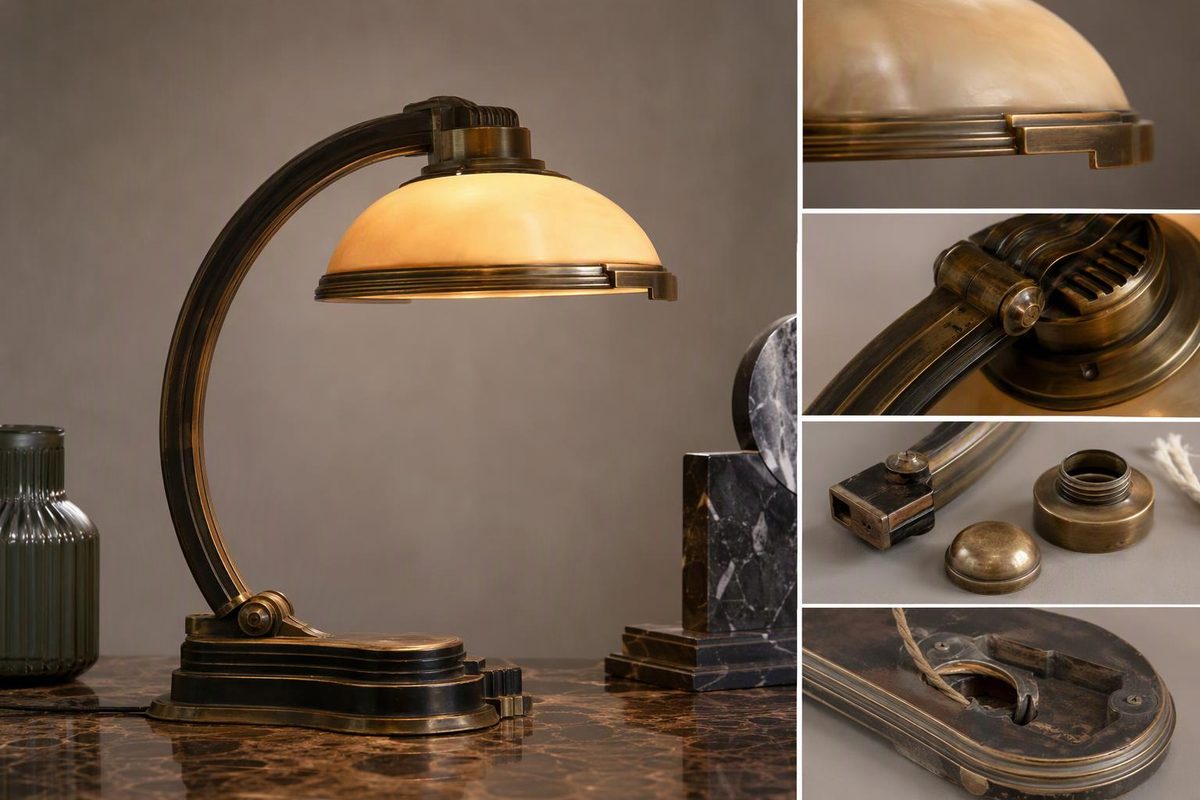
For a desk lamp, the mechanism deserves equal attention. Record whether the shade pivots, the arm extends, or springs balance the assembly. Compare the joints, knobs, switch position and cable route—not just the front view—with a documented example.
The Model 114 illustrates this approach. Cooper Hewitt describes a trapezoidal shade, an inverted cone-shaped aluminum shaft and a cylindrical metal switch at the front. A similar black lamp with a different support or switch arrangement needs further investigation, not an automatic Teague attribution. Model 114 description
Separate the design date from the lamp’s date
An old design can remain in production or return decades later. “Designed in 1935” does not mean “manufactured in 1935.”
Anglepoise’s Model 1227 is a particularly useful comparison when a seller points to a stepped base as proof of age. The manufacturer identifies these versions:
| Version | Details in the maker’s dating guide |
|---|---|
| 1935–1938 | Solid, painted three-tier base; fork assembled from separate components; cooling holes in the side of the shade |
| 1938–1968 | Two-tier base with a steel cover; fork mainly cast as one component; wider shade without side vents |
| 1993–1996 reissue | Plastic base cover; adjustable springs; a plastic lamp-holder switch operated by a slider |
These are model-specific clues, not rules for every Deco lamp. The same guide lists replacement shades and rewiring parts, reinforcing the need to assess components separately. Anglepoise identification and dating guide
The 1938–1968 version spans interwar and postwar production: matching it alone cannot establish an interwar date. An Anglepoise may suit a Deco interior, but its model history is a more precise description than a broad stylistic label. Establish what it is before deciding how to classify it.
Build a model match from marks and measurements
Ask for clear photographs of:
- The complete lamp from the front, side and rear.
- The underside, including labels, stamped marks and the base cover.
- The shade interior, socket, switch and cable entry.
- Every pivot, spring assembly or adjustment knob.
- Damage, repairs and any parts the seller identifies as replacements.
Request overall height, base dimensions and shade dimensions. For an adjustable lamp, specify the position in which height was measured. For a glass shade, obtain the mounting dimensions too; our glass lamp shade identification and fit guide covers that separate check.
Transcribe marks exactly. Then seek a catalogue or museum record that matches both the mark and the construction. A name on one component should not, by itself, authenticate the entire assembly.
There is a useful documented example: Wright’s 2004 catalogue entry for a Polaroid Model 114 explicitly notes a manufacturer’s label on the bottom and records Bakelite, aluminum and plastic film. That supports looking beneath the base and inside the shade, rather than relying on the silhouette. Wright lot 297
Assess originality and usability separately
Ask which parts have changed: shade, socket, switch, cable, plug, base cover or finish. Record cracks around mounting points, shade dents, loose joints, missing panels and refinishing. If the lamp is adjustable, ask whether it holds its position throughout the intended range.
New wiring does not date the body; old wiring does not prove authenticity. Nor does “it lights up” establish safety. Before use, have an unverified vintage lamp assessed by a qualified electrical professional familiar with older lighting and local requirements. Ask for documentation behind any claim of professional testing. In its report on a March 2016 inspection campaign, London Trading Standards noted that some second-hand goods labelled as safety-tested had not been, and recommended reassurance of professional testing. Second-hand electrical safety guidance
Use prices only after identification
Wright reported $3,835 for its Polaroid Model 114 in the sale of 28 March 2004, against a $2,000–3,000 estimate. The page labels that figure “result”; it does not specify the fee treatment in the lot text. This is a historical sale of a catalogued model, not a current price guide for anonymous Deco-style lamps. Published auction result
Before using any comparison, match the model, materials, completeness and restoration history. If the evidence supports only the appearance, describe the object as Art Deco-style, maker and date unverified. Reserve a period attribution for a lamp whose records and surviving details support it—and state replacements alongside that attribution.