
Parts of the Commode: An Art Deco Furniture Guide
Learn the parts of a furniture commode, from carcass and drawer runners to veneer and handles, and what they can reveal about an Art Deco attribution.
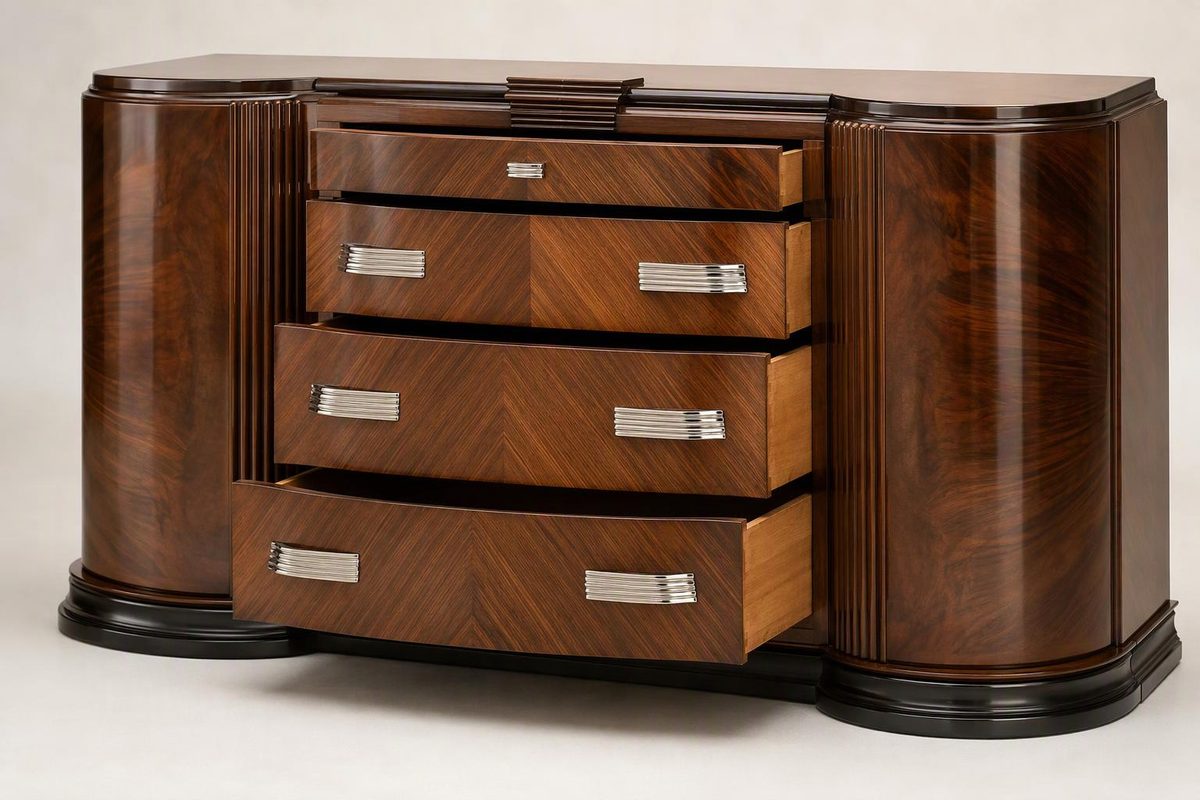
On Émile-Jacques Ruhlmann’s Lasalle commode of about 1925, the decoration makes the drawers harder to distinguish: ivory stringing forms diamonds across the division between the upper and lower drawers. The Metropolitan Museum of Art describes that division as an integral part of the design. Knowing where decoration ends and construction begins is a useful first step in reading a piece of furniture. See the Met’s object record.
The main parts of a furniture commode are its top, carcass, drawers or doors, internal supports, base or legs, hardware, and decorative surfaces. Here, commode means a storage cabinet or chest—not a toilet or a chair containing a chamber pot. Auction terminology allows the furniture form to have doors as well as drawers. Christie’s furniture glossary makes that distinction.
Name the parts, outside and inside
Not every commode contains every component below. These terms provide a vocabulary for photographs, condition reports and conversations with a seller or conservator.
| Part | What it means | What to record |
|---|---|---|
| Top | The upper surface of the cabinet. | Material, edge profile, cracks and any reported replacement. |
| Carcass or carcase | The main case enclosing the storage space, including its sides and back. | Overall shape, visible construction, back panels and any labels or marks. |
| Drawers | The sliding storage boxes. Distinguish the decorative drawer front from the sides, back and bottom; drawer linings refers to the boards forming the drawer. | Drawer arrangement, joints, damage and differences between drawers. |
| Doors and shelves | Doors close off storage compartments; shelves divide the space inside. | Door alignment, hinge condition, shelf supports and reported replacements. |
| Drawer runners and stops | Runners provide sliding support; in the traditional wooden construction described by the National Trust, stops prevent a drawer being pushed too far into the case. | Wear, added pieces and whether drawers close correctly. |
| Dustboards | Boards forming horizontal partitions between drawers. | Their presence and condition, where safely visible. |
| Base, legs and feet | The lower supporting structure. A commode may stand on legs or have a low base; the foot is the leg’s terminal portion. | Form, stability and reported repairs or replacements. |
| Handles, locks and escutcheons | Handles open the storage compartments; locks secure them. An escutcheon is a decorative plate around a keyhole. | Missing components, mounting positions and any claim that the fittings are original. |
| Veneer, inlay and mounts | Veneer is a thin wood layer applied to another surface. Inlay introduces contrasting material into a decorative pattern; mounts are applied fittings or ornaments. | Material claims, pattern alignment, losses and lifting edges. |
The construction terms above follow the National Trust’s furniture glossary, which concerns eighteenth-century cabinetmaking, and Christie’s broader glossary. They describe components and techniques—not an Art Deco date by themselves.
What the Art Deco examples show
Look at how the parts work together, rather than searching for one compulsory motif. Ruhlmann’s Lasalle combines Macassar ebony, ivory and silvered bronze. Its geometric decoration sits on gently curved forms, not a strictly rectangular body. The Met specifically notes his preference for technically demanding curves. Met collection record.
A related Ruhlmann commode discussed by Cooper Hewitt has diamond-patterned ivory inlay extending across two drawers to create the illusion of a single panel. The museum also records that the firm sold the design in several woods. That is a useful warning against treating one wood species—or an uninterrupted decorative front—as essential to identifying the form. These are examples of luxury French Art Deco, not a checklist of features every Art Deco commode must have. Cooper Hewitt’s account.
Use the parts to test an attribution
For a commode advertised as “Art Deco,” ask for photographs of the front, sides, back, drawer interiors, hardware attachments and any marks. Request dimensions and a written account of restoration. Avoid removing fittings merely to look for evidence.
Then separate three questions:
- Style: Does the overall design resemble documented Art Deco furniture?
- Date and maker: Is there a credible model match, maker record or provenance supporting the attribution?
- Originality: Which drawers, fittings, surfaces or structural parts have been repaired or replaced?
A documented comparison offers more than a similar silhouette. For Ruhlmann’s Redhead commode, catalogued circa 1930, Christie’s records a branded signature with an atelier mark, published literature and model numbers in the Ruhlmann archives. Those are the kinds of corroborating details to seek—not evidence that a similar-looking unmarked chest is automatically by Ruhlmann. Christie’s catalogue entry.
For closer hardware assessment, use our guide to Art Deco drawer pulls.
Inspect gently. A sticking drawer need not indicate poor manufacture: rising humidity can swell wood and jam drawers, while also loosening veneer. The North Carolina Museum of History advises against wet-cleaning antique furniture without consulting a conservator and against lifting furniture by its top or handles. Record fragile areas before attempting cleaning or moving. Museum furniture-care guidance.