
South Beach Miami Art Deco District: Buildings and Walking Guide
Read South Beach’s Art Deco district through its fins, eyebrows, portholes and neon, with history and a compact Ocean Drive walking route.
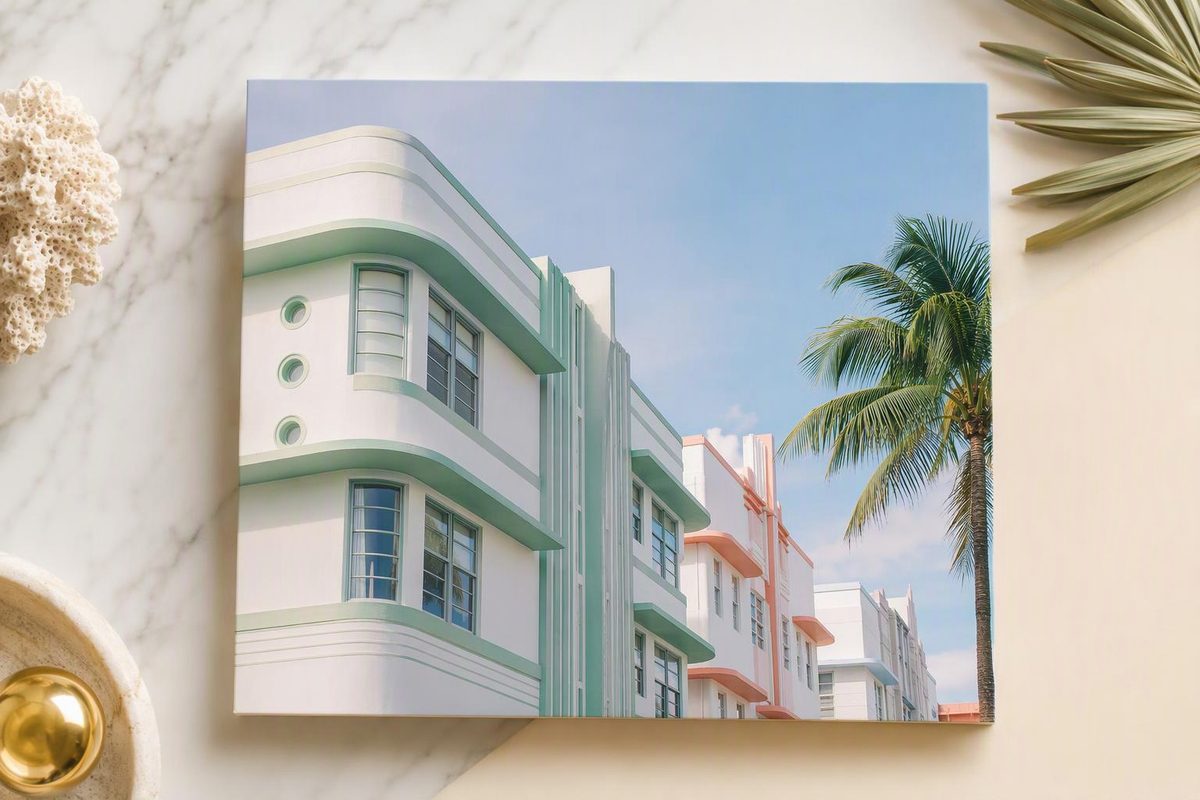
At 1001 Collins Avenue, the Essex House looks less like a conventional hotel than an ocean liner run aground. Porthole windows, a ship-like profile and a neon-topped metal spire turn a modest building into an advertisement for speed and travel. Henry Hohauser designed it in 1938; its nautical theatricality is a useful starting point for understanding South Beach Art Deco (Miami Design Preservation League).
The neighborhood is not a parade of miniature Chrysler Buildings. Most of its signature hotels and apartments are low-rise structures built for a resort city during the 1930s and 1940s. Their architects created spectacle with stucco, symmetry, fins, curves, shallow relief and neon rather than monumental height.
What is the South Beach Art Deco district?
“Art Deco Historic District” is the familiar name for the Miami Beach Architectural Historic District. The roughly one-square-mile South Beach area entered the National Register of Historic Places on May 14, 1979, after a preservation campaign associated with Barbara Baer Capitman, Leonard Horowitz and the Miami Design Preservation League (MDPL). About 800 buildings were listed as contributing structures at the time (MDPL archive; PBS).
The name can mislead: not every historic building in the district is Art Deco. Mediterranean Revival represents an earlier phase of resort development, while some later properties belong to Miami Modern, or MiMo. MDPL identifies Art Deco, Mediterranean Revival and MiMo as the district’s three dominant styles (MDPL). A clay-tile roof and arched loggia should not be relabeled Deco merely because the building stands near Ocean Drive.
For a first visit, the most concentrated introduction is Ocean Drive between 5th and 15th Streets (MDPL). It is not the whole historic district. Collins and Washington avenues add hotels, apartments and civic buildings that broaden the story beyond the familiar oceanfront façades.
Why Miami Beach Deco looks different
Miami Beach’s building boom met Art Deco after the luxury and ornament associated with the 1925 Paris exposition had begun to give way to Streamline Moderne. The Depression-era vocabulary was cleaner and more machine-like: curved corners, horizontal bands, glass block and forms borrowed from ships, trains and automobiles.
Local architects adapted it to a seaside resort. Concrete and stucco enabled relatively economical construction; projecting “eyebrow” ledges shaded windows; nautical imagery sold a fantasy of ocean travel. Pelicans, palms, waves and fountains appeared in shallow relief. The local combination is often called Tropical Deco.
Henry Hohauser and L. Murray Dixon were two principal architects of the South Beach group. PBS describes the shared vocabulary of their milieu as streamlined curves, projecting towers, window eyebrows and neon (PBS). Repetition makes the streetscape coherent, but close comparison shows how differently each building handles those elements.
Seven details to look for
Start with the whole façade before focusing on color or ornament.
- A balanced front. Many small hotels arrange windows and entrances symmetrically around a central vertical feature.
- A vertical fin or tower. This gives a three-story building an exaggerated sense of height and supplies a prominent place for its name.
- Horizontal eyebrows. Thin ledges above windows provide shade while making the façade appear longer and faster. When judging whether glazing is original, however, the frame and opening matter more than the eyebrow alone; see the guide to Art Deco windows.
- Rounded corners. Curves evoke streamlined vehicles and work especially well on corner sites.
- Portholes and speed lines. Round windows, rail-like bands and prow-shaped corners turn a hotel into a stationary ship.
- Stepped rooflines and details in threes. Ziggurat silhouettes, repeated bands and groups of three recur across the district.
- Relief panels and terrazzo. Stylized plants, fountains, shells and geometric forms decorate otherwise simple stucco surfaces. A chevron or sunburst supports a stylistic reading but cannot date a building by itself; the same caution applies to Art Deco geometric patterns.
The City of Miami Beach likewise lists symmetry, geometric forms, chevrons, fluting, floral and nautical motifs, modern materials, streamlined forms and neon among recurring Art Deco features (City of Miami Beach). No single item is conclusive. A persuasive attribution usually rests on several coordinated features, the building date and documentary evidence.
A compact self-guided walk
Begin at 1001 Ocean Drive, the location MDPL gives for its official guided tour. As of September 2026, MDPL lists that tour as a daily, two-hour walk of approximately 1.5 miles; check its page for the live schedule and prices (MDPL tour). For a shorter independent study, follow this sequence.
1. Walk south to the Colony Hotel
The Colony Hotel at 736 Ocean Drive is an exceptionally clear façade lesson: central symmetry, eyebrow awnings, a vertical fin and a name rendered in neon. View it in daylight, when the massing is easy to read, and after dark if possible. Here, the sign is not an incidental accessory; it completes the architectural composition (MDPL).
2. Return north to the Breakwater and Essex House
The Breakwater Hotel, designed by Anton Skislewicz in 1939, uses its central tower and neon name to announce itself along Ocean Drive. At 10th Street, turn inland to Essex House on Collins Avenue. Its portholes and spire make the ocean-liner analogy explicit. The pair shows how buildings from nearly the same moment could manipulate vertical signs and nautical imagery differently (PBS).
3. Continue north to the Carlyle
At 1250 Ocean Drive, the Carlyle shifts the emphasis toward Streamline Moderne. Curved corners and a more aerodynamic composition temper the upright, stepped character associated with earlier Deco. MDPL points to its three vertical columns, curved corners and animated roofline as a particularly clear local example (MDPL).
Along the way, compare whole blocks rather than collecting isolated details. Similar heights, repeated window bands and narrow lots create continuity; fins, signs and entrance treatments give each hotel its identity.
The pastels belong to the preservation story
Pastel pink, turquoise, yellow and lavender now seem inseparable from South Beach. They should not automatically be treated as restored 1930s colors.
In the late 1970s, designer Leonard Horowitz developed a coordinated pastel palette to attract attention to façade details and create continuity from one building to the next. The National Park Service explains that the palette came largely from Horowitz’s imagination and surroundings rather than scientific analysis of original paint layers. Historically, many hotels, apartments and shops had been predominantly white, with smaller touches of jade, ochre or coral (National Park Service).
Horowitz’s palette was therefore a preservation and revitalization device, not a reliable record of every building’s first color scheme. Massing, window patterns, construction dates, architect records and building permits offer stronger evidence for identifying period design. A current peach-and-mint exterior may instead document the district’s late-20th-century revival.
The same caution applies indoors. Some hotel lobbies retain terrazzo, decorative ceilings or period layouts; others mix surviving fabric with later renovations. A business operating in a historic building is not proof that every visible finish is original, and lobby access remains at the operator’s discretion.
Historic status did not freeze the district
National Register recognition was a turning point, but it did not by itself prevent demolition. Hohauser’s New Yorker Hotel was demolished in 1981, while Dixon’s Senator Hotel followed in 1988. Miami Beach locally designated the Española Way and Ocean Drive/Collins Avenue districts in 1986; the city later expanded local designation across the full National Register district (MDPL history).
Even now, “in the historic district” is not equivalent to “unchangeable.” National Register listing, local designation, a property’s contributing status and the review required for a proposal are distinct questions, examined in Can Miami Beach Art Deco Buildings Be Demolished?.
South Beach is best read as two histories at once: the interwar resort city expressed in fins, eyebrows, portholes and neon, and the later preservation movement that made those modest buildings visible again—and gave them the pastel identity now recognized around the world.