
What Is Neo Deco Style? Period Deco vs. the 2026 Revival
Learn which Neo Deco details are genuinely interwar, what Pinterest repackaged for 2026, and how to distinguish it from 1980s glamour.
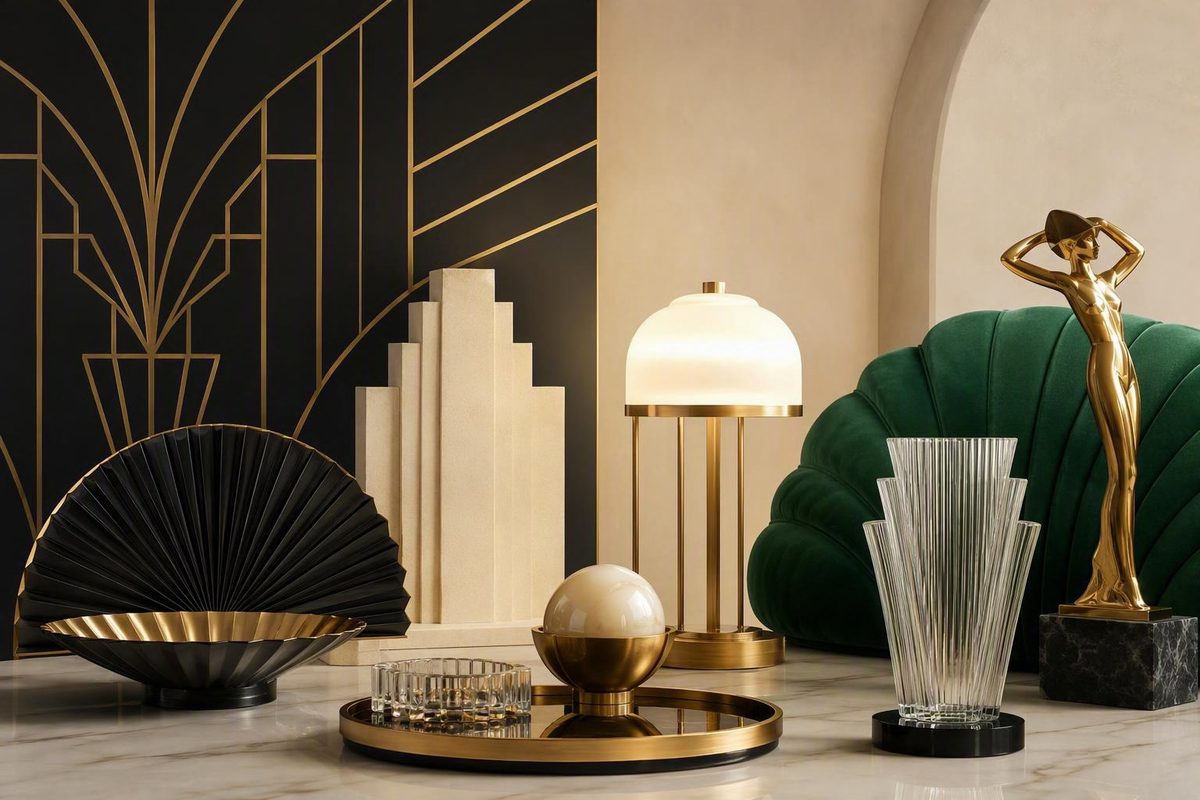
Neo Deco is a contemporary edit of Art Deco: it keeps interwar geometry, symmetry, sculptural silhouettes and contrasting luxury materials, then places fewer of those elements in a modern room. Sunbursts, chevrons, fluting, stepped forms, chrome, brass, lacquer and richly figured woods can all be period-correct. The distinctly 2026 part is their packaging as a lighter lifestyle look built around isolated statement pieces, leather seating, bar carts and present-day layouts—not the motifs or materials themselves.
Choose a finish, motif, silhouette and room treatment to see which historical reference the combination supports.
The finish and motif show compatibility; the silhouette and room treatment usually decide the historical reading.
The decisive tell is the tiered case silhouette within a coordinated ensemble. Macassar and stepped geometry both fit the historical vocabulary.
Reference window: 1925–39This combination may resemble period design, but it does not date or authenticate an object.
| Choice | Historical Reading | Contemporary Use | Dating Value |
|---|---|---|---|
| Chrome | Compatible with machine-age Deco | Crisp accent, frame or bar-cart finish | None by itself |
| Brass | Compatible as hardware and ornament | Warm metallic highlight | None by itself |
| Lacquer | Compatible luxury surface | Glossy focal color or cabinetry | None by itself |
| Macassar | Figured wood suits period veneer work | Natural pattern in restrained rooms | None without construction evidence |
| Sunburst | Established radiating Deco motif | Often isolated as one mirror or headboard | Widely reused |
| Chevron | Established angular Deco motif | Often confined to a border or surface | Widely reused |
| Fluting | Creates period-compatible rhythm | Common on current vanities and cabinets | Widely reused |
| Stepped Form | Established tiered Deco geometry | Used on consoles, frames and bases | Shape alone is insufficient |
| Silhouette | Room Treatment | Likely Reading | Decisive Tell |
|---|---|---|---|
| Tiered case | Coordinated ensemble | Period-compatible | Integrated massing and architecture |
| Rounded Streamline | Coordinated ensemble | Period-compatible | Horizontal, aerodynamic profile |
| Tiered case | Quiet current room | Neo Deco | Historical form isolated as a focal point |
| Rounded Streamline | Mixed current furniture | Neo Deco | Period vocabulary in a present-day mix |
| Slim contemporary | Quiet current room | Neo Deco | Lightened proportions and negative space |
| Slim contemporary | Coordinated ensemble | Neo Deco | Current silhouette overrides period motif |
| Oversized leather | Layered maximal luxury | 80s Glamoratti | Scale, shine and leather dominate |
| Any silhouette | Layered maximal luxury | 80s Glamoratti | 1980s luxury framing outweighs Deco editing |
Authentication limit: “Period-compatible” means the selected vocabulary could fit 1925–39 design. It does not prove manufacture within that window.
Sources: Britannica and the V&A on historical Art Deco; Architectural Digest and Pinterest Predicts 2026 on Neo Deco; cited Pinterest-related coverage for the separate 225% “80s luxury” search figure.
The picker gives a stylistic reading, not an authentication. An original object needs evidence of its date, maker and provenance; a sunburst or brass fitting cannot supply that evidence by itself.
The 2026 Version Edits Rather Than Re-Creates Art Deco
Historical Art Deco could coordinate architecture, furniture, lighting, textiles and decorative objects into one ensemble. Neo Deco more often extracts one or two recognizable features: a fan-shaped headboard against a plain wall, a fluted cabinet in a streamlined kitchen or a sculptural pendant above contemporary furniture.
That selectivity is the main distinction. Neo Deco accommodates televisions, modern appliances, open-plan rooms, modular storage and furniture from several periods. Its connection to Deco comes from composition and form rather than historical reconstruction.
Architectural Digest describes Neo Deco as a process of choosing and editing Deco references. Its March 12, 2026 coverage emphasized expressive materials and sculptural forms without the full theatrical weight of a period-style room.
A Neo Deco interior may be glossy, combining marble, chrome, glass, lacquer and saturated color. It may instead use walnut or mahogany, honed stone, plaster, natural grain and subdued metal. Neither palette establishes the style alone. The stronger evidence is deliberate geometry, repeated rhythm, a sculptural focal point, controlled balance and enough unornamented space for those decisions to register.
This is also why a brass bar cart is not automatically Neo Deco. It becomes part of the vocabulary when its geometry, placement and relationship to nearby furniture create a coherent composition. Brass accessories scattered through an otherwise unrelated room amount to a finish preference, not a style.
Period-Correct Details Mostly Predate the Neo Deco Label
Art Deco developed in Western Europe during the 1910s and 1920s and became especially prominent in the United States during the 1930s. The 1925 Exposition Internationale des Arts Décoratifs et Industriels Modernes in Paris was pivotal to its development and international visibility. Britannica traces this chronology and vocabulary.
For the comparison here, 1925–39 is a practical period window rather than a claim that the style began and ended on exact dates. Objects still require individual dating.
| Detail | Period-Correct? | What Matters |
|---|---|---|
| Sunburst or fan | Yes | Radiating construction or ornament |
| Chevron or zigzag | Yes | Deliberate geometric repetition |
| Fluting | Yes | Architectural or furniture rhythm |
| Stepped profile | Yes | Tiered massing or nested outlines |
| Chrome or steel | Yes | Machine-age contrast and structure |
| Brass | Yes | Hardware, edging or decorative metalwork |
| Lacquer | Yes | Rich surface and material contrast |
| Macassar or figured wood | Yes | Veneer pattern and craftsmanship |
Historical Deco was not exclusively angular. Circles, arches, rounded cabinets, curving chairs and smooth Streamline Moderne profiles appeared alongside zigzags, vertical fins and tiered forms. Streamline Moderne is historically situated and related to Deco, but it is not another name for Neo Deco. Its rounded corners, long horizontal lines and aerodynamic surfaces are among the precedents contemporary designers now reuse.
Nor was historical Art Deco one uniform style. The Victoria and Albert Museum describes it as a pastiche drawing on historic European design, Art Nouveau, avant-garde movements, the Ballets Russes, folk traditions, ancient and non-European cultures, and the imagery of the modern city and machine age. The V&A outlines those varied influences.
That breadth matters because simplified comparisons often cast period Deco as dark, heavy and overdecorated. Some examples were sumptuous and densely coordinated; others were pale, streamlined or machine-like. Luxury woods, stone, lacquer, ivory, jade, silver and rock crystal coexisted with chrome, reinforced concrete, glass, plastics and other manufactured materials.
The historical vocabulary also extended far beyond rooms. Architecture, furniture, jewelry, textiles, fashion, graphic design, transportation and household products all participated. A skyscraper crown, cocktail cabinet, bracelet, cinema foyer, perfume bottle and radio grille could share a visual culture without sharing one silhouette.
The Neo Part Lies in Composition and Context
The materials promoted as Neo Deco in 2026 are not new inventions. Chrome, brass, lacquer, glass and richly grained wood all have historical precedents. So do sunbursts, chevrons, fluting, fans and steps.
What is contemporary is the way these elements are grouped and marketed. Neo Deco commonly isolates one motif, lightens the apparent mass of furniture and combines Deco references with current technology, open space and unrelated modern pieces. Negative space becomes an active part of the design.
| Aspect | Period Art Deco | Neo Deco |
|---|---|---|
| Composition | Often a coordinated ensemble | Selected focal references |
| Ornament | Applied across several surfaces | Usually isolated or enlarged |
| Furniture | Monumental, tiered or streamlined | Often slimmer and mixed-period |
| Context | Interwar design culture | Contemporary rooms and functions |
A period-style room might repeat a motif through flooring, grille work, furniture veneer, lighting and textiles. A Neo Deco room is more likely to use one fan headboard or stepped console as its visual anchor. The gesture is legible because surrounding walls, upholstery and storage are quieter.
Scale changes as well. Neo Deco can retain sculptural confidence without a matching suite or monumental cabinet. A compact side table may carry the reference through a stepped base. A slender lamp can establish vertical rhythm. A curved chair can supply the theatrical silhouette while the principal sofa remains understated.
The most convincing examples retain several parts of Deco’s visual grammar at once: controlled symmetry, purposeful geometry, repetition, material contrast and a strong silhouette. A single generic arch or metallic accessory is weak evidence.
Geometry Is More Diagnostic Than Glamorous Materials
Angular geometry includes chevrons, zigzags, triangles, stepped profiles, nested frames and emphatic vertical or horizontal lines. Neo Deco usually restricts these devices to one surface or object. A chevron may appear at a rug’s border; a stepped outline may form a console base rather than covering a wall.
Radiating motifs include fans, shells and sunbursts. Their lines direct attention toward a center, making them effective above a bed, mantel, console or vanity. Construction can carry the motif without a printed pattern: chair-back ribs, pendant pleats, divided cabinet doors and shaped mirror frames can all radiate from a focal point.
Curves are equally legitimate. A rounded sofa beneath rectilinear wall panels or an arched niche within a cabinetry grid creates the contrast found in many Deco compositions. The reference strengthens when a curve is centered, framed or repeated rather than used incidentally.
Architectural rhythm is subtler and often more persuasive than applied decoration. Fluted surfaces, aligned cabinet doors, repeated panels, matching lights and layered moldings create measured movement. A fluted vanity or island can establish that rhythm without wallpaper or a collection of themed accessories.
Symmetry need not be absolute. Paired bedside lamps can establish an axis while the art differs. A pendant can center an asymmetrical seating group. The aim is visual stability, not a mirrored copy of every object.
Chrome, Brass, Lacquer and Macassar Are Historically Plausible
No single finish separates Deco from Neo Deco. The same material can support a period-compatible object, a contemporary reinterpretation or an unrelated design.
Chrome, steel and polished nickel emphasize crisp outlines and machine-age associations. Brass can provide warm edging, hardware or a reflective accent. Lacquer creates a saturated, controlled surface. Macassar and other strongly figured woods use natural grain as pattern, often through veneers and carefully arranged panels.
The underlying strategy is contrast. Polished metal becomes sharper beside suede, wool or plaster. Veined stone gains definition beside a quiet cabinet face. Velvet appears more structured when bounded by wood or metal. If every surface is reflective, patterned or saturated, the hierarchy disappears.
Neo Deco expands the tactile side of this contrast through linen, bouclé, honed stone, matte ceramics and familiar contemporary upholstery. Those additions do not cancel the historical reference, provided the geometry and composition remain clear.
A wood-and-stone interior can therefore read more convincingly as Neo Deco than a room full of brass accessories. Material expense is not the test. Proportion, repetition and placement carry more weight.
“80s Luxury” Belongs to Glamoratti, Not Neo Deco
Pinterest placed Neo Deco in its Pinterest Predicts 2026 forecast, helping make the label newly visible. Pinterest-related coverage associated it with geometric patterns, chrome, brass, pendant lighting, leather furniture and bar carts.
That package overlaps with another forecast label, Glamoratti, but the historical reference differs. Neo Deco points principally toward interwar Art Deco. Glamoratti invokes a maximalist vision of 1980s luxury: oversized gestures, assertive shine and layered opulence.
The widely reported 225% increase in searches for “80s luxury” applies to Glamoratti, not Neo Deco. August 25, 2026 coverage discussing Pinterest’s home data did not provide a comparable percentage for Neo Deco. AOL’s report keeps the two forecasts distinct.
That number measures search activity on Pinterest rather than adoption by all homeowners, renters, designers or buyers. It does not establish that Neo Deco will dominate interiors or endure beyond 2026. Nor does the forecast prove that Pinterest coined the term or supplied its only authoritative definition.
A useful dividing line is the silhouette and composition. A tiered cabinet, geometric grille or streamlined rounded case can be compatible with 1925–39 design. One such form isolated in a present-day room reads as Neo Deco. Oversized leather seating, conspicuous reflective finishes and maximal layering point more strongly toward the 1980s luxury reference.
A Style Label Cannot Date an Object
“Neo Deco” identifies a design relationship, not an age, maker, provenance or value. Three categories can look deceptively similar:
- An original period Art Deco object made during the historical period and supported by evidence.
- A later reproduction manufactured to copy an older model or type.
- A new Neo Deco design borrowing selected motifs, proportions or materials without claiming period manufacture.
A contemporary chair may closely reproduce a historical model, borrow only a fan-shaped back or merely create a broad Deco impression. Appearance alone cannot establish which category it occupies.
Likewise, an original cabinet can anchor a Neo Deco room without turning the whole interior into a period reconstruction. Contemporary seating, present-day lighting and current technology keep the composition mixed. A newly made object may be accurately described as Neo Deco when its manufacture and historical inspiration are stated honestly.
Listings that say “Deco,” “Deco style,” “revival” or “Neo Deco” provide stylistic descriptions, not proof. Geometry, fluting, brass-colored hardware and velvet upholstery have all been reused. Authentication requires object-specific construction, documentary and provenance evidence.
The Clearest Neo Deco Rooms Use One Dominant Gesture
A fan-shaped headboard can dominate a bedroom while paired lamps establish order and plain walls preserve its outline. A dining room can use a statement pendant over a restrained table, with curved chair backs supplying limited repetition.
In a kitchen, fluted cabinet fronts, strongly veined stone or a sculptural pendant can each establish the reference. Using all three at equal intensity creates competition. If the stone has dramatic movement, simpler cabinet fronts give it space; if the cabinetry is deeply fluted, a plain backsplash keeps the rhythm legible.
A bathroom needs no more than a shaped mirror, fluted vanity, arched niche or controlled set of metal fittings. Renters can achieve the same relationship with a movable bar cart, sculptural lamp, geometric textile, shaped mirror or curved chair. None is inherently Neo Deco, but each can become the focal element in a balanced composition.
The final test is not whether a room contains enough fashionable objects. It is whether period-derived geometry, rhythm and material contrast have been deliberately edited for a contemporary setting. That edited relationship is Neo Deco; the historical ingredients themselves are not a 2026 invention.